
Lip Filler with Hyaluronic Acid

 BeforeSimulation
Lip filler is probably the best-known hyaluronic acid procedure among the public. What patients ask for varies a lot: "I want more volume," "I want definition," "I want to correct the asymmetry" or "I just want hydration." Separating these requests in the consultation is the first step toward a coherent plan and toward avoiding the disproportionate lip that patients themselves fear.
On this page you will find the indication, usual volumes, durability, risks and how to simulate it in Harmy.
What is lip filler?
It is the placement of hyaluronic acid in the lips to adjust volume, contour, projection or the proportion between upper and lower lip. It can involve the vermilion, the border (contour), the Cupid's bow and, in some plans, the columns of the philtrum.
Each goal calls for a different product and volume. A thin lip that needs volume is not treated like a full lip that only needs contour definition.
Who is lip filler usually indicated for?
Generally, for patients with:
- thin lips or lips that have lost volume with age;
- poorly defined contour or a faded Cupid's bow;
- asymmetry between the sides or disproportion between upper and lower lip;
- fine lines on the lip associated with volume loss, in selected cases.
In the assessment, the usual proportion between upper and lower lip and the relationship of the lips to the rest of the lower third guide the plan. Requests for volume far beyond the proportions of the face deserve a frank conversation. General contraindications include active infection, active herpes, active autoimmune disease, pregnancy, breastfeeding and allergy to the product. The decision belongs to the qualified professional, in line with the rules of their professional council in Brazil.
Which areas are involved?
The main area is the lips. The plan usually also considers the mouth corners, because downturned commissures make a freshly filled lip look "sad," and the chin, which influences how the profile reads.
Which product is used?
Hyaluronic acid developed for lips, with flexibility suited to an area with a lot of movement. Firmer products may be preferred for contour; softer ones for volume and hydration. Reversibility with hyaluronidase is an important advantage. Choice of product and technique is the professional's decision.
What volumes are usual?
The ranges below are general references; the final volume is set by the qualified professional after assessment.
| Goal | Usual range per session | Note |
|---|---|---|
| Hydration or discreet adjustment | 0.5 ml | Common in a conservative first treatment |
| Moderate volume and contour | 0.5 to 1 ml | Frequent reference in practice |
| More noticeable volume | 1 to 1.5 ml | Consider splitting into sessions |
Splitting into sessions usually gives more control over proportion and reduces the risk of overdoing it.
How long does lip filler last?
Usual durability is generally between 6 and 12 months. The lips move constantly and have an active metabolism, which tends to shorten how long the product lasts compared with more static areas. Product, volume and the patient's metabolism also play a role.
What are the risks and complications?
The most frequent complications are swelling, bruising, pain, asymmetry and nodules. Product migration above the lip border, giving a "duck lip" look, and cold sore reactivation in people who carry the virus can also occur.
The lips are supplied by the superior and inferior labial arteries, branches of the facial artery. An intravascular injection can cause vascular occlusion, with a risk of necrosis of the lip and nearby skin. Hyaluronidase must be available whenever hyaluronic acid is used, with a known management protocol. See also safety and complications in facial harmonization.
What care is needed before and after?
Beforehand, the medical history should record cold sore history, anticoagulants, previous lip procedures (including permanent products) and upcoming events, since the swelling of the first days is visible. The standardized before photo goes into the patient record, and the informed consent should mention the risks above.
Afterward, usual instructions include avoiding pressure, intense kissing and unsupervised massage in the first days, plus intense heat and heavy exercise for 24 to 48 hours. Disproportionate pain, pallor or purplish patches on the lip call for immediate contact with the professional. A follow-up at about 15 days, once the swelling has gone down, is the time to assess proportion and symmetry.
How do you align lip expectations in the consultation?
Lip requests often come with a reference: a photo, a celebrity, a friend's lips. A few questions help turn that into a plan:
- Is the concern volume, contour, asymmetry or dryness?
- Do the upper and lower lip bother the patient equally?
- Does the patient want other people to notice the change, or prefer something discreet?
- Have they had filler before? With what volume, and how was the recovery?
With the answers, the projection in Harmy becomes a concrete starting point: instead of discussing someone else's photo, the patient sees their own face with the proposed volume. If the plan has prices per ml, the PDF quote comes out of the same session.
What is not promised to the patient
- A lip identical to a reference photo.
- Absolute symmetry, including when speaking and smiling.
- No swelling or bruising.
- An exact duration.
- That more volume means a more attractive lip.
Simulation in Harmy
The image at the top of this page was generated by Harmy itself, using the fictional person we use across all our pages, marking only the Lips point with 1 ml. Drag the line to compare. The change is subtle on purpose: the AI alters only the lips, respecting the volume, and does not apply lipstick, change the color of the mouth, retouch the skin or alter the teeth or expression. It is an honest projection, proportional to the marked volume, and not a filter lip. It remains an illustrative simulation, not a promise of results.
This helps a lot in the consultation: the patient who asks for "just a little" sees a simulation with 1 ml on their own face, and the patient who asks for a lot can compare simulations with 1 and 2 ml before deciding.
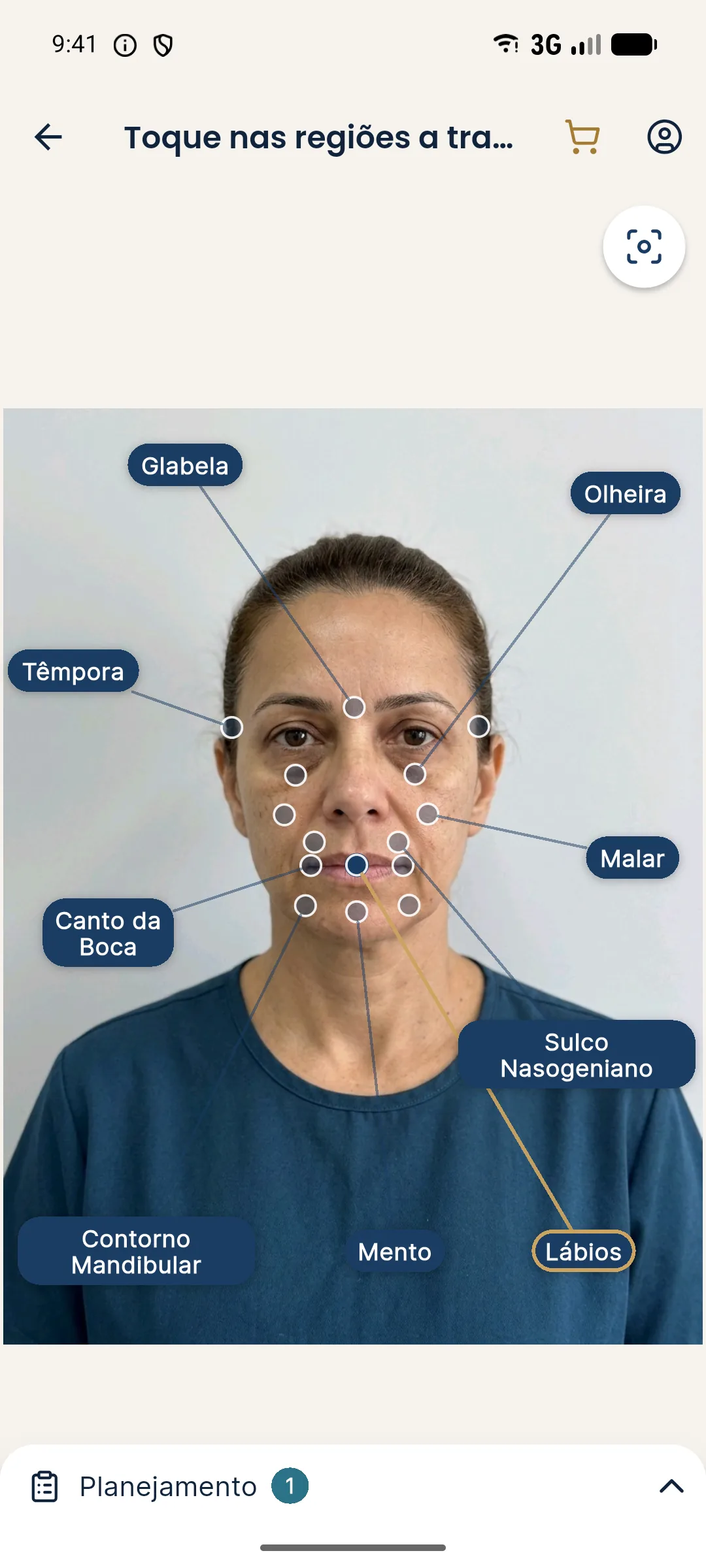
How to simulate in 3 steps
- In New projection, enter the patient's name and use a frontal photo with relaxed lips, not smiling and without lipstick.
- In the marking screen, tap the Lips point and set the volume in the Plan (from 0.5 to 5 ml, in 0.5 steps).
- Tap Create projection and compare on the Before / After slider. Two fingers zoom in to show the contour.
Details and screenshots in how to mark areas and volumes. To take the plan to closing, the volume set here also feeds the PDF quote.
Frequently asked questions
How long does lip filler last?
Generally 6 to 12 months, depending on the product, the volume and the patient's metabolism.
How many ml are used in lip filler?
Generally 0.5 to 1.5 ml per session, with 1 ml a common reference for a first treatment, at the discretion of the qualified professional.
Are the lips swollen after filler?
Yes, swelling is expected and is usually strongest in the first 2 to 3 days. The final look is assessed once the swelling goes down, generally in about 2 weeks.
Can lip filler be undone?
With hyaluronic acid, yes. Hyaluronidase breaks down the product and is used both for complications and for corrections, at the professional's discretion.
Can lip filler cause a cold sore?
It can reactivate herpes labialis in people who already carry the virus. Patients with a history should tell the professional, who decides on prevention.
Harmy images are illustrative simulations generated by AI from the patient's photo to support the conversation between practitioner and patient. They are not a promise of results. Indication, technique, product and volume are solely the decision of the licensed practitioner. This content is for information only and does not replace a clinical assessment.