
Downturned mouth corners: reading at rest and when smiling

 BeforeSimulation
- Muscle
- Highlighted area
Quick facts
- Concern
- Mouth corners tilted downward, with an air of sadness or fatigue
- Essential reading
- Compare the tilt at rest and when smiling, using the same front-facing photo
- Frequent causes
- Depressor pull, loss of lateral support, marionette lines and thin skin around the mouth
- Limit
- The dominant cause is corrected; symmetry and lift measured in millimeters are not guaranteed
"My mouth looks sad." It is one of the concerns that comes up most in the office and one of the most poorly formulated. The patient describes an impression (tiredness, sadness, an angry look) and attributes it to one detail, the corner of the mouth. It is up to you to turn the impression into measured findings: where the corner sits, where it tends to go and what pulls it.
This page organizes the reading into two photos, rest and smile, separates the most common causes and shows when each approach makes sense. When the concern is the expression of the face as a whole, also see sad mouth and sad face at rest.
How do you read the tilt of the mouth corners?
In many faces, the mouth corners (commissures) sit on a horizontal line or slightly raised when the mouth is relaxed. A corner that drops below the line between the lips sends a message of sadness, even if the patient is fine. There is no single "right" angle: the reference is harmony with the rest of the face, especially with the shape of the lips and the position of the eyebrows.
So that you are not fooled, always photograph both situations with the same framing, the head straight and the pupil line horizontal (see standardized clinical photography):
| Situation | What to observe | What it may indicate |
|---|---|---|
| Rest | Position of the corner relative to the line between the lips | Loss of lateral support, depressor pull |
| Spontaneous smile | How far the corner rises and whether it rises equally on both sides | Zygomaticus major strength, dynamic asymmetry |
| Speech | Whether the corner drops when speaking or relaxing | Depressor overactivity, habit |
| End of day (patient report) | Whether it gets worse with fatigue | Dynamic and habit component |
What pulls the corner down?
The position of the corner is the result of a play of forces. On one side, the elevators (mainly the zygomaticus major and the levator anguli oris); on the other, the depressor anguli oris, which pulls down and outward. The meeting point of these forces is the modiolus, a crossing zone of fibers beside the commissure.
When the depressor is strong or lateral support weakens, the balance tips downward. In practice, the droop rarely has a single cause:
- Muscle pull: an overactive depressor, sometimes with the mentalis contracting along with it, which "pushes" the chin up and deepens the groove.
- Loss of support: bone resorption and volume reduction at the side of the mouth and chin leave the commissure without support.
- Marionette lines: the groove that runs down from the corner (marionette lines) creates a shadow that visually prolongs the droop.
- Jowl and laxity: fat and skin that descend laterally pull the corner down, which ties into laxity along the face contour.
- Thin skin around the mouth: loss of skin quality accentuates folds and shadows.
- Habit and dentition: missing teeth, a poorly fitting prosthesis or a habitual lip posture.
If the mentolabial fold is deep, remember that it changes how the lower third reads, and it is worth looking at shadow under the lip as well.
What fits in the approach?
The central question is which force dominates. The answer defines what to offer, and also what not to offer.
| Dominant finding | Approach usually discussed | Main caution |
|---|---|---|
| Shadow and loss of lateral support | Support filler in the mouth corner area | Highly vascularized area, risk of vascular occlusion |
| Overactive depressor | Botulinum toxin at a conservative dose, after assessment | Effect on the lower lip and speech |
| Deep marionette lines | Combine support with treatment of the fold | Do not fill only the fold |
| Jowl laxity | Support of the lower third and contour | Too much volume weighs down and worsens the droop |
| Thin skin | Skin quality (biostimulation, skinbooster) | Expectation of firmness |
Toxin in the depressor anguli oris calls for fine knowledge of the muscle and its surroundings, because diffusion can compromise lower lip movement. The chin also enters the reasoning when mentalis contraction is part of the picture, and there are supporting pages on mentalis toxin.
How do you combine marionette lines, chin and lip without overdoing it?
The most common mistake is to treat the groove the patient points to and forget where it originates. If lateral support of the jaw and chin has been lost, filling only the marionette lines can give an artificial, heavy result. For these combinations, the combination reasoning is in mouth corners, marionette lines and chin and, for the order of the stages, in lips and mouth corners in the plan.
A few decisions help keep the plan lean:
- Define the dominant cause before talking about product. Without it, any approach is a guess.
- Start with the smallest volume that changes the reading. You can come back and add; it is not easy to take away.
- Reassess the mouth in motion after each stage, not only at rest.
- Consider the lip: a heavy lower lip also pushes the corner down. The lip assessment comes before any addition.
- Document the initial photo of both situations. It is what allows comparison without relying on memory.
How do you show the concern before deciding?
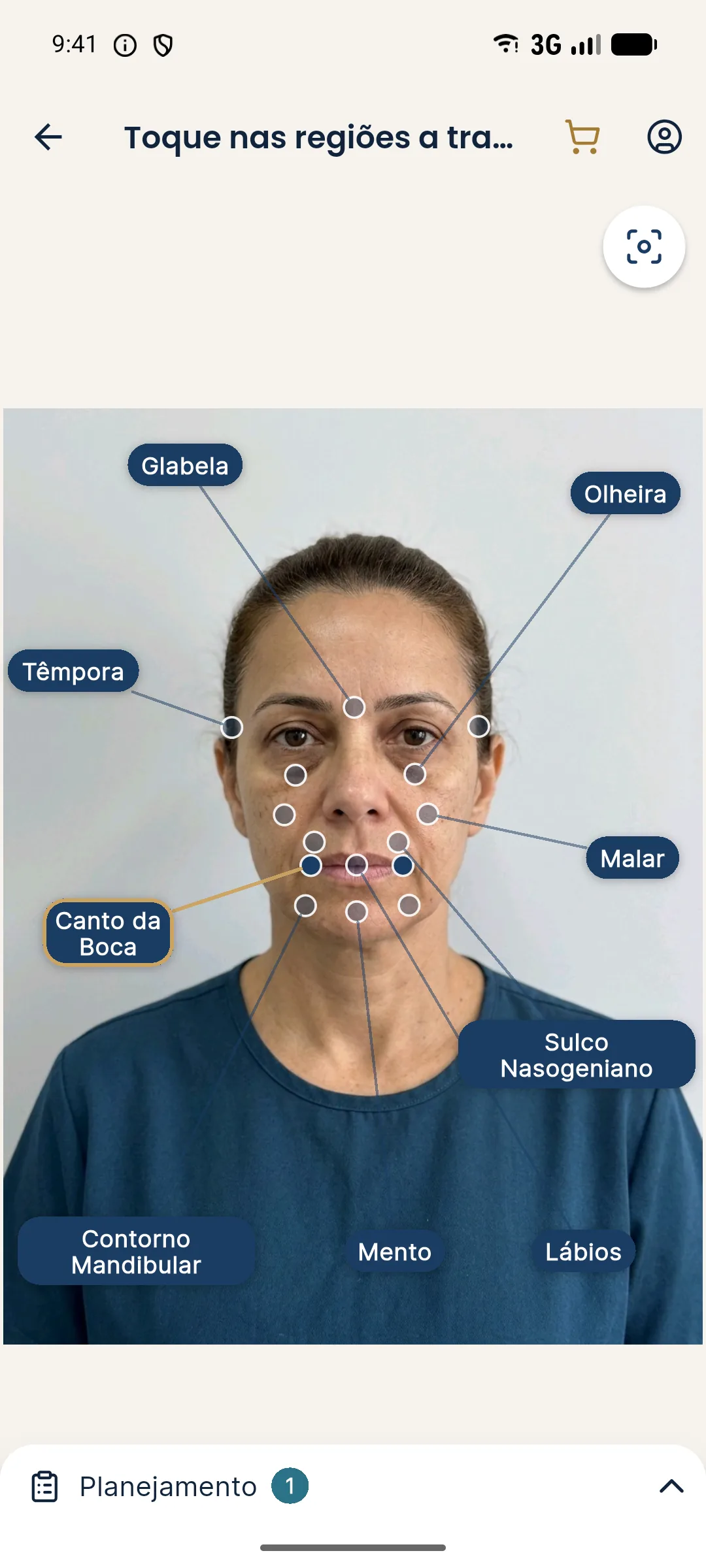
A projection on a frontal photo helps turn "my mouth looks sad" into something the patient sees and you discuss. In Harmy, the area is Mouth Corner: you mark it, set the ml and generate the projection. The change is subtle on purpose, because the app only alters what was marked. This is useful for calibrating expectations, since the simulation shows a softened shadow, not a "lifted" corner.
When is the approach not the right one?
There are situations in which promising improvement is risky. Think twice when:
- The concern is out of proportion to the visible finding, or the patient repeatedly asks for "a little more." It is worth investigating body dysmorphic disorder in facial harmonization.
- The droop is dental or prosthetic in origin: the loss of support comes from the mouth, and a dental prosthesis or dental treatment may be the first step.
- There is significant laxity of the lower third, where local support does not solve it and the patient expects a "lifting effect."
- There is a history of active cold sores or of a previous complication in the area.
In these cases, explain clearly the limit of what harmonization delivers and, when it makes sense, agree on stages over time. The honest conversation usually protects you and the patient more than an ambitious plan.
Record and follow-up
Record the two photos, the dominant cause you identified, the agreed approach and what was said to the patient about limits. At follow-up, compare using the same standardization. If the result fell short of expectations, an explanation based on the initial photos avoids the feeling of a broken promise. The history by patient in Harmy keeps the sessions organized, and the comparison between projection and actual result helps close the cycle honestly.
Frequently asked questions
What makes the mouth corners droop?
Generally a sum of factors: pull from the depressor anguli oris muscle, loss of volume and support at the side of the chin and mouth, thinner skin and fat descent in the jowl. Each patient combines these factors in their own way.
Does filler lift the corner of the mouth?
It can soften the shadow and support the inflection point, but it does not work as a mechanical lift. When the cause is muscular, filler alone tends to fall short of what the patient expects.
Does toxin help when the corner drops?
It may be considered when the depressor clearly plays a role in the concern, at the discretion of the qualified practitioner, after assessment. There is a risk of affecting lower lip function, so the approach calls for caution.
Why do I need to assess the mouth when smiling and at rest?
Because the corner can be neutral at rest and drop when speaking, or look dropped at rest and rise well when smiling. The approach changes depending on dynamic behavior.
Harmy images are illustrative simulations generated by AI from the patient's photo to support the conversation between practitioner and patient. They are not a promise of results. Indication, technique, product and volume are solely the decision of the licensed practitioner. This content is for information only and does not replace a clinical assessment.