
Sad Mouth: Drooping Corners and What Harmonization Does

 BeforeSimulation
- Muscle
- Highlighted area
Quick facts
- Concern
- Mouth corners turned down, a sad or tired expression at rest
- Three mechanisms
- Muscle pull, tissue ptosis and loss of supporting volume
- Useful test
- Manually lift the corner and see what changes in the expression
- Risk
- Vascular and dynamic area, with a risk of smile asymmetry
"People always ask if I'm sad." The sentence sums up the sad mouth: a face whose resting expression conveys discouragement because of mouth corners turned downward. It is not a disease, it is an appearance issue with social impact, and it is one of the most rewarding concerns when handled well, precisely because small changes alter the reading of the expression a great deal.
The difference from the mouth with a closed or angry expression lies in the focus: here the center is the drooping corner. This page separates the causes and organizes the options. See also mouth corners turned down and deep oral commissure.
Three mechanisms for a drooping mouth corner
| Mechanism | What happens | Clinical clue |
|---|---|---|
| Muscle pull | The depressor anguli oris predominates over the elevators | The corner rises when smiling but drops quickly on relaxing |
| Tissue ptosis | Descent of the lower third, with jowl and loss of support | Loose skin, jowl, pre-jowl sulcus |
| Loss of supporting volume | Atrophy of fat and bone around the corner | Deep shadow at the corner, pronounced marionette lines |
In general all three coexist, with one predominating. That is why the most valuable test is manual lifting: with a finger, gently lift the mouth corner and see what changes. If the expression improves a lot, the corner responds well to support or muscle balance. If it does not improve, the cause is in more distant tissues, such as the midface and the jaw.
The modiolus is the point where the muscles converge. The levator anguli oris is one of the elevators, and the balance of forces between it and the depressors defines the corner at rest.
How to assess
The link with the midface is important: descent of the cheekbone and the nasolabial fold drags the mouth corner down. See sagging cheeks and midface ptosis.
What harmonization offers
The options vary with the predominant mechanism, at the discretion of the licensed professional.
Support of the corner and the marionette line. Mouth corner filler can restore volume and reduce the shadow that accentuates the droop. The area is delicate and the product can migrate or create irregularity if overused.
Muscle balance. Toxin in the depressor anguli oris and, in some cases, in the mentalis can reduce the downward pull. See toxin in the depressor anguli oris and mentalis toxin. The risk of lip ptosis and smile asymmetry calls for caution. See lip ptosis after toxin.
Chin and labiomental fold. Chin filler supports the lower lip and softens the labiomental fold. See deep marionette lines.
Midface and contour. When the ptosis comes from above, support of the cheekbone and jaw usually has more effect on the corner than direct injection. See cheekbone filler and cheek sagging over the jaw.
Significant laxity. When the skin and tissues descend markedly, injectables have limits, and the conversation includes other approaches. See lower third laxity: assessment.
Risks
Filler carries the usual risks: swelling, bruising, asymmetry, nodules and irregularities, plus less frequent vascular complications. The area receives branches of the facial artery and hyaluronidase must be available when hyaluronic acid is used. With toxin, smile asymmetry, lower lip ptosis and difficulty pronouncing some letters can appear, usually temporary.
How to show it in Harmy
In Harmy, the Mouth Corner point is the closest to this concern. The projection shows the effect of volume on the shadow and the expression at rest, in the frontal photo, and changes only what was marked. The app does not simulate the action of toxin in the mouth or the movement of the smile.
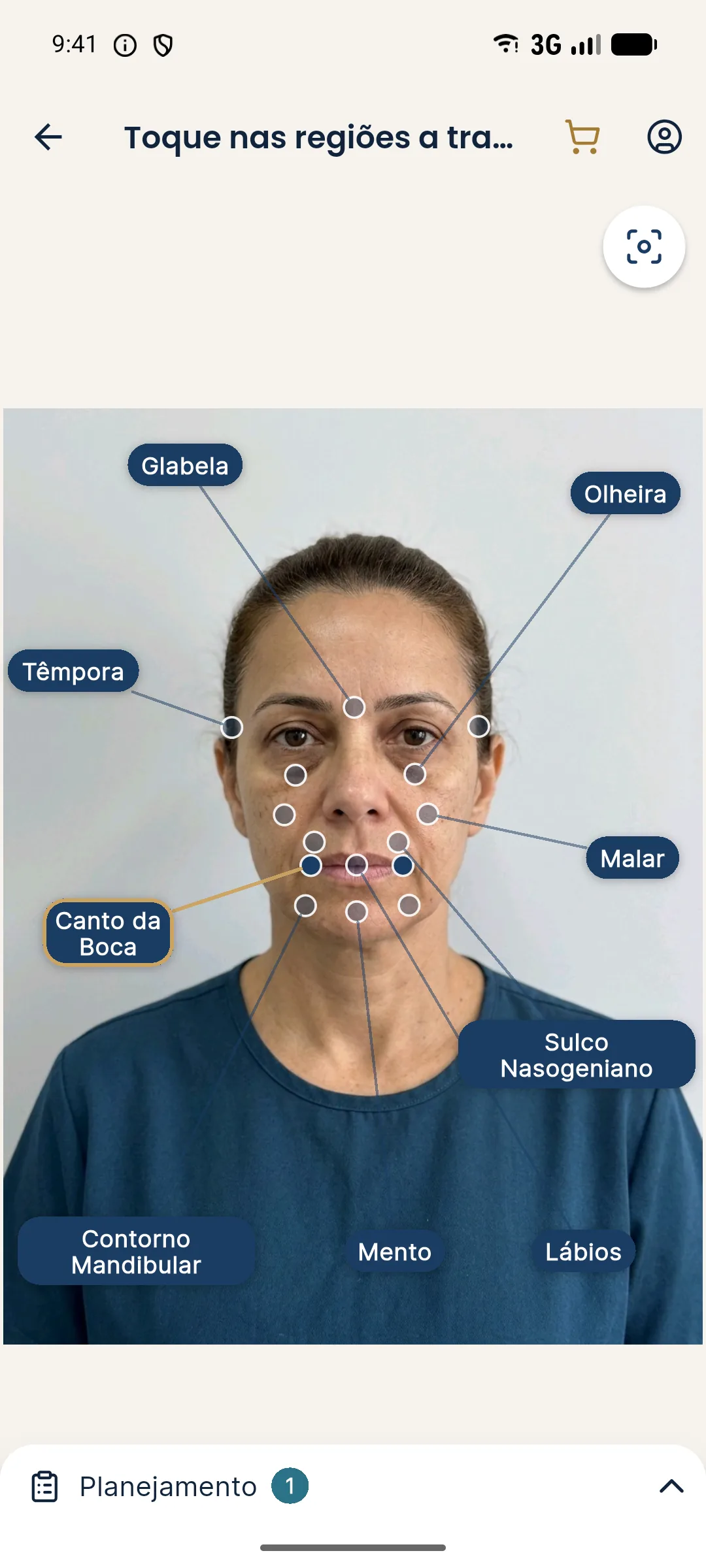
A practical idea is to make two projections: one with Mouth Corner only and another with Mouth Corner, Cheekbone and Chin, and compare them. The patient sees that the expression changes more when upper support enters the plan, which helps in accepting a plan in stages.
Care in maintaining the result
The mouth corner is an area that moves all day, so filler durability there is usually shorter than in more static areas, varying with the product and the metabolism. The patient should be told that maintenance may be more frequent and that excess product, used to compensate, is the road to irregularity.
It is also important to advise on habits that accentuate the droop: clenching the chin, bruxism, chewing on one side, keeping the head down for long periods on the phone, which leaves the neck and contour skin in a folded position. Small changes in habit complement the plan. At follow-up, always compare with the before photo and with the video, because the change is in expression, and expression is assessed in motion. Record the progress and adjust maintenance case by case.
Wrap-up
Record the photo and video, the predominant mechanism and the plan in stages, with reassessment. For the patient who, besides the mouth, has a tired appearance, see sad face at rest and tired face. Volumes and techniques are at the discretion of the licensed professional, in accordance with the rules of their professional council in Brazil.
Frequently asked questions
Why do the mouth corners droop with age?
There is loss of volume and support in the surrounding area, descent of the tissues of the lower third and a predominance of the muscles that pull the mouth down. The result is a sad expression at rest, even without sadness.
Does filler lift the mouth corners?
It can visually lift the corner when the cause is lack of support, and soften the shadow of the marionette line. When the cause is muscle pull, filler alone has a limited effect.
Does toxin in the depressor anguli oris solve it?
In selected cases, small doses balance the downward pull. It can cause smile asymmetry if poorly indicated. The decision belongs to the licensed professional, after assessment.
Is a sad mouth the same as marionette lines?
They are related. The marionette line runs from the mouth corner down to the chin and is one of the signs of a sad mouth, but the concern also involves corner position and expression.
Harmy images are illustrative simulations generated by AI from the patient's photo to support the conversation between practitioner and patient. They are not a promise of results. Indication, technique, product and volume are solely the decision of the licensed practitioner. This content is for information only and does not replace a clinical assessment.