
Sagging cheeks: how to assess midface descent

 BeforeSimulation
- Highlighted area
Quick facts
- Concern
- The cheeks have dropped, the face "fell," and the cheekbone lost its height
- Classic sign
- Inverted triangle of youth, with the base at the bottom and the apex at the top
- Mechanisms
- Volume loss, fat descent and loosening of the ligaments
- Limit
- Injectables support in part, but do not replace what is surgical laxity
"My face is falling." When patients describe it this way, they usually point to two areas: the cheeks, which lost their height, and the contour, which lost its definition. The phenomenon is midface ptosis, and understanding it well is the basis of any planning for a mature face.
This page explains the mechanism, the assessment and the logic of the plan. It links to midface ptosis, cheek sagging over the jaw and low cheekbone.
What happens when the cheeks descend?
In a young face, volume is concentrated in the upper part of the midface, over the cheekbone, and tapers toward the chin: this is the triangle of youth, with the base at the top and the apex at the bottom. Over time, volume is redistributed and the triangle inverts: the base drops toward the jawline and the apex rises toward the eyes.
The triangle of youth is an assessment concept, not a ruler. It helps visualize where volume sits and where it was lost. Three processes add up:
| Process | What happens | What it looks like |
|---|---|---|
| Volume loss | Atrophy of malar fat, such as the SOOF, and bone resorption | Flattened cheekbone, marked tear trough |
| Fat descent | Fat shifts downward, the nasolabial compartment accumulates | Deep nasolabial fold, jowl |
| Ligament loosening | The zygomatic ligament and other retaining ligaments stretch | Looser tissue, folds |
| Skin quality | Less collagen and elasticity | Laxity, fine lines |
The result is a face that looks more tired and heavier in its lower half. The full layered approach is in facial aging by layers.
How to assess
The assessment combines observation and palpation, preferably with the patient seated, from the front and in three-quarter view.
A comparison with a photo from 5 to 10 years earlier often helps show where volume has changed, and makes the conversation more concrete. The importance of standardizing photos is covered in standardized clinical photography.
What harmonization offers
The logic is to support from the cheekbone and reassess the whole, in stages, at the discretion of the qualified practitioner.
Cheekbone and midface. Malar filler restores projection and supports the superficial layers, which can reduce the sense of descent. It is the usual starting point. See the complete midface in the plan.
Nasolabial fold. Nasolabial fold filler comes in as a complement, often after the cheekbone, because the fold improves indirectly with upper support. The area carries high vascular risk.
Skin quality and support. A collagen biostimulator may be considered for quality and gradual support in suitable cases. See biostimulator or filler.
Thread lift. Thread lifts are an alternative in selected cases, with their own indications, risks and limits. See PDO threads: risks.
Lower contour. When jowl is evident, the plan may include the jawline and the chin, after the upper support.
The limit: significant laxity, with excess skin and marked descent, has a limited response to injectables, and referral for surgical assessment may be the honest course. Document the conversation.
Risks
Risks include swelling, bruising, asymmetry, nodules and irregularities, plus less frequent but serious vascular complications, mainly in the perinasal and orbital region. The area has branches of the transverse facial artery, and hyaluronidase should be on hand with hyaluronic acid. In thin skin, the risk of irregularity and of the Tyndall effect is higher.
How to simulate in Harmy
In Harmy, the Cheekbone area and the Nasolabial Fold area show the effect of support on the frontal photo. The projection changes only what was marked, with no skin retouching, and it shows the effect of volume, not the lifting of tissue. This should be told to the patient: the app simulates volume, and does not "lift" the face.
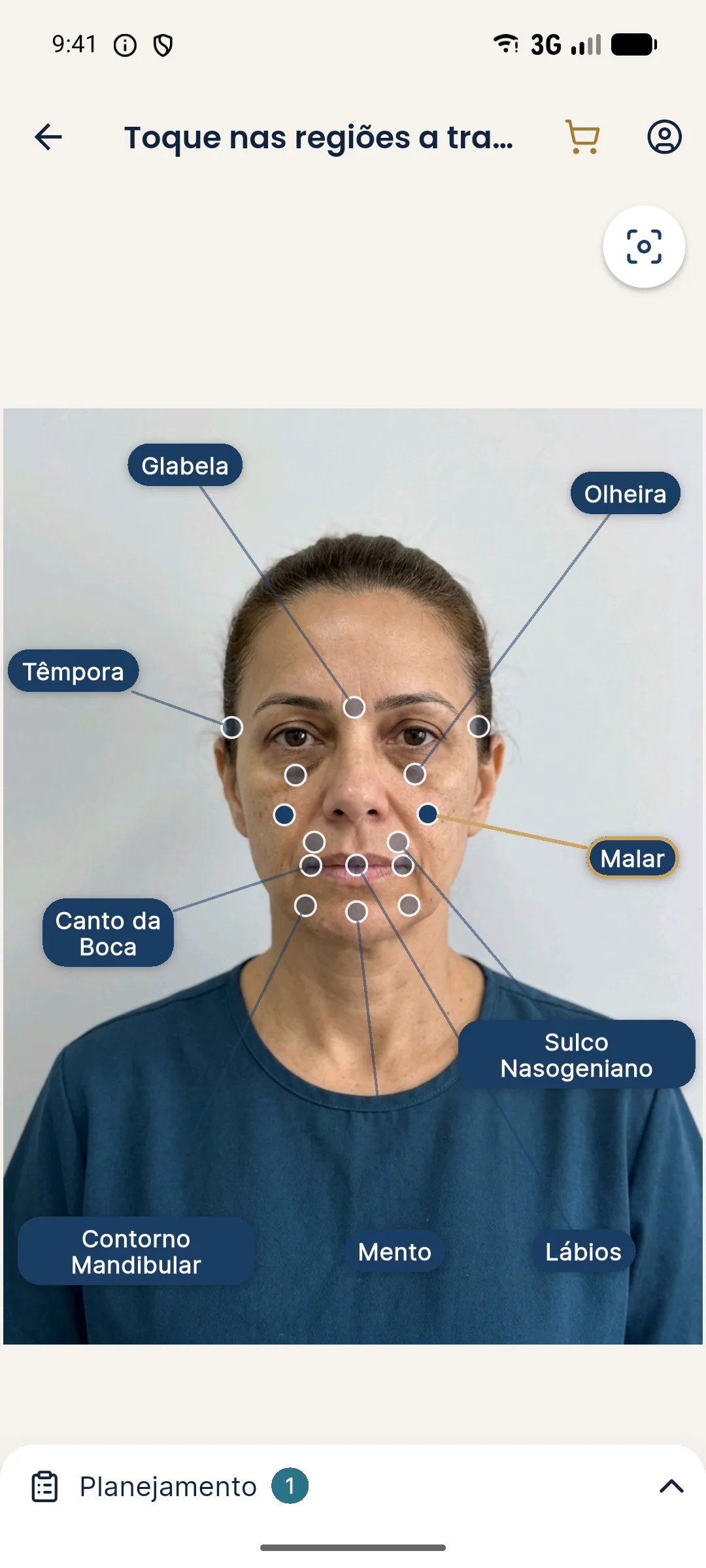
The Full harmonization shortcut marks cheekbone 2 ml, jawline 2 ml, chin 1.5 ml, lips 1 ml and fold 1 ml at Moderate intensity, with tear trough 1 ml Subtle, and you adjust each area. For sagging cheeks, it is worth starting with only Cheekbone and Fold at Subtle.
When to talk about surgery
Part of the ethical work with sagging cheeks is knowing when injectables stop being the best answer. Signs that the conversation should include surgery: clearly excess skin, marked midface descent with significant jowl, laxity that does not improve on the lift test, and an expectation of a "lifting effect." In these cases, insisting on filler increases the amount of product, weighs the face down and frustrates the patient.
Referring is not losing the patient: it preserves the relationship and, often, you get to treat them again later, refining the surgical result with injectables. Explain clearly that facial harmonization works well on volume and quality, and that pronounced laxity belongs to a different approach. Record the recommendation and the patient's decision. That honesty tends to be remembered and valued.
Wrap-up
Record the photos, the lift test and the staged plan, with reassessment. For the sequencing logic, see nasolabial fold and cheekbone: combining in the plan and laxity along the face contour. Volumes and techniques are at the discretion of the qualified practitioner, according to the rules of their professional board.
Frequently asked questions
What causes sagging cheeks?
A combination of midface volume loss, fat descent from loosening of the retaining ligaments, loss of skin quality and bone resorption. Weight loss and aging speed up the process.
Does filling the cheek lift the face?
Restoring volume and projection at the cheekbone can give support and reduce the sense of a sagging face, in mild to moderate cases. With significant laxity, the effect is limited and other approaches may be discussed.
Do thread lifts fix sagging cheeks?
They may be considered in selected cases, with their own indications, risks and limits. The decision belongs to the qualified practitioner, after assessment.
What is the relationship between sagging cheeks and smile lines?
Midface descent deepens the nasolabial fold. Treating cheekbone support often softens the fold indirectly.
Harmy images are illustrative simulations generated by AI from the patient's photo to support the conversation between practitioner and patient. They are not a promise of results. Indication, technique, product and volume are solely the decision of the licensed practitioner. This content is for information only and does not replace a clinical assessment.