
Nasolabial Fold Filler (Smile Lines)

 BeforeSimulation
Nasolabial fold filler (popularly, "smile lines") softens the line that runs from the side of the nose to the corner of the mouth. It is one of the oldest requests in facial aesthetics and remains among the most frequent in orofacial harmonization (HOF). The patient often points straight at it: "I want to get rid of these lines." The useful conversation starts when you explain why they appeared.
On this page you will find the indication, usual volumes, durability, risks and how to simulate it in Harmy.
What is nasolabial fold filler?
It is the placement of hyaluronic acid to reduce the depth of the nasolabial fold. The fold is a natural structure, present since youth, that deepens with loss of midface support, displacement of malar fat and changes in skin quality.
That is why treatment can be direct, in the fold itself, or indirect, restoring support above it. Often the plan combines both approaches, at the professional's discretion. The goal is to soften, never to erase: a face with no nasolabial fold looks artificial.
Who is nasolabial fold filler usually indicated for?
Generally, for patients with:
- a nasolabial fold that is marked at rest and bothers them in photos and in the mirror;
- a hollow at the base of the fold, near the side of the nose;
- a fold that is still marked after treatment of malar support;
- an expectation of softening, not elimination.
Folds caused mainly by excess skin and marked laxity respond poorly to volume. In those cases, insisting on filler tends to weigh down the midface. General contraindications include active infection, active herpes, active autoimmune disease, pregnancy, breastfeeding and allergy to the product. The decision belongs to the qualified professional, in line with the rules of their professional council in Brazil.
Which areas are involved?
The main area is the nasolabial fold. It depends on the malar area above and continues toward the mouth corners below. Assessing the three together usually avoids the classic mistake of filling the fold and leaving the midface heavy.
Which product is used?
Generally, hyaluronic acid with medium to high G', chosen according to the depth of the fold and the goal: support at the base or softening of the line. Reversibility with hyaluronidase weighs heavily in the choice in a high vascular risk area. Product, instrument and plan are technical decisions for the professional.
What volumes are usual?
The ranges below are general references; the final volume is set by the qualified professional after assessment.
| Depth of the fold | Usual range per side | Usual total range |
|---|---|---|
| Mild | 0.3 to 0.5 ml | 0.6 to 1 ml |
| Moderate | 0.5 to 1 ml | 1 to 2 ml |
| Pronounced | Treat support first and reassess | At the professional's discretion |
Excess volume in the fold often creates a visible ridge when smiling. Preferring less and reassessing is the rule.
How long does nasolabial fold filler last?
Usual durability is generally between 6 and 12 months. The area is highly mobile, because of speech and facial expression, which tends to shorten how long the product lasts compared with more static areas. Product, volume and the patient's metabolism also play a role.
What are the risks and complications?
The nasolabial fold is a high vascular risk area. The facial artery and its angular branch run through it, with frequent anatomical variations. An intravascular injection can cause vascular occlusion, with a risk of skin necrosis at the side of the nose and the upper lip and, rarely, a visual complication.
For that reason:
- hyaluronidase must be available whenever hyaluronic acid is used;
- the professional must master early recognition and the occlusion management protocol;
- the patient must know which signs mean seeking immediate care.
Other possible complications: swelling, bruising, nodules, a ridge when smiling, asymmetry and cold sore reactivation. See also safety and complications in facial harmonization.
What care is needed before and after?
Beforehand, the medical history should record anticoagulants and antiplatelet drugs, history of cold sores, previous procedures in the area (including permanent products) and autoimmune disease. The standardized before photo goes into the patient record, and the informed consent should state the vascular risk explicitly.
Afterward, usual instructions include avoiding massage and pressure in the area, intense heat and heavy exercise for 24 to 48 hours. Disproportionate pain, pallor, or lacy or purplish skin near the nose or lip call for immediate contact with the professional. A follow-up at about 15 to 30 days allows symmetry and the need for a top-up to be assessed.
Why do smile lines appear?
Explaining where the fold comes from often changes what the patient asks for. In broad terms, these contribute:
- Loss of midface support: fat and bone in the malar area lose volume, and the tissue above the fold "slides down."
- Facial expression: the fold is the natural crease of the smile; people who smile a lot tend to mark it earlier.
- Skin quality: with less collagen and elasticity, the crease stays marked at rest.
- Weight and genetics: rapid weight loss and inherited traits also play a part.
When the main cause is support, treating only the line usually gives a short effect and a higher risk of excess. When it is a localized hollow, direct filling makes more sense. This judgment belongs to the professional, after assessment.
What is not promised to the patient
- That the smile lines will disappear.
- That the fold will not mark again when smiling.
- Absolute symmetry.
- An exact duration.
- That more volume in the fold means more softening.
Simulation in Harmy
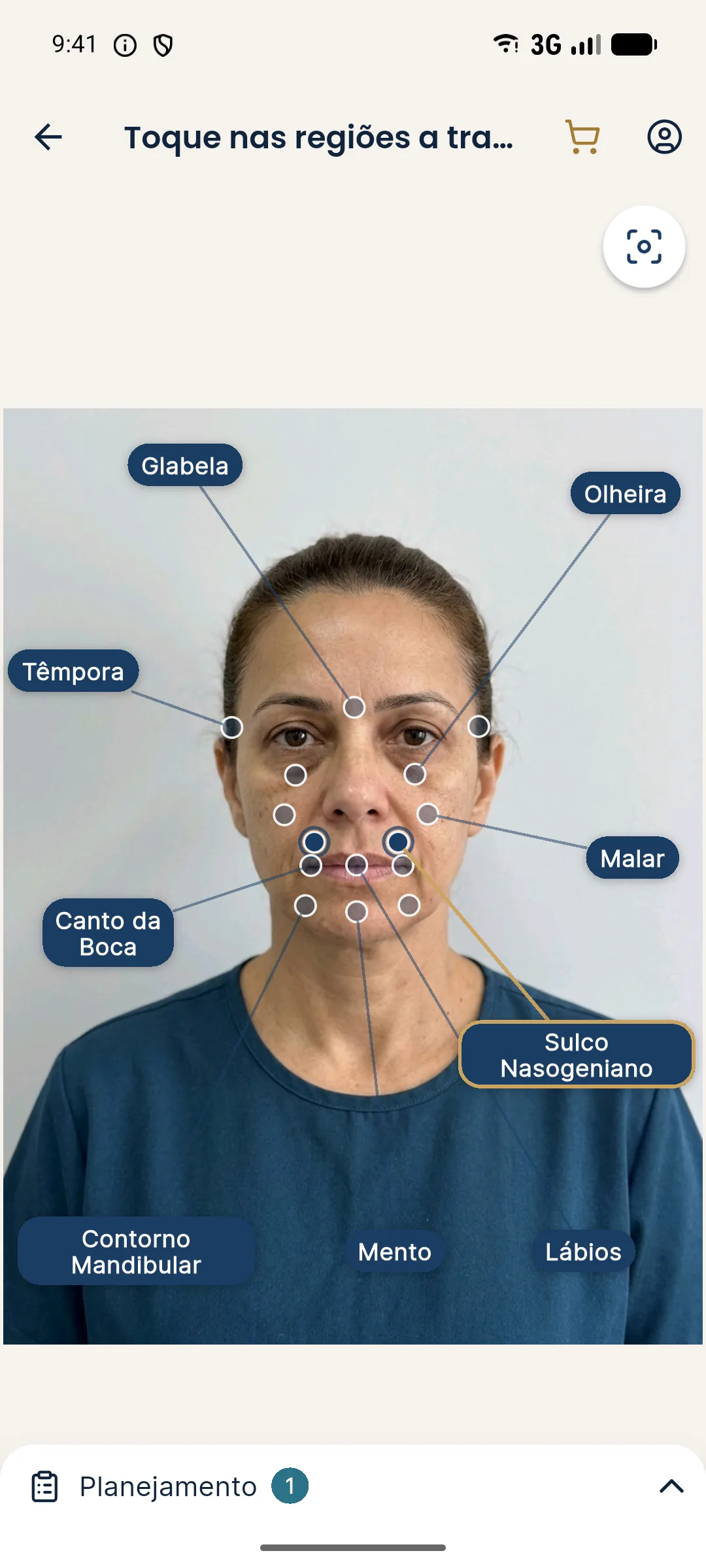
The image at the top of this page was generated by Harmy itself, using the fictional person we use across all our pages, marking only the Nasolabial Fold point with 2 ml. Drag the line to compare. The change is subtle on purpose: the AI alters only the marked area, respecting the volume, and does not apply makeup, retouch the skin or change expression or lighting. It is an honest projection: the fold becomes softer, it does not vanish, and that already sets the right expectation. It is an illustrative simulation, not a promise of results.
The fold is bilateral. In Harmy, the ml is the total: with 2 ml, about 1 ml on each side.
How to simulate in 3 steps
- In New projection, enter the patient's name and use a frontal photo with a neutral expression, not smiling.
- In the marking screen, tap the Nasolabial Fold point and set the total volume in the Plan (from 0.5 to 5 ml, in 0.5 steps). If the plan includes the malar, mark that point too.
- Tap Create projection and compare on the Before / After slider.
Details and screenshots in how to mark areas and volumes. A useful strategy in the consultation is to generate one projection with only the fold and another with malar and fold, so the patient understands the difference between treating the line and treating the support.
Frequently asked questions
How long does smile line filler last?
Generally 6 to 12 months, depending on the product, the volume, how much the area moves and the patient's metabolism.
How many ml are used in the nasolabial fold?
Generally 0.5 to 1 ml per side, or 1 to 2 ml in total, at the discretion of the qualified professional after assessment.
Is filling smile lines dangerous?
The nasolabial fold is a high vascular risk area, because of the facial artery and its branches. It demands anatomical mastery, proper technique and hyaluronidase on hand.
Is it better to fill the nasolabial fold or the malar?
It depends on the cause. When the fold deepens because of lost midface support, treating the malar may be the first step. The decision belongs to the professional after assessment.
Harmy images are illustrative simulations generated by AI from the patient's photo to support the conversation between practitioner and patient. They are not a promise of results. Indication, technique, product and volume are solely the decision of the licensed practitioner. This content is for information only and does not replace a clinical assessment.