
Facial analysis at 40: volume, folds and contour

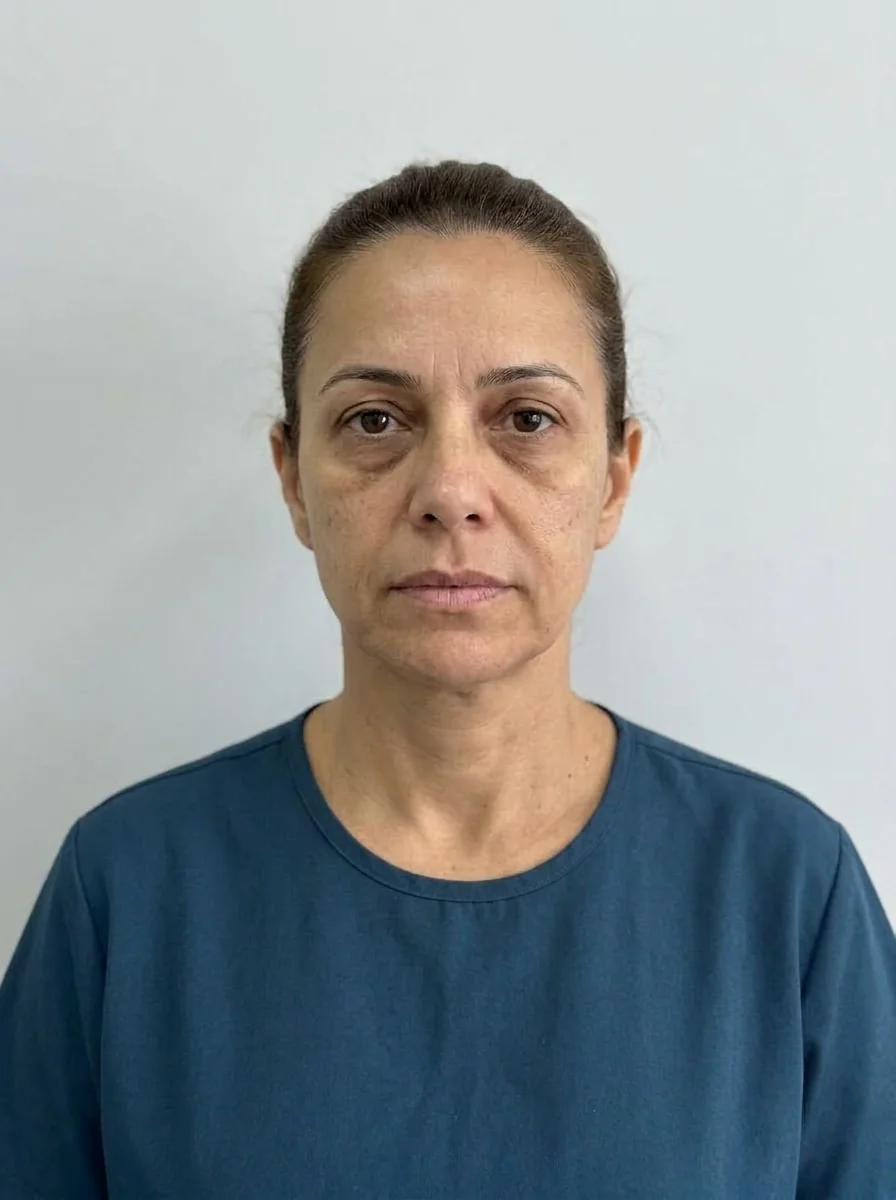 BeforeSimulation
- Highlighted area
Quick facts
- Goal
- Read the descent of the compartments at 40 and define the order of priority of the plan
- Typical signs
- Deeper nasolabial fold, loss of malar support, early marionette lines and jowls
- Logic
- Treat support before the fold: the fold is usually a consequence, not a cause
- Caution
- Too much volume in the middle third looks heavy; the goal is to restore support, not to fill
At 40, most HOF (orofacial harmonization) patients already notice the face changing in a way the mirror confirms and the photo reinforces. The fold between the nose and mouth has deepened. The cheek area has lost some projection. The mouth corner starts to "drop". The jawline is no longer so firm. This is the age group in which the fat compartments begin to descend and the ligaments that hold the tissue become more evident, and the plan stops being just "a little volume".
This page helps read that picture and define the order of priority. It follows facial analysis at 30 and comes before at 50.
What happens to the face at 40?
Facial aging is not just volume loss. It is a set of changes in layers: bone, fat, ligaments, muscle and skin. In planning terms:
- Fat: the middle third compartments lose volume or descend, such as the SOOF and the nasolabial compartment. The relationship with support is in fat compartments of the middle third in the plan.
- Ligaments: fixed points, such as the zygomatic ligament, hold the skin while the surrounding tissue descends, and that accentuates folds.
- Bone: mild bone resorption changes the projection of the middle third and the jaw.
- Skin: less collagen and elastin, with a thinner texture.
Hence the central idea for this age group: the fold is very often the symptom, and lost support is the cause.
Which signs appear and how do you read them?
| Sign | Possible structural cause | Planning reading |
|---|---|---|
| Deeper nasolabial fold | Loss of malar support and descent of the compartment | Assess support before filling the fold |
| Marionette lines and drooping mouth corner | Tissue descent and depressor activity | Assess support, volume and muscles |
| Early jowls | Loss of definition of the mandibular line | Assess contour and skin |
| Under-eye hollow and palpebromalar groove | Volume loss at the eyelid-cheek transition | Tell apart volume, pigment and vessels |
| Hollow temples | Loss of the temporal fat pad | Assess the frame of the upper third |
| Elongated upper lip | Lip lengthening and thinning | Assess proportion before volume |
What is the order of priority?
A logical sequence, which the professional adjusts to each face:
- Middle third support. Restoring a discreet malar projection usually eases the fold and the under-eye hollow as a consequence.
- Jawline and chin. Definition improves how the lower third reads.
- Nasolabial fold and marionette lines. Refinement, after support.
- Lips and perioral area. If there is a concern, with conservative volume.
- Dynamic lines. Toxin, when the expression weighs on the face.
- Skin quality. Biostimulation and skin care, in parallel.
The idea of structure before detail has its own page: structure before detail in the HOF plan. The order is a practical rule, and the decision always belongs to the licensed professional, after assessment, in line with the rules of their professional board.
Volume or stimulus?
At 40, it is common for the professional to combine approaches. Hyaluronic acid delivers immediate volume and support depending on its cross-linking and its G prime. Biostimulators work differently, with a gradual effect. Thread lifts appear as an option in some cases. The choice depends on the face, skin quality and expectations. How to divide areas between approaches is in biostimulator and filler: how to divide areas.

How the simulation helps and where it misleads
In this age group, the patient usually arrives with a localized concern ("smile lines") and little sense of the whole. The simulation shows what changing one area does to the whole face, and helps explain why the plan starts with the cheekbone.
The projection uses only the frontal photo and is two-dimensional, so it does not reflect three-quarter projection. Explain this to the patient, and see the limits in limits of 2D simulation.
How do you avoid a heavy look?
The main fear of patients in this age group is "looking operated on". The practical answer rests on three ideas:
- Restore support, do not fill shadow. When there is structural loss, volume goes where the tissue lost support.
- Stages. Small volume, follow-up, assessment, add-on if needed.
- Three-quarter photo. A middle third that looks good from the front can look wide from the side.
A view of the whole also protects against the domino effect: changing one area changes how its neighbors read. See domino effect between facial areas.
What should you say about maintenance?
At 40, maintenance enters the plan. Resorbable products last for varying times depending on the product, the area, the volume and the patient, and the yearly budget needs to be stated upfront. The frequency is covered in maintenance: toxin, filler and biostimulator.
Myth or fact?
Summary
- At 40, compartments descend and the fold is usually a consequence.
- The logical order: support, contour, fold, lips, lines, skin.
- Combine approaches with judgment, in stages.
- Watch for the heavy look: restore support, do not overfill.
- Hyaluronidase available and an alert for signs of vascular occlusion.
Frequently asked questions
What changes in the face at 40?
There is usually loss of support in the middle third, deeper folds, early marionette lines and jowls, and reduced definition of the contour. The pace varies a lot between people.
Should I treat the nasolabial fold first?
Not always. Often the deeper fold is a consequence of lost malar support, and restoring support can soften it. The decision depends on the professional's assessment.
Is filler alone enough at 40?
No. Depending on skin quality and the type of loss, the approach may combine volume, biostimulator, toxin and skin care, always at the discretion of the licensed professional.
How do I avoid a heavy look when treating the middle third?
With conservative volumes, in stages, and checking the result in frontal and three-quarter photos. Filling where the structure lost support, not where there is shadow, helps avoid excess.
Harmy images are illustrative simulations generated by AI from the patient's photo to support the conversation between practitioner and patient. They are not a promise of results. Indication, technique, product and volume are solely the decision of the licensed practitioner. This content is for information only and does not replace a clinical assessment.