
Maintenance of toxin, filler, and biostimulator through the year

Quick facts
- Topic
- Annual calendar for three product types with different durations
- Central question
- How to avoid one session a month without losing the reassessment
- Principle
- Each cycle has its own rhythm, the decision comes from reassessment, not a fixed date
- Care
- Durations vary widely between patients and products, use them only as a range
The long-term patient usually lives with three clocks running at the same time. Toxin has its cycle, filler has another, and the biostimulator a third. If each is treated separately, the result is a schedule full of small consultations, none of them looking at the whole. If they are treated by the calendar and not by need, excess follows. The challenge is to organize without making it rigid.
This page proposes a way of thinking about the year: separate the cycles, group the reassessments, decide by criteria, and record the plan so the patient understands why they are coming back. For the view of the patient who already has a long history, see maintenance after five years of facial harmonization.
Why are the cycles different?
Each product acts differently. Botulinum toxin acts on muscle contraction and its effect wears off in months. Hyaluronic acid fills volume and degrades slowly, in ranges that vary with the product and the area. The collagen biostimulator stimulates a tissue response and has a more gradual effect, with spaced-out sessions. These behaviors are usual ranges, and the real patient may fall outside them.
| Product type | Rhythm of perception | Reassessment logic |
|---|---|---|
| Toxin | Effect noticeable in days, wears off in months | Follow-up guided by the return of movement |
| Filler | Immediate volume, gradual loss | Reassess by shape and concern, not by the clock |
| Biostimulator | Gradual response, spaced-out sessions | Reassess after the tissue response time |
There is no universal duration table. Metabolism, area, technique, product, habits, and individual traits all vary. Record the ranges you observe in your practice, patient by patient. To understand how the result transforms, see aging of facial harmonization results.
How do you build the annual calendar without making it rigid?
A simple approach is to lay out the year in reassessment blocks, with the patient informed that each block may result in doing, postponing, or doing nothing.
The sketch is an example of organization, not a sequence to follow. The real order depends on what the patient has, wants, and can carry. The principle is the same as in what to treat first in facial harmonization: priority criteria: criteria before the schedule.
How do you avoid session overload?
Excess usually comes from two sources: automatic scheduling ("come back in six months") and the day's concern being addressed without looking at the whole. To reduce it:
- Always assess against the starting photo, not against the patient's memory.
- Record the reason for each session, so you know later why it happened.
- Decide area by area, not product by product.
- Accept the decision to pause as part of the plan.
See also pillow face: how planning avoids the effect, which deals with accumulated volume, and domino effect between facial areas.
What should you record in each cycle?
A calendar only works if there is a record. For each cycle, note:
| Field | What it is for |
|---|---|
| Area and product | Knowing what is in the face |
| Approximate volume | Tracking accumulation over the years |
| Session date | Measuring the real interval, not the assumed one |
| Standardized photo | Comparing with criteria |
| Concern and decision | Understanding why it was treated or postponed |
| Agreed follow-up | Ensuring the reassessment |
The record format is in the plan diary: session-by-session progress record and in abbreviations and notation in the facial harmonization plan.
Where does Harmy fit in?
Harmy does not control inventory or a product calendar. It keeps the history by patient and lets you create a new projection at each reassessment, from a frontal photo. The "Maintenance" shortcut already brings lips 0.5 ml, nasolabial fold 1 ml, and cheekbone 1 ml, all at Subtle, and serves as a starting point for simulating what is usually discussed at a follow-up.
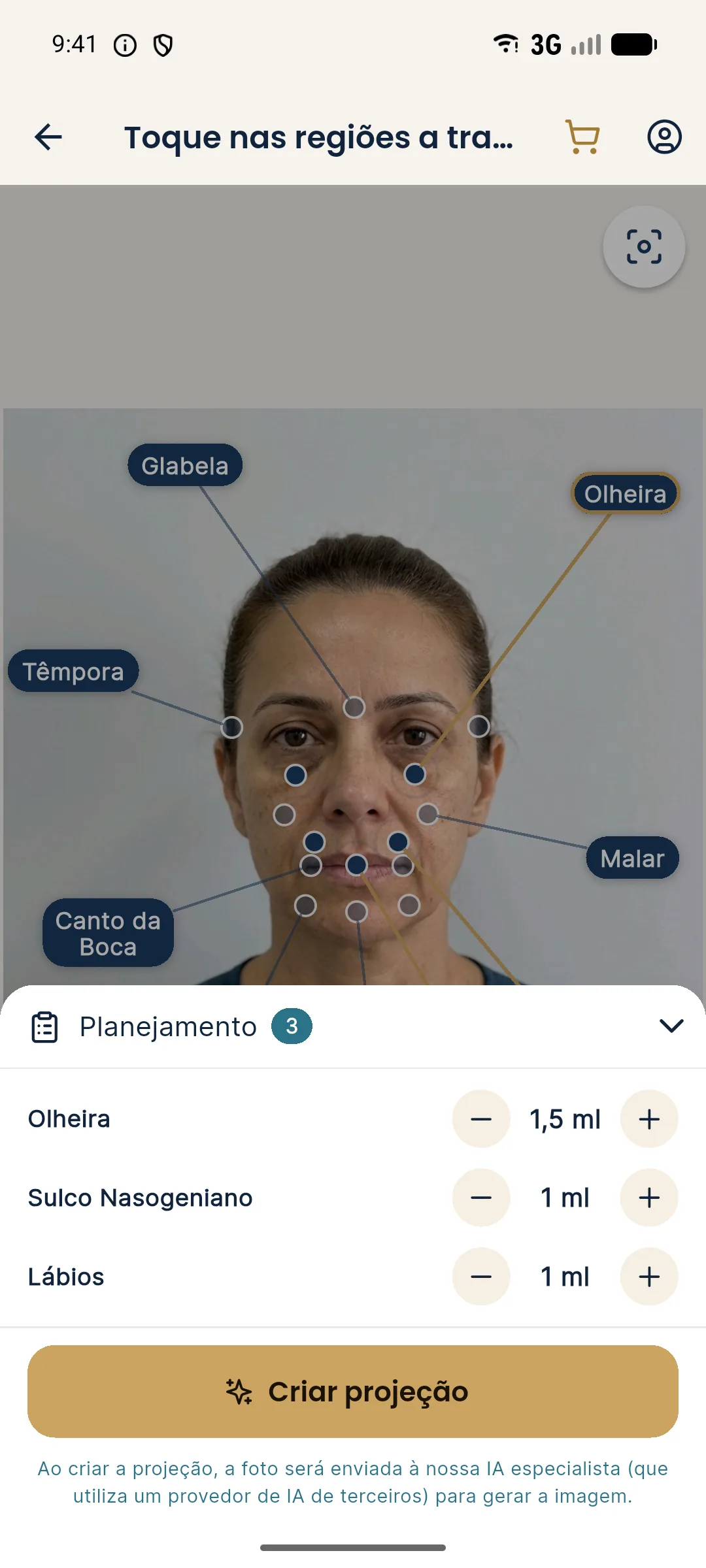
The simulation shows only the frontal view and only what was marked. It does not show product duration or wear. Use the image to talk about shape, and keep the calendar in your own records. For the patient who compared follow-up photos, see alignment errors when comparing photos.
How do you explain the calendar to the patient?
The patient understands better when the calendar becomes a simple story: what to expect from each phase and why they come back. Avoid presenting a long agenda of dates, because that sounds like a return contract, and prefer presenting the year as three or four conversations.
Points that help:
- Say that maintenance is an assessment, and that it may result in "do", "wait", or "adjust".
- Explain that different products behave in different ways, without going into technique.
- Show the starting photo and the current one in the same consultation, so they see what really changes.
- Agree on how they can contact the clinic if something looks different between follow-ups.
It is also worth addressing costs transparently. If the annual plan has several stages, present an estimate per stage and make clear that each will be confirmed at the reassessment. To organize prices per ml, see pricing per ml.
Every product, volume, and frequency is a decision for the qualified professional, after assessment, and the simulation is illustrative.
Frequently asked questions
Do toxin, filler, and biostimulator have the same maintenance frequency?
No. Each has its own rhythm, which varies with the product, the area, and the patient. That is why the plan works with reassessment, not with a fixed date.
Can follow-ups be combined into a few consultations a year?
Often yes. Grouping reassessments reduces the patient's trips, as long as each approach is decided by need and not by the schedule.
Which product is usually reassessed most often?
Toxin tends to have a shorter cycle than fillers and biostimulators, but the real interval depends on the patient. The reassessment decides.
Does Harmy help plan maintenance?
The app keeps the history by patient and has the Maintenance shortcut, with lips, nasolabial fold, and cheekbone at Subtle, for simulating. You keep the product calendar outside the app.
Harmy images are illustrative simulations generated by AI from the patient's photo to support the conversation between practitioner and patient. They are not a promise of results. Indication, technique, product and volume are solely the decision of the licensed practitioner. This content is for information only and does not replace a clinical assessment.