
Maintenance after five years of HOF: a global reassessment

Quick facts
- Topic
- Global reassessment of a patient with a long history of facial harmonization
- Central question
- What the face needs today, not what was done five years ago
- First step
- Gather the history and the starting photo before any decision
- Care
- Repeating the old plan without reviewing the whole leads to excess
Five years of facial harmonization are not five years of a plan. They are, almost always, a sequence of decisions made at different moments, sometimes by different practitioners, with different products and concerns that have changed. When the patient arrives asking for "one more touch-up", the risk is treating the concern of the day without looking at what has accumulated. The global reassessment is the consultation that prevents this.
This page proposes a routine for the patient with a long history: what to gather, what to observe, how to decide between keeping, reducing, or stopping, and how to record the new plan. For the aging of the result itself, see aging of facial harmonization results.
What should you gather before the consultation?
The reassessment begins before the patient sits down. Without a reliable history, any decision is a guess. It is worth gathering as much as possible of what was done, even if part of it comes from the patient's account.
If the patient has no photos, today's photo becomes the new baseline. See the patient's old photo as a reference and plan diary: session-by-session progress record.
How do you do the global reading of the face?
Unlike the first consultation, here the face already has a history. The eye needs to separate three things: what is the effect of natural aging, what is the effect of previous treatment, and what is the patient's perception.
- Structure: bone, support of the middle third, and underlying support. See facial skeleton before injecting.
- Soft tissue: skin, fat, volume remaining from previous treatments.
- Proportion: relationship between thirds and areas. Has some area gained a prominence it did not have?
- Expression: does the face in motion keep its naturalness?
- Concern: what bothers them now, and why.
The reading in a fixed order is in facial analysis in facial harmonization: step by step.
What to decide: keep, reduce, or stop?
For each area, the question is the same, and the answer may differ.
| Situation | Reading | Possible path to discuss |
|---|---|---|
| Area with a stable, harmonious result | The old plan still works | Keep, with an assessed interval |
| Area with signs of excess | Accumulation or volume that no longer fits | Pause and reassess, consider reducing |
| Area with loss of effect | The result is already gone | Reassess the need, do not repeat by reflex |
| Area new to the concern | Change in the face or in priorities | New plan, with a follow-up to adjust |
| Area with no concern and no indication | Can continue without treatment | Do not include out of habit |
Two mistakes appear often. The first is repeating the protocol from last time just because it worked. The second is treating only today's concern without noticing that the whole has lost balance. In both cases, the order of the plan is in what to treat first in facial harmonization: priority criteria.
How do you talk to the patient who wants "just a touch-up"?
A touch-up request often hides a larger concern. Ask what has changed in the mirror since last time and what they see today. Show the starting photo and the current one side by side. In many cases the conversation shifts from "more" to "adjust" or "wait".
The conversation about expectations is the same as in any plan: no promise of results. See explaining that a simulation is not a guarantee and adjusting the plan based on patient feedback.
How does Harmy fit into the reassessment?
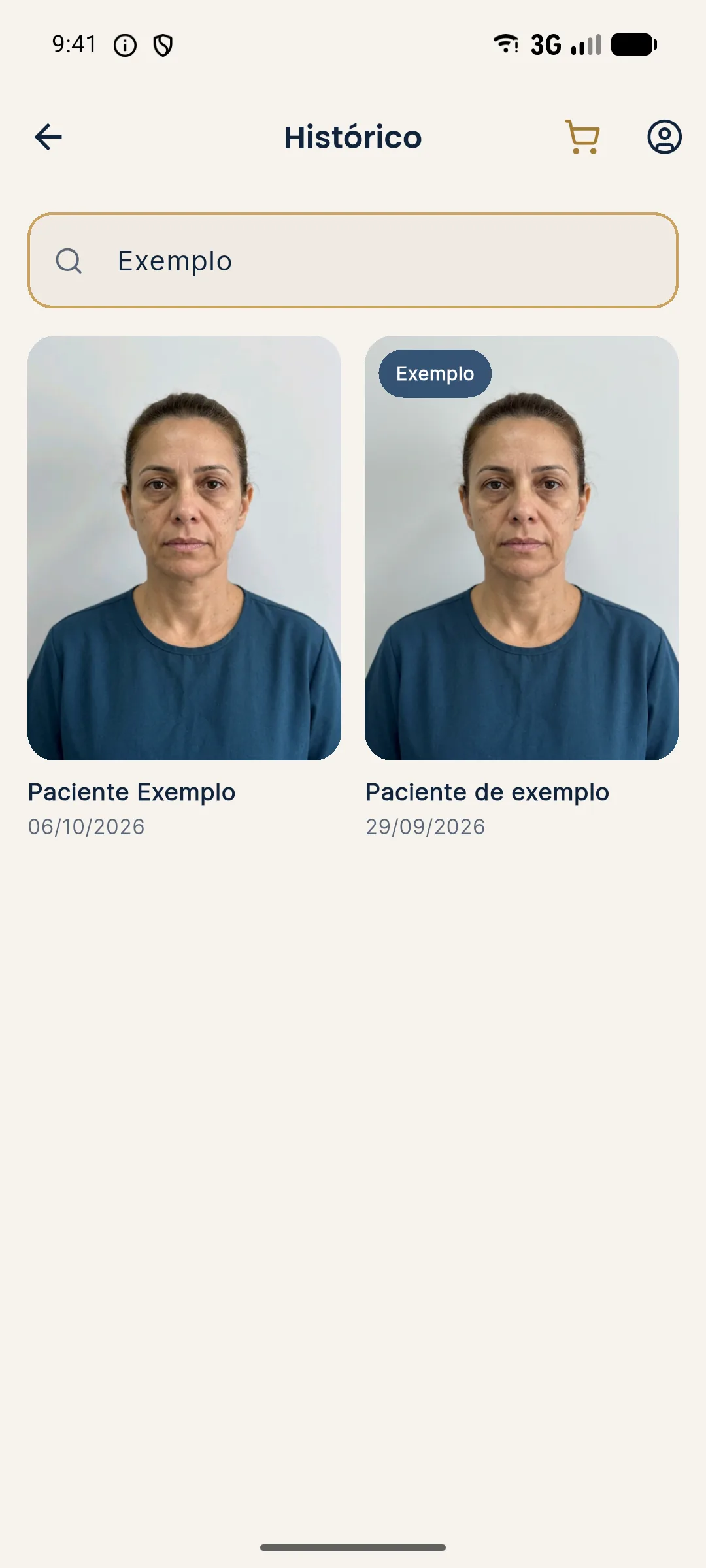
The app's History keeps the sessions by patient. The old photo from a session helps to talk about progress. For the new plan, you create a new projection from a current frontal photo: the app detects the face on the device, shows the labeled points, and you mark the areas, the ml (0.5 ml step), and the intensity (Subtle, Moderate, or Pronounced).
The projection starts from today's photo and shows only what was marked. It does not "go back in time" or remove previous material, and it is important to tell the patient this. It is also only the frontal view. The "Maintenance" shortcut brings lips 0.5 ml, nasolabial fold 1 ml, and cheekbone 1 ml, all at Subtle, but it is a starting point, not a prescription. To compare photos rigorously, see comparing projection and actual result.
How do you record the new long-term plan?
A long-term plan is not a list of sessions but a revisable direction. Record, in a few lines:
- The observable goal for the next year, without promising results.
- The areas that stay under observation without intervention.
- The areas where there is an intention to treat and the conditions for it.
- The reassessment interval and what will be observed.
- What the patient understood and accepted, in writing.
To align the cycles of different products throughout the year, see maintenance of toxin, filler, and biostimulator through the year.
Product, volume, and frequency are decisions for the qualified professional, according to the rules of their professional council. The simulation is always illustrative.
Frequently asked questions
What should be reassessed in someone who has had facial harmonization for five years?
The face as a whole: products already used, accumulated volumes, skin quality, current proportions, and today's concern. The starting photo and the history guide the conversation.
Should I repeat the same plan from years ago?
Not by reflex. The face has changed, and the old plan may no longer make sense. Reassess area by area and decide what to keep, reduce, or suspend.
Is there a limit to the accumulated ml in the face?
There is no universal number. What matters is the whole: proportion, skin, signs of excess, and the patient's perception. The decision belongs to the professional, after assessment.
How does Harmy help with long-term reassessment?
History keeps the sessions by patient along with the starting photo. You can generate a new projection from the current photo to talk about what to adjust. The image is illustrative.
Harmy images are illustrative simulations generated by AI from the patient's photo to support the conversation between practitioner and patient. They are not a promise of results. Indication, technique, product and volume are solely the decision of the licensed practitioner. This content is for information only and does not replace a clinical assessment.