
Facial Analysis in Facial Harmonization: Step by Step

Quick facts
- Steps
- Complaint, medical history, photos, static reading, dynamic reading, layers, priorities and plan
- Principle
- Observe before deciding and record the reasoning, not just the outcome
- Output of the assessment
- Prioritized list of areas, observable goals and what is left out
- Useful time
- Enough not to skip steps, with no rush to close the plan
A good facial analysis in facial harmonization looks simple from the outside and is methodical on the inside. It follows a sequence that protects you from two opposite mistakes: deciding too fast from the complaint, and getting lost in measurements the patient never asked for. The order of the steps matters because each one feeds the next: the complaint guides the photos, the photos guide the reading, the reading guides the priorities.
This page gathers the sequence in eight steps, what to record in each and the points where the assessment tends to fail. Each step has a deeper page, linked throughout the text, so you can go further into what fits your routine.
Step 1: what does the patient want?
Start with the open question: "what brought you here?". Write down the exact words, without translating them into technical terms. The stated complaint ("I look tired") is different from the request for a procedure ("I want to fill the dark circle"), and the assessment serves to find out whether one leads to the other. Also ask what the patient does not want to change, since the identity of the face is part of the plan. See facial identity: how to preserve it.
Step 2: what must the medical history cover?
The medical history comes before the photos, for safety: some answers change or postpone the plan. Cover diseases, allergies, medications (including anticoagulants and supplements), pregnancy and breastfeeding, history of herpes, previous procedures and products used, when the patient can say. The full list of situations that call for caution is in general contraindications in facial harmonization, and the question script is in medical history in facial harmonization.
Step 3: how to standardize the photos?
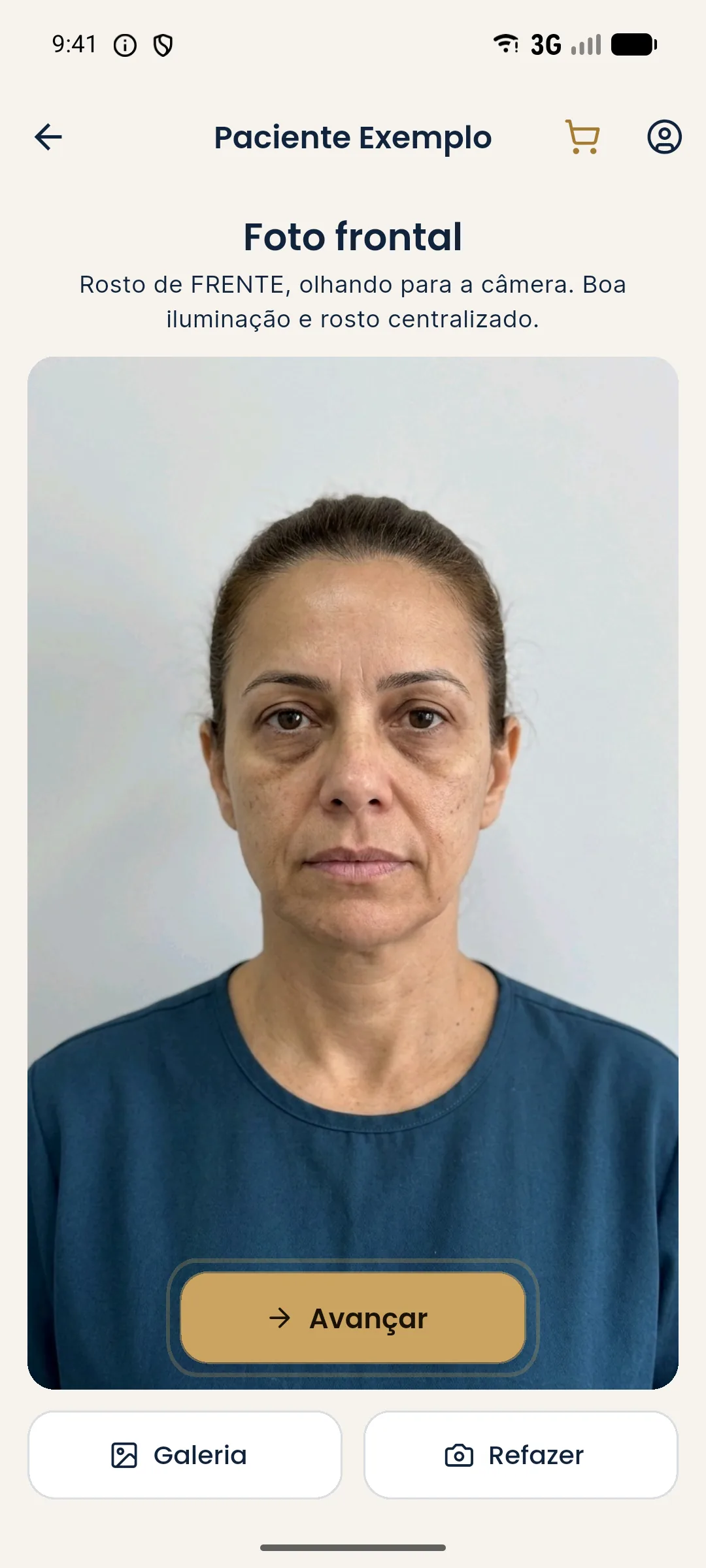
Photograph before interpreting. The standardized photo becomes the basis for reading, planning, comparison and the patient record. The minimum is the frontal view with a neutral expression, soft frontal light, a plain background, the camera at face height and a fixed distance. Many clinics add three-quarter and profile. Details are in standardized clinical photography, neutral expression in the planning photo and makeup and beard in the planning photo.
Step 4: what to read in the face at rest?
The static reading organizes the face by thirds: upper, middle and lower, looking at proportion, symmetry, volume and contour. Follow a fixed order so you do not skip areas. The guide is frontal facial analysis: checklist, complemented by facial assessment by thirds. If needed, reference lines help, as in reference lines on the frontal photo.
A rule of common sense applies here: perfect symmetry does not exist and is not the goal. See perfect symmetry is not the goal and how to measure facial symmetry. What matters is the asymmetry the patient perceives or that gets in the way of the plan.
Step 5: what changes when the face moves?
Ask for simple movements (raising the brows, frowning, smiling, speaking) and observe. What does not appear at rest appears here: compensations, asymmetries of strength, dynamic lines. The script is in dynamic facial analysis in expression and the difference between rest and motion in face at rest vs. in motion.
Step 6: where is the cause, in which layer?
Every visible complaint has a cause in some layer of the face: bone, deep fat, ligaments, muscle or skin. A fold can come from loss of bone support, fat descent or muscle action. Treating the fold without understanding the layer is treating the symptom. See treating the fold or the cause of the fold and facial skeleton before injecting. For reasoning by age, facial analysis at 40 and at 50.
Step 7: how to prioritize?
With everything read, prioritization follows: what brings the greatest visual impact, what has the lowest risk, what the patient's budget allows, what depends on something else. The order is not the order of the complaint but of clinical logic. Supporting pages: prioritize by visual impact, prioritize by risk, prioritize by the patient's budget and what to treat first in facial harmonization.
Step 8: how to close the plan and the record?
The final plan contains observable goals, order, volume range per area, estimated number of sessions, explained risks and consent. Also record what was proposed and declined. See what to include in the written treatment plan and facial treatment plan form: fields. Hyaluronidase must be available whenever the plan involves hyaluronic acid, and every indication of product, volume and technique belongs to the licensed professional, according to the rules of their professional council.

Where does the assessment tend to fail?
| Failure | Consequence | How to avoid it |
|---|---|---|
| Deciding before photographing | Plan based on memory | Standardized photo first |
| Skipping the dynamic reading | Lines and asymmetries come as a surprise | Fixed movement script |
| Treating the symptom | The fold returns, excess volume | Think by layer |
| Accepting the request without questioning | Plan that does not solve the complaint | Compare complaint and findings |
| Not recording what was declined | Noise at follow-up | Complete patient record |
| One large session | Excess and risk | Conservative volume and stages |
Frequently asked questions
What is the order of a facial analysis in facial harmonization?
A usual sequence is to listen to the complaint, take the medical history, standardize the photos, read the face at rest and in motion, think in layers, set priorities and only then build the plan. The order may vary by practice.
What should be recorded at each step of the assessment?
The complaint in the patient's words, risk factors, standardized photos, static and dynamic findings, asymmetries, hypotheses by layer, priorities, and what was agreed and declined.
Can I start with the procedure and assess later?
That is not recommended. The assessment defines whether there is an indication, which area comes first and which precautions apply. Skipping steps raises the risk of a wrong plan and dissatisfaction.
Where does Harmy fit in facial analysis?
After the clinical assessment, in the visual conversation with the patient. From a frontal photo, it projects the subtle effect of the planned ml in the marked areas, as support and not as a diagnosis.
Harmy images are illustrative simulations generated by AI from the patient's photo to support the conversation between practitioner and patient. They are not a promise of results. Indication, technique, product and volume are solely the decision of the licensed practitioner. This content is for information only and does not replace a clinical assessment.