
Frontal Facial Analysis: Checklist of What to Observe
Quick facts
- Goal
- Read the frontal view in a fixed order, without skipping areas or getting stuck on detail
- Prerequisite
- Standardized frontal photo, with a neutral expression and the head in the Frankfurt plane
- Reading order
- Thirds, midline, fifths, gaze, nose, mouth, chin and contour
- Golden rule
- A measurement is a question, not a goal; the relevant asymmetry is the one the patient perceives
The frontal view is the most used in facial harmonization, and the most misleading. It is where symmetry, proportions and contour show up, but it is also the view in which a slightly tilted head, side lighting or a faint smile create differences that do not exist in the face. That is why the checklist starts with the photo and only then moves to the reading.
This page offers a reading order in checklist form, from the most general to the most specific: thirds, midline, fifths, gaze, nose, mouth, chin and contour. For the full assessment sequence, see facial analysis in facial harmonization: step by step. For the profile and the oblique view, see profile facial analysis and three-quarter facial analysis.
How to make sure the frontal photo is reliable?
Before interpreting, check the photo. If it fails, any reading becomes noise.
The influence of lens and distance is in distance and lens in the assessment photo, and that of hair, earrings and glasses in hair, earrings and glasses in the assessment photo. Digital rulers and lines help, as in reference lines on the frontal photo and digital rulers and scale in the photo.
What to look at in the three thirds?
The face divides into the upper third, from the hairline to the glabella, the middle third, from the glabella to the base of the nose, and the lower third, from the base of the nose to the chin. The theoretical ideal is similar thirds, but real faces vary and can still be harmonious. Use the division to locate a disproportion, not to impose equality.
| Third | What to look at | Reading questions |
|---|---|---|
| Upper | Forehead height, hairline, brows | Is the forehead high or low? Is the brow symmetric and in the expected position? |
| Middle | Eyes, cheekbone, nose, nasolabial fold | Does the midface look flat, full or descended? Is there a dark circle or shadow? |
| Lower | Lips, chin, jaw | Does the lower lip take the expected proportion? Does the chin have projection and width? |
See more in facial assessment by thirds, short or long upper third, midface disproportion from excess and lower third larger than the middle.
The midline and symmetry
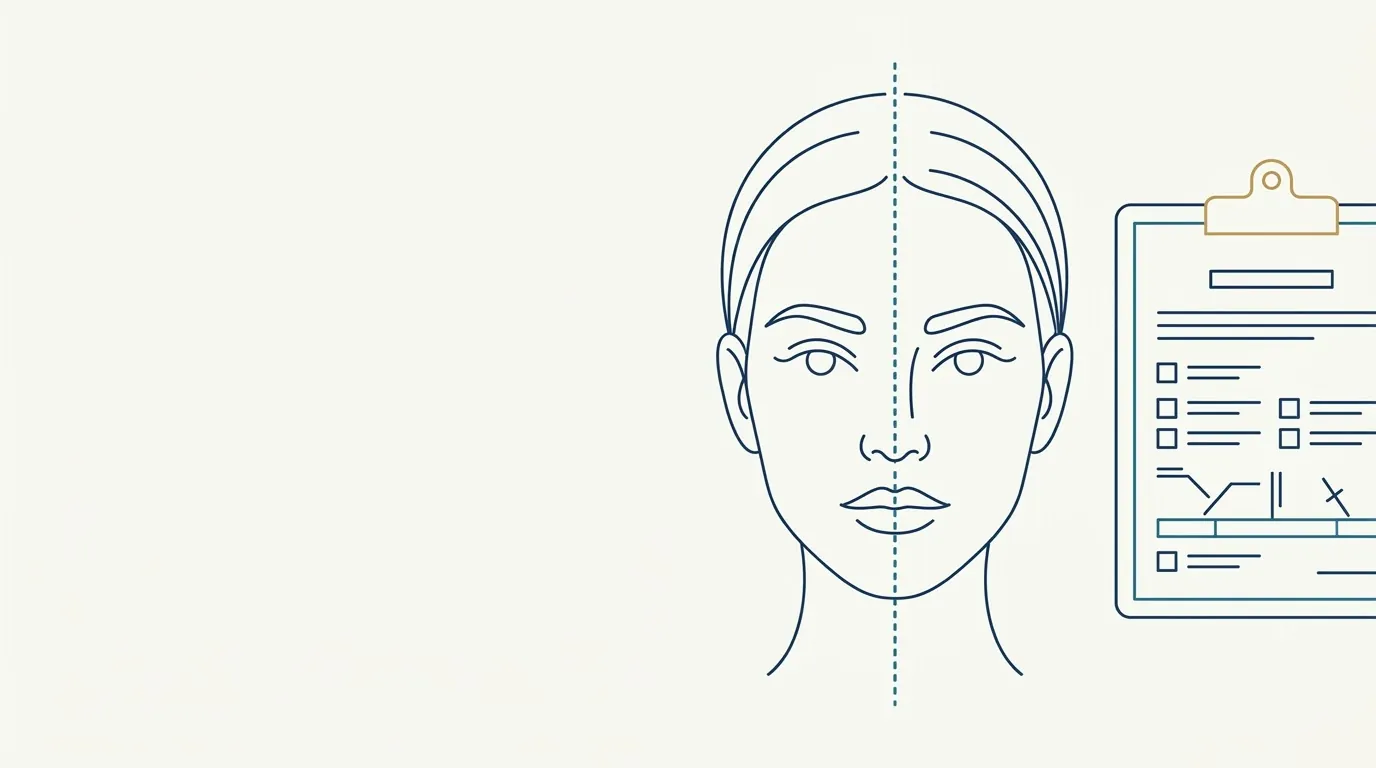
Draw a vertical line from the middle of the forehead to the middle of the chin and observe the facial midline. Note where the nose, philtrum, central incisors and chin line up. A deviation of the nose, chin or smile changes the plan, and the patient rarely notices their own deviation until it is pointed out.
Two ideas avoid traps. First, facial asymmetry is universal: the human face has differences between sides, and the goal of perfect symmetry is unrealistic, as discussed in perfect symmetry is not the goal. Second, not every asymmetry is soft tissue: part comes from the skeleton, and injecting over misaligned bone does not solve it. See how to measure facial symmetry, midline deviation: how to plan and plan for an asymmetric face.
Rule of fifths, eyes and brows
The rule of fifths divides the width of the face, edge to edge, into five equal parts, with each eye taking one and the space between the eyes another. It is a proportion reference, useful for noticing eyes set wider or closer. It is not a goal, since proportions vary between populations, as in facial proportions vary between populations.
Also observe:
- Tilt of the eye corner: a lateral corner slightly above the medial one is usually read as younger. See eye corner tilt and gaze tilt and lateral corner.
- Distance between the eyes: see eye width and intercanthal distance.
- Brow: position, arch and symmetry, in ideal brow position in planning.
- Periorbital area: dark circle, bag and palpebromalar groove, in dark circles: types and assessment.
Nose, mouth and chin
On the nose, assess the width of the base relative to the distance between the eyes, the alignment of the dorsum and the symmetry of the nostrils. On the mouth, observe the lip proportion (the lower lip generally a little larger than the upper), the cupid's bow, the symmetry of the corners and the position of the corners relative to the line of the mouth. See asymmetric lips: assessment and thin lip: assessment.
The chin deserves a frontal look for width, symmetry and midline position. Projection, however, can only be read from the profile. See plan to project the chin.
Contour, jaw and silhouette
Finish by looking at the silhouette: from the angle of the jaw to the base of the chin, the facial contour forms a shape (oval, round, triangular, square, heart, long) and a more or less defined jawline. The silhouette guides the volume plan: more width in the midface, for example, changes how the face is perceived. See planning an oval face, round face, triangular face, heart-shaped face and long face.
And Harmy in the frontal view?
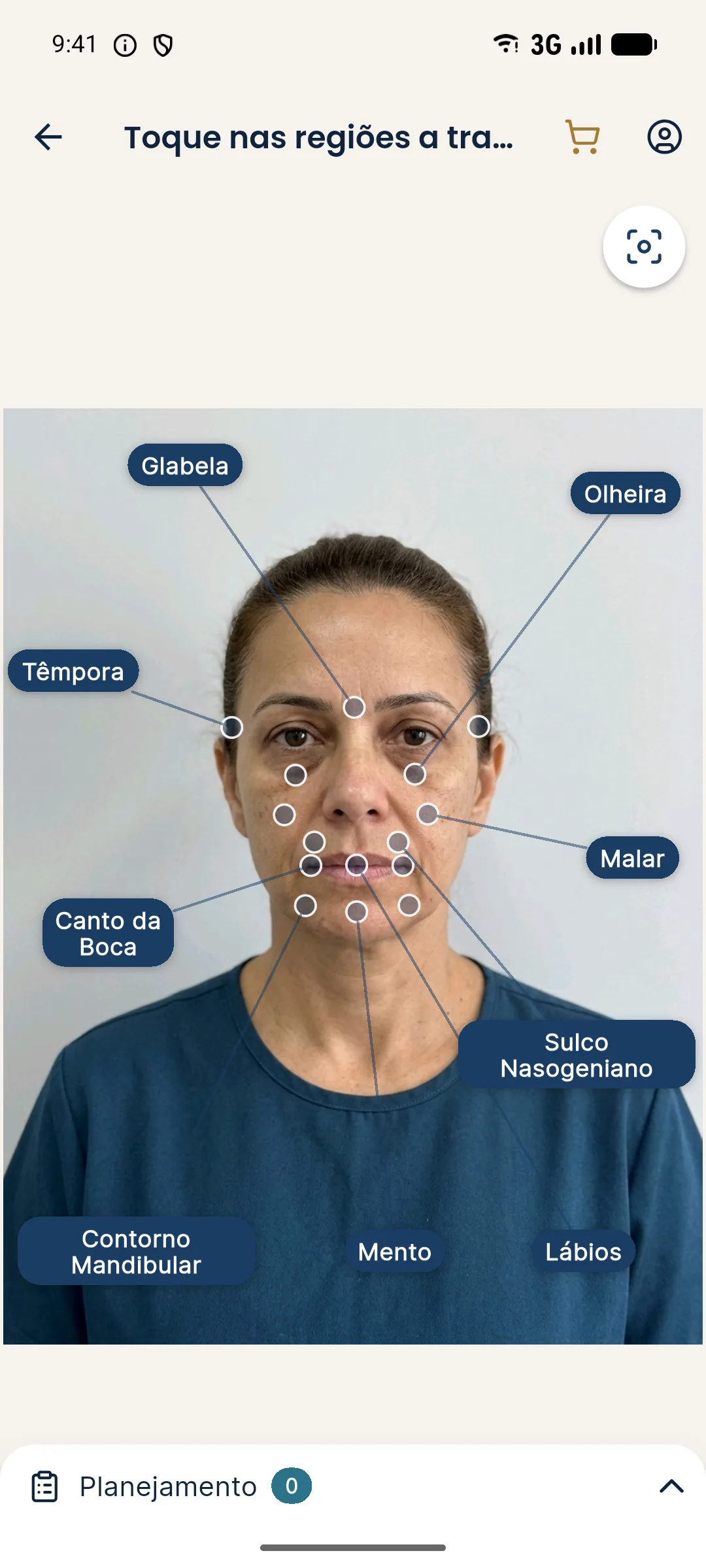
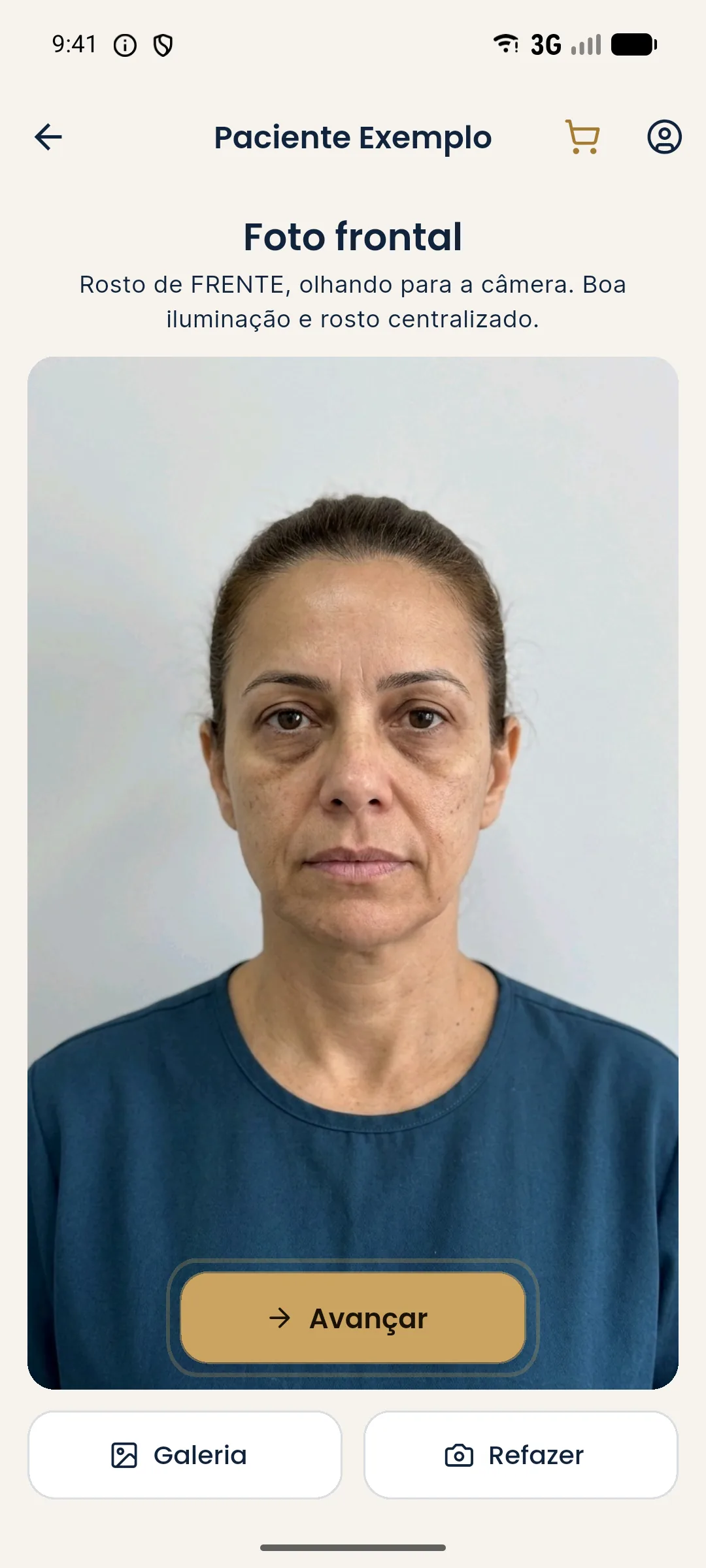
The clinical reading comes first and is yours. The projection comes afterward, as support for the patient to see the subtle effect of the plan. It is illustrative, not a promise of results, and works only on the frontal view.
Every indication of product, area and volume is the decision of the licensed professional, according to the rules of their professional council.
Frequently asked questions
What should be observed in frontal facial analysis?
The three thirds, the midline, the rule of fifths, the tilt of the gaze, the width of the nose, the proportion of the lips, the position of the chin and the contour of the jaw, in a fixed order.
What is the rule of fifths?
It is the division of the face width into five parts, where each eye takes one fifth and the space between the eyes another fifth. It serves as a reference, but it is not a goal, and it varies between populations.
Does every asymmetry need to be corrected?
No. Every face has some asymmetry, and perfection is not a goal. Treat only what bothers the patient or harms harmony, after explaining the causes.
Does the frontal photo need to be standardized for the analysis?
Yes. A level head, neutral expression, soft frontal light and a fixed distance prevent tilt or shadow from creating asymmetries that do not exist.
Harmy images are illustrative simulations generated by AI from the patient's photo to support the conversation between practitioner and patient. They are not a promise of results. Indication, technique, product and volume are solely the decision of the licensed practitioner. This content is for information only and does not replace a clinical assessment.