
Planning Facial Harmonization for an Oval Face: Keep vs Adjust
Quick facts
- Characteristic
- Balanced proportions, forehead and jaw of similar width, slightly larger cheekbones
- Main risk
- Overdoing it on a face that is already balanced
- Usual strategy
- Keep what works and treat only specific concerns, with restraint
- Warning sign
- The patient asks for a change without a concrete concern
The oval face is the one the manuals treat as "ideal": forehead and jaw of similar width, slightly wider cheekbones and a lower third that tapers without points. Precisely because it is close to the standard, it is the shape where overdoing it is the most common mistake. The patient arrives wanting to "improve", and the professional, with no objective concern, starts looking for something to change.
What does being "close to the standard" mean?
It means the base is balanced, not that there is no concern. An oval face also ages, loses volume in the midface, and has asymmetries, folds and dynamic wrinkles. What it usually lacks is a structural imbalance of shape. See the glossary entry on oval face and, on why the oval is taken as the reference, neoclassical canons of the face.
The point is to remember that "reference" is a cultural convention. Average beauty and attractiveness are discussed in average beauty and facial attractiveness, and neither is a prescription.
When should the plan be minimal?
On an oval face, the minimal plan is often the best plan. Three situations where restraint is the rule:
- A young patient with no concrete concern. They ask for "a touch" because of a social media reference.
- A symmetrical, proportional face. Any new volume shifts a balance that already existed.
- A patient who has already had procedures. The risk of piling on is high, and the oval face is the one that "loses its grace" the most when overdone.
What can actually be adjusted?
| Possible concern | Area | Note |
|---|---|---|
| Midface volume loss with age | Cheekbone | Restraint, assess compartments |
| Line between the eyebrows | Glabella | Toxin, at the professional's discretion |
| Thin lips or lacking definition | Lips | Proportion with the rest, moderate volume |
| Mild asymmetry | Area depending on assessment | Explain that perfect symmetry does not exist |
| Pronounced folds | Nasolabial fold | Assess the cause before filler |
Each row in this table must come from the patient or from your assessment, not from the shape. The reasoning of prioritizing the essentials appears in what to treat first in facial harmonization, and that of preserving identity in facial identity: how to preserve it.
How does the simulation fit in?
On an oval face, the simulation serves two purposes. The first is to restrain: show that a small volume already changes how the face reads, and that a large volume strips it of character. The second is to compare: see the difference between Subtle, Moderate and Pronounced in a chosen area.
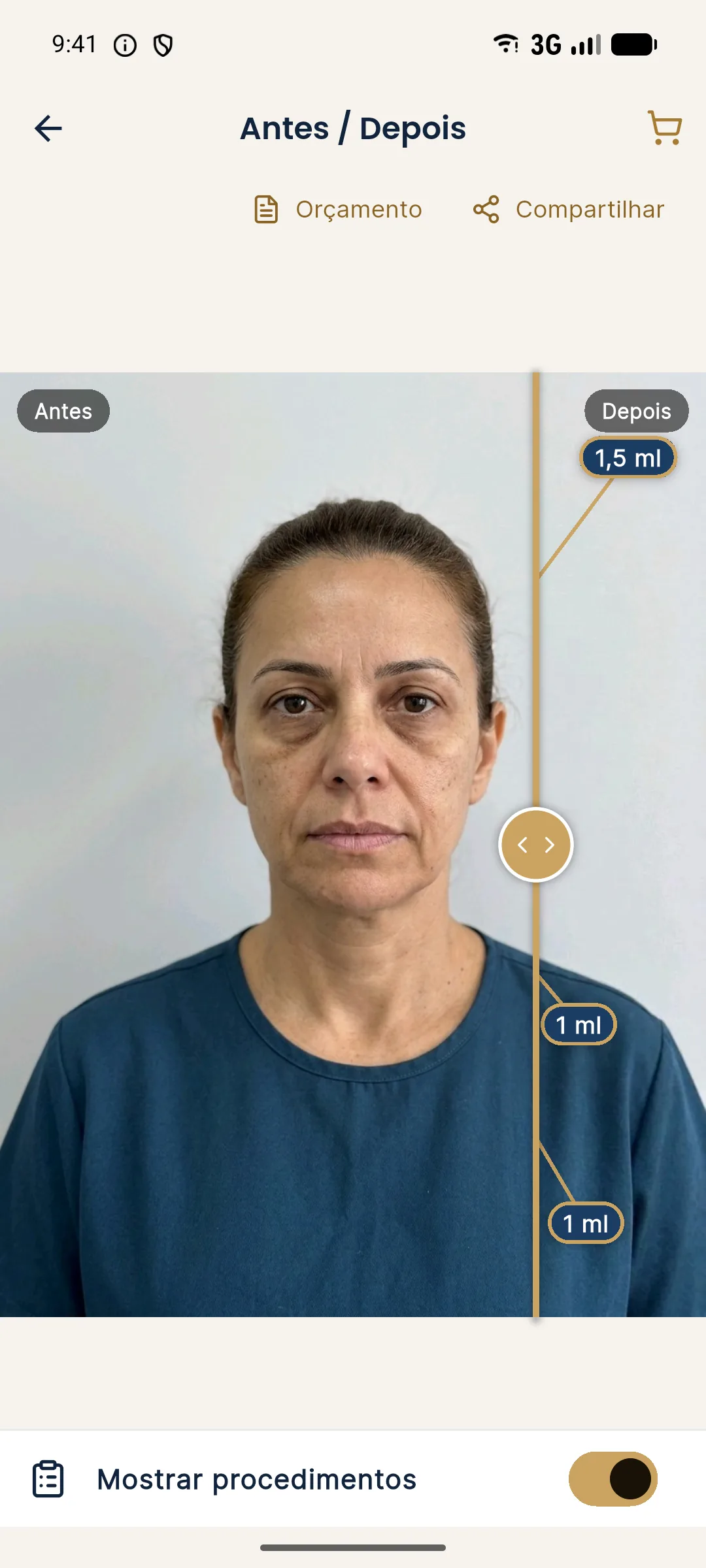
Watch out for bias: the more balanced the face, the "prettier" the simulation can look, because little changes. That does not mean the patient needs the procedure. The honest conversation includes saying "your face is already balanced". See ethics of result simulation.
How do you say "you don't need it" or "just a little"?
This is the hardest and most valuable part. A patient with an oval face and no objective concern should hear clearly that the plan can be minimal, or that there is no indication.
If the patient insists on changes without a concern, review the motivation. In some cases the request comes from dissatisfaction with self-image, a topic covered in dysmorphia and the wish to change the face and in facial harmonization plan and patient mental health. See also how to tell a patient they do not need a procedure.
What about maintenance?
On an oval face, the long-term strategy is usually preventive and low intensity: follow the aging, treat dynamic wrinkles when they bother the patient and reassess the midface every year. The long-term view is in patient timeline in facial harmonization.
How do you avoid the mold effect on an oval face?
Since the oval is taken as the reference, there is a tendency to use it as the target for every other shape. The effect is a series of patients with different shapes who end up looking alike. On a true oval face, the risk is the opposite: because it is already close to the target, it gets little, and the professional compensates with more volume than needed.
One way to protect yourself is to keep a critical eye on your own cases: periodically review what you did on already balanced faces and ask how much product actually changed how the face reads. Almost always, the answer is "less than I used".
What can be "good enough" without treatment?
Accepting that the face is fine is a clinical skill. Saying "your face is harmonious" is not losing a patient; it is building credibility. Many patients come back precisely because you did not push them into an unnecessary procedure. See my face is already pretty, why do it.
What about an oval face with asymmetry?
Every face has asymmetry, the oval included. The question is whether the asymmetry bothers the patient and whether it can be corrected safely. Before proposing a correction, measure and show that the asymmetry is natural, as in natural facial asymmetry. In many cases, the conversation resolves the concern with no injection at all. When correction is indicated, it is usually targeted, with low ml and reassessment.
Practical summary
On an oval face, the central question is "what is the concern?". If there is one, treat it with restraint; if there is not, say that the face is balanced. Use the simulation to restrain, not to sell, and record the decision not to treat, when that is the case, as part of the care.
Frequently asked questions
Does an oval face need facial harmonization?
Not necessarily. The shape is considered balanced, but the indication depends on the patient's concern, asymmetries, age and aging. Often the best plan is a small one.
What can be adjusted on an oval face?
Specific points, such as midface volume loss with age, lip contour, folds or dynamic wrinkles, always based on a concern and an assessment.
Why is the oval face seen as the reference?
Because its proportions come close to those used in classical beauty manuals. That is a convention, not a rule: many harmonious faces have other shapes.
Does the simulation help on an oval face?
It helps, mainly to show that a small volume already changes how the face reads and to rein in exaggerated requests. It is always illustrative.
Harmy images are illustrative simulations generated by AI from the patient's photo to support the conversation between practitioner and patient. They are not a promise of results. Indication, technique, product and volume are solely the decision of the licensed practitioner. This content is for information only and does not replace a clinical assessment.