
Average Beauty and Facial Attractiveness in Planning

- Nerve
- Highlighted area
Quick facts
- Concept
- The average face is the mean of a group's proportions; it is not the ideal face
- Use in the plan
- Proportions serve as a reading guide, not as a target to hit
- Pitfall
- Standardizing faces and erasing the patient's identity
- Alternative
- Plan from the patient's concern, the harmony of the whole face and the identity of the face
Every facial harmonization professional learns early to look at the face in thirds, in fifths, in angles. Those tools are useful and give a common language. The risk is forgetting that they describe tendencies, not a face everyone should have. When the plan becomes an attempt to bring the patient closer to a mold, you get the faces that "look like they were done by the same professional."
This page discusses the concept of average beauty, the real role of attractiveness, how to use proportions with judgment and how to protect the patient's identity in the plan. For the reading tools, see facial assessment by thirds and facial analysis in facial harmonization: step by step.
What is average beauty?
The idea of the average face comes from the observation that the result of combining many faces tends to be perceived as balanced and pleasant. In other words, the "average face" is a mean of a group's proportions. That does not mean it is the most beautiful, nor that it is the only possible model.
Three points prevent misuse of the concept:
- Average is not ideal: it describes what is frequent, not what is desirable.
- The group matters: the average of one population does not represent another, and changing ancestry changes the references.
- Striking faces tend to depart from the average: distinctive features, well integrated, are part of what makes a face attractive.
Is attractiveness only proportion?
No. Facial attractiveness is perceived through a set of factors that includes proportion, skin, expression, apparent health, context and culture. Proportion is one component, and often not the strongest. Good skin quality and a pleasant expression weigh on the impression as much as the distance between the eye and the mouth.
For the plan, this has a practical implication: treating proportions alone leaves out what the patient usually notices first. See facial analysis at 50 for the role of skin quality.
And symmetry?
Perfect symmetry is rare and, when it shows up in composites, tends to look strange. The human eye accepts, and even appreciates, small differences between the sides. What bothers people is a difference that pulls the center of attention, such as a drooping mouth corner on one side or an eyebrow much higher than the other.
For this reason, the goal of the plan is usually to reduce the asymmetry that bothers, not to eliminate it. See new asymmetry during the plan for the topic in practice.
Which proportions are useful as a guide?
| Reference | What it describes | How to use it | Limit |
|---|---|---|---|
| Facial thirds | Relationship between forehead, midface and lower face | Reading vertical imbalance | Hair and dentition interfere |
| Rule of fifths | Face width in five equal parts | Reading width and the space between the eyes | Varies with ancestry |
| Facial midline | Reference axis of the face | Align nose, philtrum, chin | Mild deviation is common |
| Lip proportion | Relationship between upper and lower lip | Guide lip volume | Not a rigid rule |
| Profile angles | Projection of nose, lips and chin | Reading the lateral view | Ranges vary by sex and ancestry |
Use the table as a map, not as a list of goals. If the patient falls within every range and still wants to change something, their concern is the compass. If they fall outside several and like their face, the same applies.
How do you avoid the standardized face?
The standardized face is born when the professional applies the same "mold" to everyone: the same cheeks, the same contour, the same lips. The feeling that "everyone ended up looking alike" is a sign that the plan followed the formula and not the patient.
What do you do in practice with all this?
A simple sequence helps keep proportions as a guide and not as a law.
The idea of a few well-chosen areas fits with the way Harmy works. See marking fewer areas produces better projections.
Where does Harmy fit in this conversation?
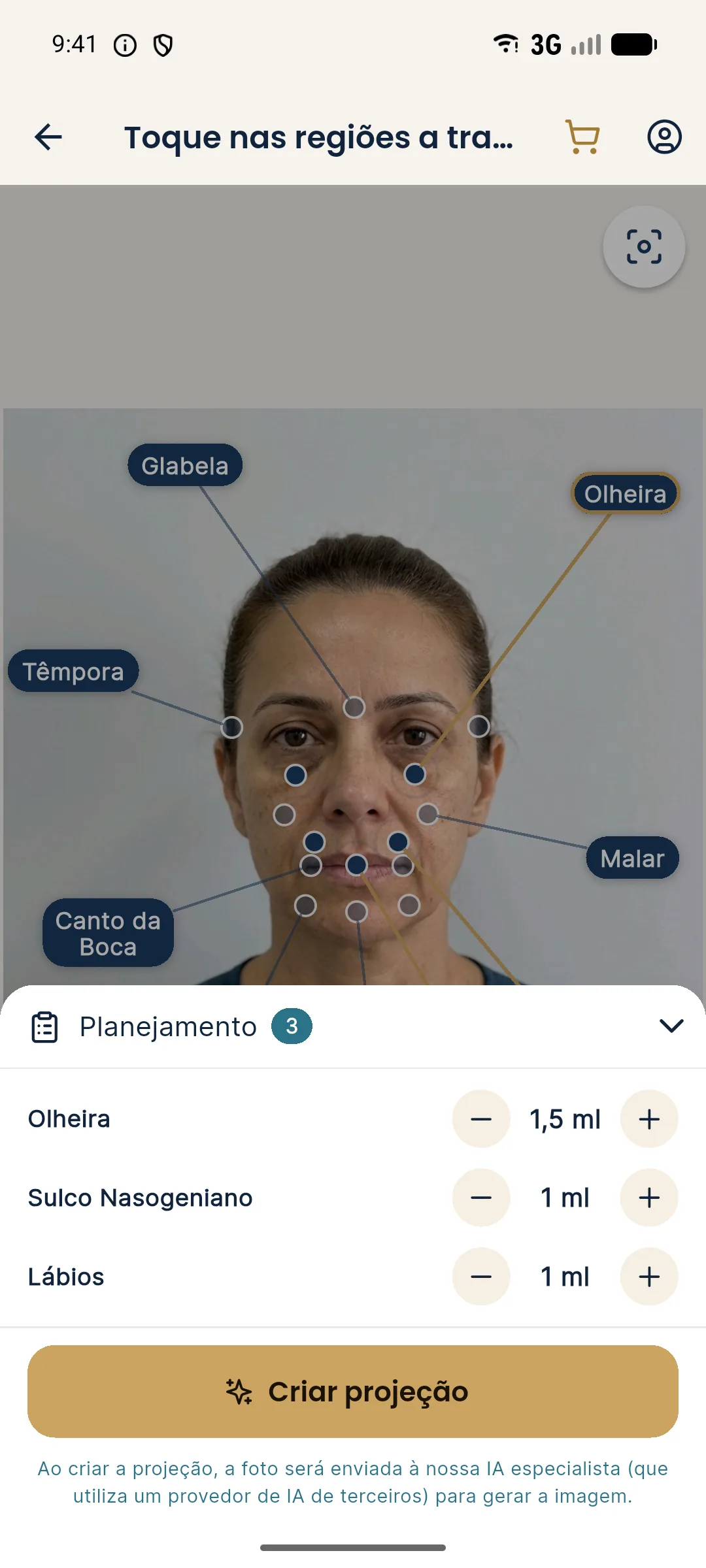
In Harmy, the projection respects the marked volume and changes only the chosen areas, without altering makeup, hair, expression or background. That is why the changes are subtle and realistic, which helps keep the conversation about the patient's identity. Subtle, Moderate or Pronounced intensity lets you show different paths for the same area.
How do you talk to the patient about beauty and standards?
Avoid phrases like "your face needs" or "the right thing would be." Prefer "one option would be" and "what do you think." The patient feels like a participant, and the plan gains buy-in.
Common mistakes
- Treating the average as a goal and applying the same mold to everyone.
- Using measurements from one ancestry to assess another.
- Chasing perfect symmetry.
- Ignoring skin, expression and context when reading attractiveness.
- Suggesting procedures the patient did not ask for just because they are "outside the average."
Frequently asked questions
What is average beauty in facial harmonization?
It is the idea that faces close to the average proportions of a population tend to be read as balanced. It serves as a reading reference, but it does not define what is beautiful or what should be done.
Is facial attractiveness the same thing as symmetry?
No. Symmetry contributes to the perception of balance, but faces with small differences between sides are often attractive. Chasing perfect symmetry tends to produce an artificial-looking face.
Can I use measurements and proportions to plan treatment?
Yes, as a guide. Measurements such as thirds and fifths help organize the reading, but they vary with ancestry, sex and age. The final decision considers the patient's concern and identity.
Is beauty the same in all cultures?
No. Aesthetic preferences vary with era, culture and context. That is why the plan should not impose a single standard, but start from what the patient wants and what is safe for their face.
Harmy images are illustrative simulations generated by AI from the patient's photo to support the conversation between practitioner and patient. They are not a promise of results. Indication, technique, product and volume are solely the decision of the licensed practitioner. This content is for information only and does not replace a clinical assessment.