
New Asymmetry During the Plan: How to Investigate

Quick facts
- Goal
- Investigate an asymmetry that appeared or worsened during the plan
- First step
- Compare with the baseline standardized photo and with the record of what was injected
- Causes
- Swelling, uneven volume, migration, toxin spread, resorption, habit and pre-existing asymmetry
- Rule
- Wait for the swelling to go down before correcting, unless there are warning signs
New asymmetry midway through the plan is one of the situations that most shakes the confidence of both patient and professional. The patient looks in the mirror and sees one side different from the other. The professional wonders whether it was the technique, the product, the swelling or something that was already there. The answer is almost never in the first impression, and the right path is to investigate methodically.
This page proposes a sequence for investigating, separates the most frequent causes, indicates when to wait and when to act, and suggests how to handle the conversation with the patient. The overall safety picture is in safety and complications in facial harmonization.
Every face is asymmetrical: what does that change?
Faces have different sides. Eyebrows, eyes, nostrils, mouth corners and jaw rarely match. Often the patient never noticed, and the procedure, by changing one area, draws attention to what was already there. That is pre-existing facial asymmetry becoming visible.
That is why the starting point is always the baseline photo. Without it, any conversation turns into opinion. The recording routine is in standardized clinical photography and in facial analysis in facial harmonization: step by step.
What are the most common causes?
| Cause | When it usually appears | Clue | General approach |
|---|---|---|---|
| Uneven swelling | First days | One side more swollen, improves with time | Wait and reassess |
| Hematoma | Early days | Bruising, local pain | Observe; assess if there is tension |
| Uneven volume | Right after | Stable difference once the swelling is gone | Add to or adjust according to assessment |
| Product migration or settling | Weeks | Volume shifts or settles | Assess; correct if necessary |
| Different response to toxin | Days to weeks | One side moves more | Touch-up according to assessment |
| Toxin spread | Days to weeks | Eyelid, eyebrow or smile altered | Observe; manage case by case |
| Uneven resorption | Months | One side loses volume first | Reassess and touch up |
| Habit or posture | Any time | Chewing or sleeping on one side | Counsel; investigate |
| Vascular or inflammatory complication | Hours to days | Pain, pallor, warmth, bluish net-like pattern | Emergency |
This table organizes the reasoning; it does not replace the examination. The frequency of each cause varies with the area, the product and the patient.
What should you do before blaming the procedure?
Start with what is documented. A short script prevents hasty conclusions.
That record guides the decision and protects the relationship with the patient. If everything was documented, the conversation stays on facts.
When to wait and when to act?
Most asymmetries in the first days are swelling. Correcting too early is risky: you may add to something that was only swollen and create an excess once it subsides. In general, you wait out the swelling phase before any adjustment, which usually takes from a few days to two weeks, depending on the area and the product.
There are, however, signs that cannot wait.
And when the asymmetry comes from toxin?
With toxin, one side may respond differently from the other because of anatomy, muscle habit or pre-existing asymmetry. The pattern of a lower eyebrow, a crooked smile or a heavy eyelid has to be read carefully. This is investigated once the effect has stabilized, generally within the first 14 days, and is often corrected with an adjustment, at the professional's discretion.
See complications with botulinum toxin and ptosis after botulinum toxin. In both, the key point is not to promise an exact timeline: toxin is temporary, and recovery follows the duration of the effect.
And when the product is a biostimulator?
In that case, the asymmetry may appear later, because the effect builds up over weeks. Nodules and irregularities deserve specific investigation. See nodules after biostimulator and complications with biostimulators.
How do you talk to the patient?
Tone matters. Blaming the patient ("you slept on your side") or denying their perception ("it doesn't look different") breaks trust. Listen, examine, compare with the photo and explain what you see.
Avoid promising symmetry. The face is not symmetrical, and the goal is harmony, not equality between the sides.
How does Harmy's actual result help?
If you use Harmy, the actual result feature stores the post-procedure photo aligned by the eyes and lets you compare Projection, Actual result and Projection vs Actual. The aligned comparison makes it easier to see whether the difference between sides has changed. But remember: the projection is an illustrative simulation, and the clinical basis is the standardized photo, not the simulated image.
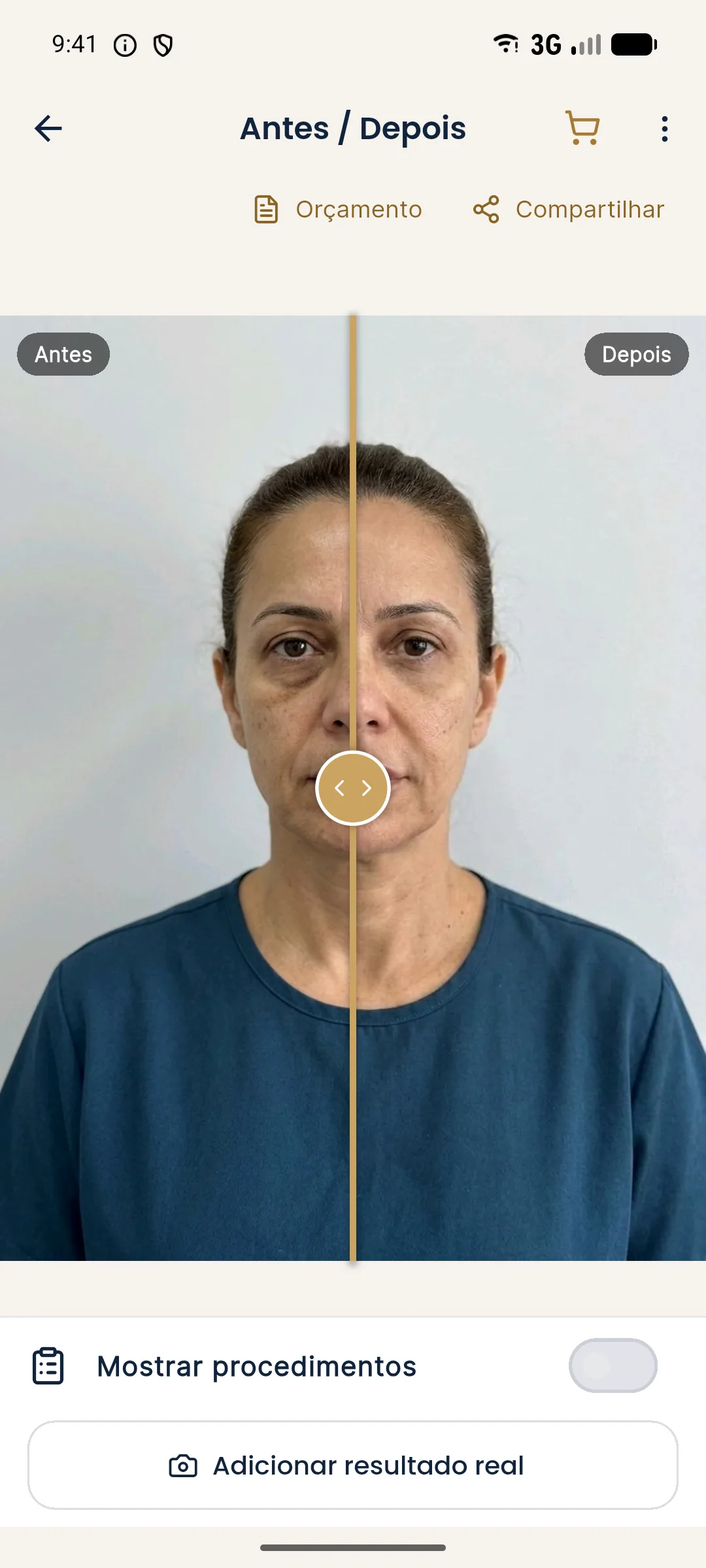
Timeline of an investigation
Quick quiz
Frequently asked questions
Why did asymmetry appear after filler?
The most common causes are uneven swelling in the first days, volume distributed differently, a pre-existing asymmetry that became more visible and, with toxin, a different response between sides. Each case needs assessment.
When should you wait and when should you act on an asymmetry?
If it is swelling or bruising in the first days, you generally wait for it to subside. Severe pain, pallor, bluish skin, hardening or any change in vision call for immediate assessment.
How can you show that the asymmetry already existed?
With standardized, dated and consented photos taken before the procedure, and with the record of the medical history and examination. Without those, the comparison relies on memory.
Is Harmy's projection a reference for symmetry?
No. The projection is an illustrative simulation and does not predict the result. The reference for investigating asymmetry is the standardized clinical photos before and after.
Harmy images are illustrative simulations generated by AI from the patient's photo to support the conversation between practitioner and patient. They are not a promise of results. Indication, technique, product and volume are solely the decision of the licensed practitioner. This content is for information only and does not replace a clinical assessment.