
Distance and Lens in the Facial Assessment Photo
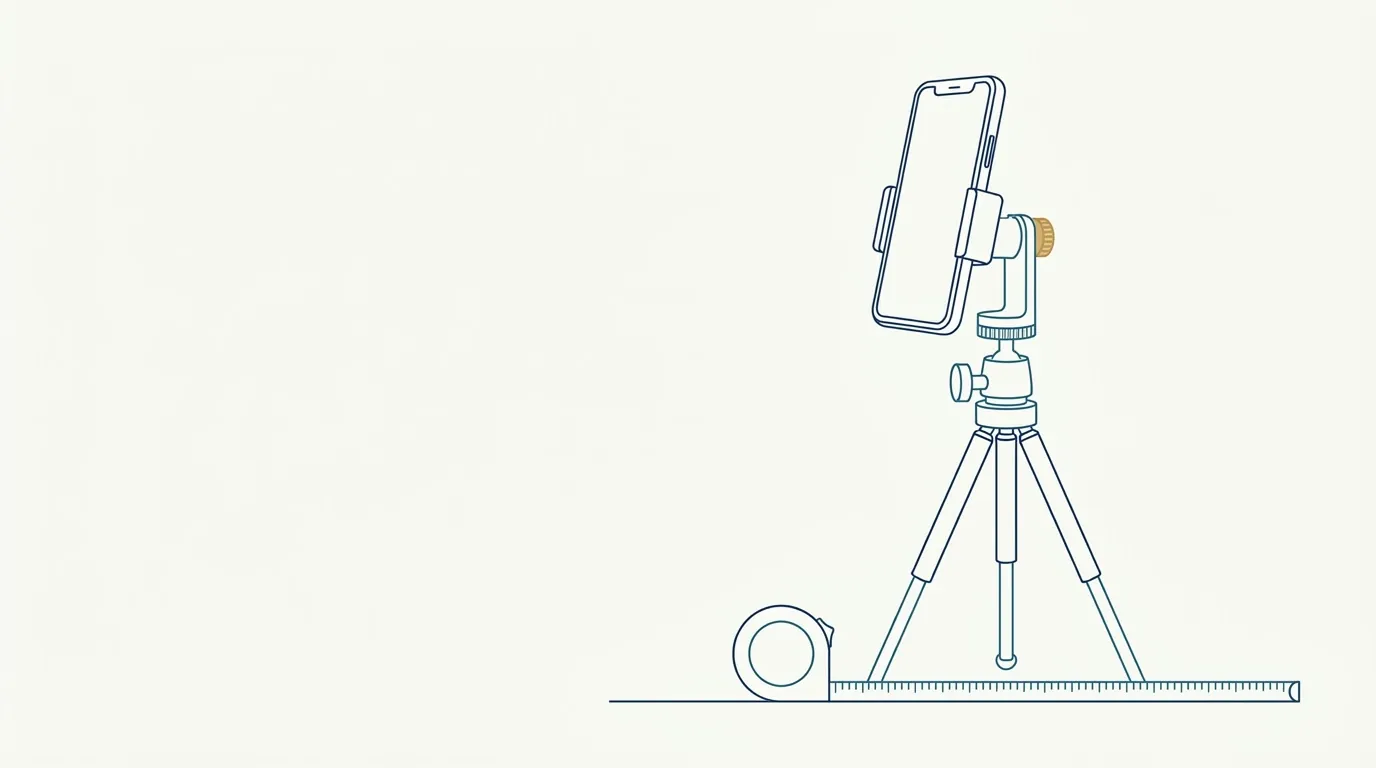
Quick facts
- Topic
- Distortion from lens and distance
- Main effect
- Nose and center of the face look larger when the camera is close
- Good practice
- Greater distance with zoom, same setup for every photo
- What suffers
- Measurements, symmetry and before/after comparison
The face does not change shape, but the photo does. Someone who shoots with the camera 30 centimeters from the patient gets a face with a bigger nose, smaller ears and compressed sides. Someone who shoots from 2 meters gets more faithful proportions. That difference contaminates measurements, before/after comparisons and even the conversation with the patient. Standardizing distance and lens is one of the cheapest ways to improve plan quality.
Why does distance alter the face?
When the camera is close, the difference in distance between the nearest point (the nose) and the farthest (the ears) is large relative to the total distance, which exaggerates what is in front. It is a perspective effect, not a device defect. Wide-angle lenses, common on phones, intensify the effect, especially at the edges of the image.
In practice, in a close-up photo:
- The nose looks wider and more projected.
- The forehead and chin look different from reality.
- Symmetry is distorted by small rotations.
- The edges of the face "run away."
This bears directly on how to measure facial symmetry and on reference lines on the frontal photo.
How do you standardize?
Details of the general standard are in standardized clinical photography, camera height in camera height in the patient photo and the rear camera in front or rear camera for the clinical photo. For light and background, see lighting for the planning photo.
What about the phone lens?
Each device has different lenses, and the main camera usually has a better profile than the ultra-wide one. Avoid the ultra-wide lens for assessment. If the device offers moderate optical zoom, it can reduce distortion when combined with a greater distance. The most important thing is to use the same device and the same lens every time, so photos from different sessions are comparable.
| Situation | Effect | Action |
|---|---|---|
| Selfie with the front camera | Strong central distortion | Do not use for measuring |
| Phone at short distance | Nose and center enlarged | Increase distance and use zoom |
| Ultra-wide lens | Stretched edges | Use the main lens |
| Camera above or below eye level | Chin or forehead distorted | Align to eye level |
| Different device at each session | Comparison compromised | Standardize the device |
How does this affect before/after comparison?
Before and after only say something when the variable is the face, not the camera. If the before photo was taken at 40 cm and the after at 1 m, the difference in the nose and cheekbone may come from distance. See alignment errors when comparing photos and aligning photos by the eyes to compare.
What about the patient's selfie?
Patients arrive with selfies and say "this is how I see myself." A selfie, taken up close, distorts the face, and the sense of self-image rests on it. This explains part of their concerns and fits the topic of mirror, selfie and photo: why patients see themselves differently. Showing the difference with a standardized photo can help calibrate the concern.
What does Harmy do with the photo?
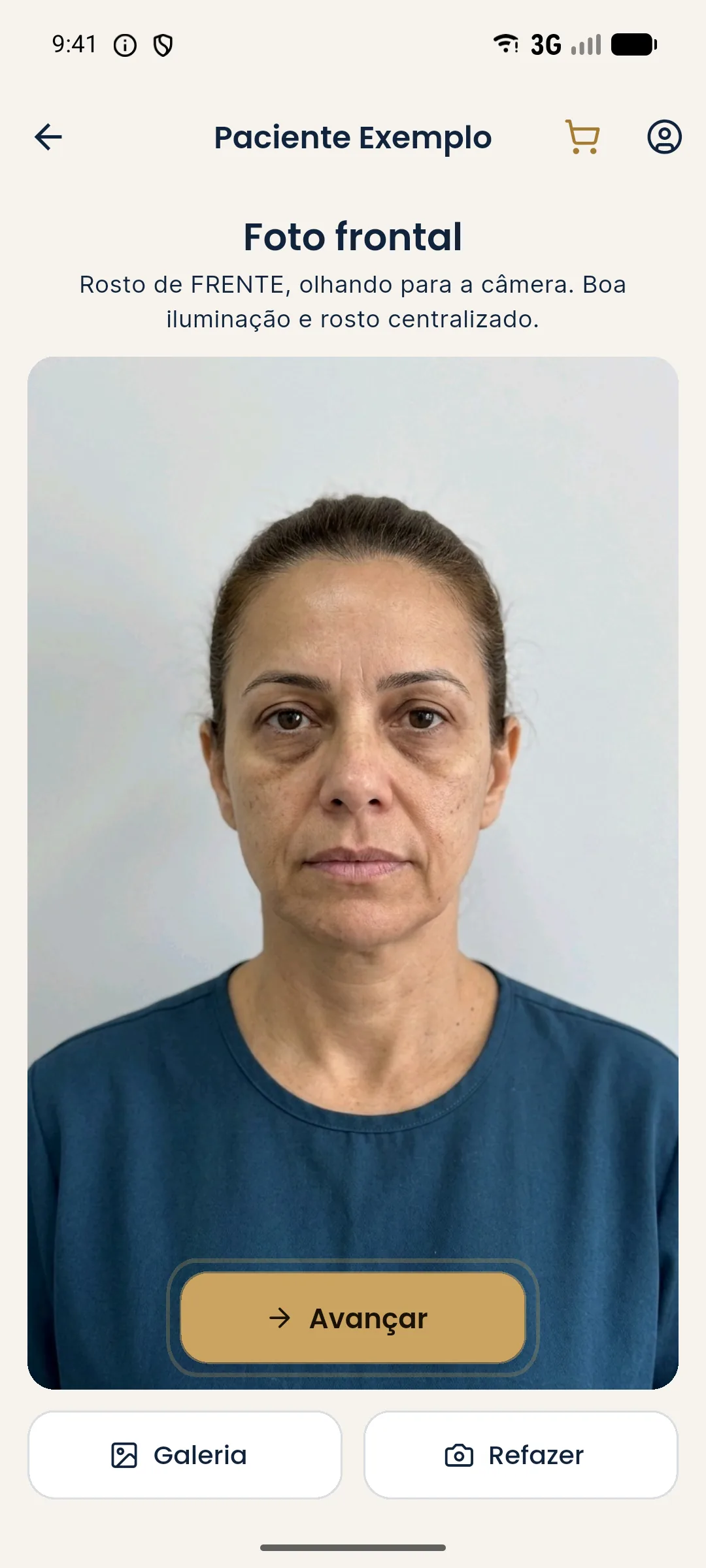
Harmy works with one frontal photo per session, taken with the camera or chosen from the gallery. It detects the face on the device to show labeled points and lets you mark the areas. The quality and standard of the photo influence the marking and the final image. The app does not correct lens distortion. So follow the frontal photo standard described in standardized frontal photo and bad photo in Harmy: how to improve it.
How do you set up a photo corner in the office?
Standardizing does not require a studio. With a few items, any room becomes a repeatable photo spot.
- Neutral wall. A plain, light, matte background with no pictures or reflections.
- Floor marks. One strip of tape for the patient and another for the device, always at the same distance.
- Tripod or support. Keeps the height and prevents shake. If you have none, rest the device on a fixed stand.
- Diffuse frontal light. A side window does not replace frontal light. Avoid overhead light, which creates shadows under the eyes.
- Stool or chair. So the patient always sits in the same position and at the same height.
- Written setup. Note the distance, height and device in the clinic's protocol, so anyone on the team can repeat it.
Train the team. Whoever takes the photo needs to know the standard and why it matters. Photos taken by different people without training produce variations that compromise the whole record. A quick check before the click, such as "eyes at lens height, chin straight, mouth relaxed," solves most problems.
If the clinic works in more than one room or location, replicate the setup in each. Comparison between sessions only makes sense when the capture is the same. Finally, store photos with the date and session ID, following storing patient photos, and protect access, in line with consent and LGPD for photos (LGPD is Brazil's data protection law).
Summary
Standardize distance, height and lens. Avoid selfies and ultra-wide lenses. Repeat the standard at every session. A faithful photo is the basis of any measurement or simulation. The clinical decision belongs to the qualified professional, in line with the rules of their professional board in Brazil.
Frequently asked questions
Does camera distance change facial proportions?
Yes. A camera that is too close enlarges what sits at the center of the face, such as the nose, and shrinks the sides. This distorts proportions and symmetry, which is why distance must be standardized.
Is a selfie good enough for assessment?
Generally not. The short distance and the wide-angle lens distort the face. Use a selfie only as a reference for what the patient sees, never for measuring.
What distance should be used for the clinical photo?
Use a fixed, comfortable distance, far enough to reduce distortion, and frame with zoom or cropping. The most important thing is to repeat the same distance at every session.
Can a phone work as a clinical camera?
It can, as long as the rear camera, lighting, distance and framing are standardized. Phones use wide-angle lenses, so distance matters even more.
Harmy images are illustrative simulations generated by AI from the patient's photo to support the conversation between practitioner and patient. They are not a promise of results. Indication, technique, product and volume are solely the decision of the licensed practitioner. This content is for information only and does not replace a clinical assessment.