
Front or Rear Camera for the Clinical Photo
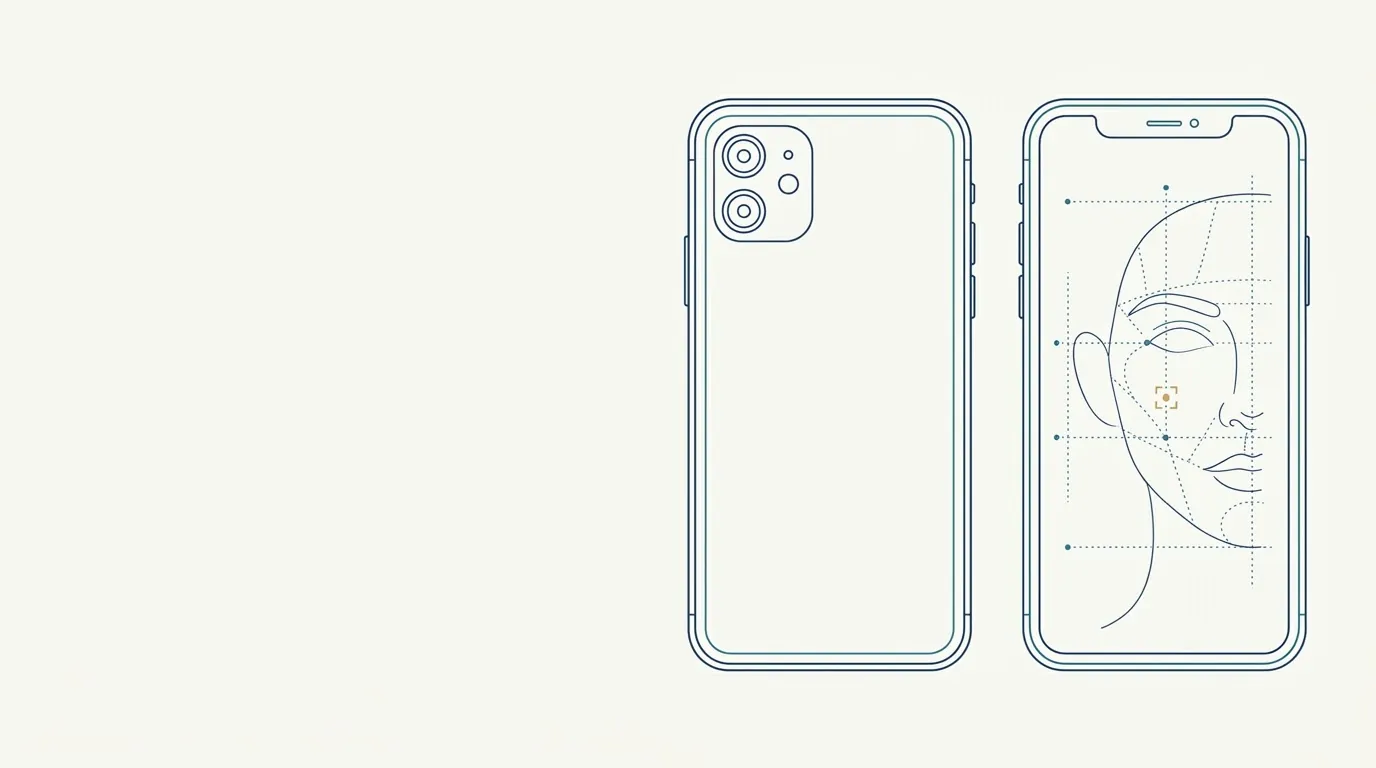
Quick facts
- Rear
- Larger sensor, better sharpness, extra lenses (telephoto) and less distortion at a distance.
- Front
- Lower quality, fixed wide-angle lens and, often, a mirrored image and automatic beautification.
- Recommendation
- Use the rear camera, with the photographer behind the device, and turn off any filter.
- Exception
- A photo taken by the patient (remote follow-up) should use the front camera with clear rules.
Every modern phone has at least two main cameras: the rear one, used to photograph the world, and the front one, used for selfies. In the rush of an appointment, it is tempting to use the one that lets you see what you are doing, which is the front one. But for the clinical photo, that choice has a cost.
This page compares the two cameras on criteria that matter in documentation: image quality, distortion, mirroring and automatic beautification, and says when each one makes sense.
What is the quality difference?
The rear camera is, on most devices, the phone's main set, with a larger sensor, more usable pixels, better low-light performance and, on many models, additional lenses (ultra wide-angle, telephoto). The front camera is built for video calls and selfies, with a smaller sensor and fixed or limited focus.
In practice, the difference shows up in:
- Sharpness: the rear camera captures skin texture, pores and fine lines with more definition.
- Low light: the front camera tends to produce more noise and automatic smoothing.
- Focus: the rear camera focuses more precisely and lets you lock focus on the face (see locking exposure and focus).
- Lens options: only the rear camera usually has a telephoto lens, the best ally for reducing facial distortion.
What about distortion?
Distortion comes mainly from distance and lens type. The front camera is almost always a wide-angle lens, used at arm's length. That combination enlarges what is closest (nose, center of the face) and shrinks the sides. The result is the selfie effect: bigger nose, smaller ears, narrow face.
The rear camera with a telephoto lens, at 1 meter or more, greatly reduces this effect. More details in wide-angle lens distorts the face and phone distance in the patient photo.
| Criterion | Rear camera | Front camera |
|---|---|---|
| Sensor and sharpness | Better | Inferior on most devices |
| Available lenses | Usually several, including telephoto | Generally one wide-angle |
| Facial distortion | Lower, with telephoto and distance | Higher, because of close use |
| Preview | Normal | Often mirrored |
| Automatic beautification | Less common | Frequent, comes on by default on some devices |
| Who photographs | Another person | The patient or the professional, up close |
The mirror effect can get in the way
The front camera usually shows the image mirrored on the screen, as if it were a mirror. Depending on the settings, the saved photo may or may not come out mirrored. In a clinical photo, that flips the right and left sides. If you record "patient's right side" from the image, you may write the wrong side.
Automatic beautification
Several devices apply skin smoothing, face slimming and brightness adjustment automatically on the front camera, sometimes without warning. These filters alter exactly what you want to document. Read phone filters and beautification in the clinical photo and turn everything off before photographing a patient.
When is the front camera acceptable?
There are two scenarios in which it can be used:
- A photo sent by the patient for remote follow-up (for example, to report swelling or a question). In that case there is no other option, and it is worth giving guidance on light, distance and framing.
- A supporting photo that will not be part of the official comparison.
For the before and after record, use the rear camera, with the photographer behind the device. The patient cannot see themselves on the screen, and that is good: they look at the fixed point, as looking at the horizon in the clinical photo asks.
How to organize use across the team
And Harmy?
In Harmy, the patient's frontal photo can be taken with the app's own camera or chosen from the gallery. The quality and framing of the input photo influence the illustrative simulation, not a promise of results: an image with selfie distortion, skin smoothing or a cropped face generates a less faithful projection. The ideal is to photograph with the rear camera, inside the clinic, and choose the file from the gallery, or use the app camera with the same rules.
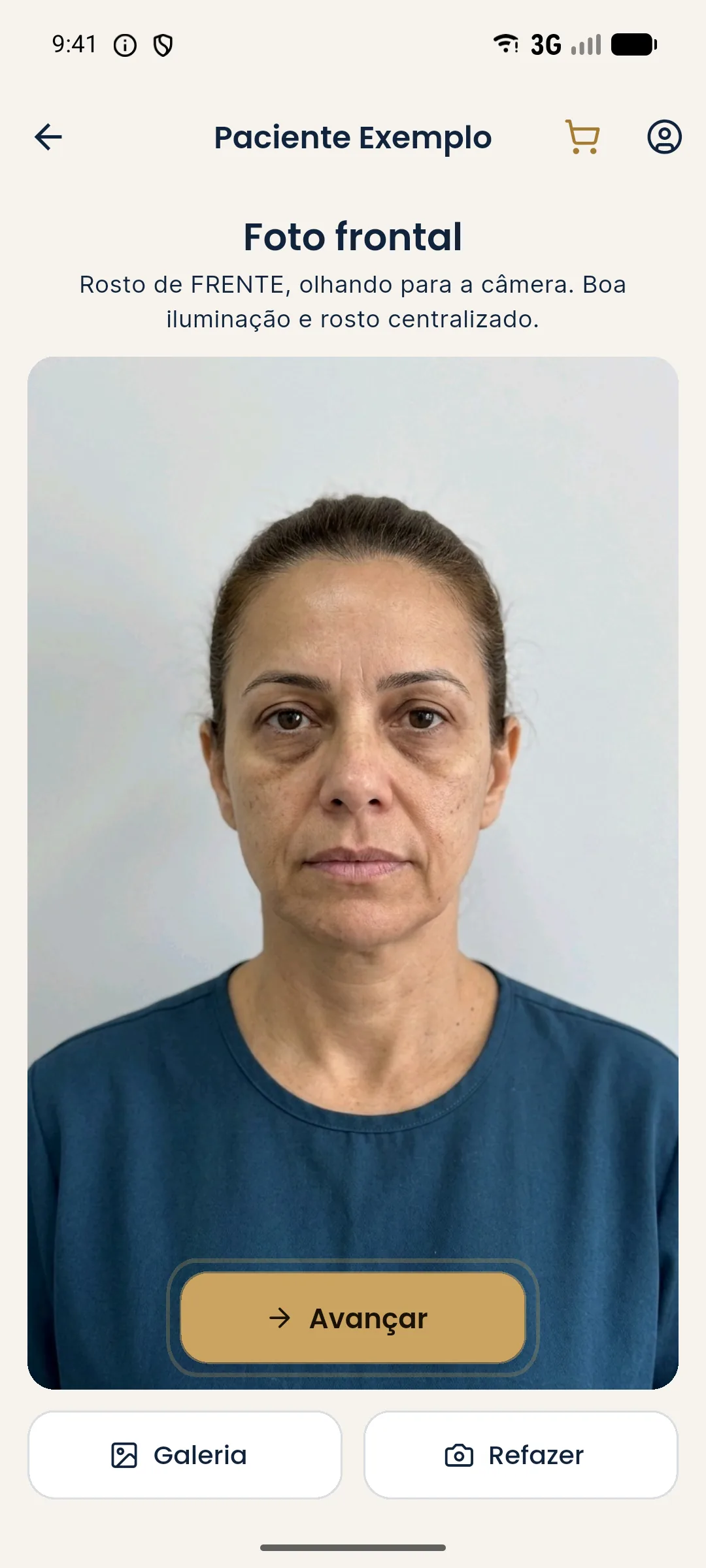
See the full flow in standardized frontal photo in the app and what happens when the image is weak in bad photo for AI projection.
Summary for the routine
For the clinical photo, use the rear camera, with the photographer behind the device, a telephoto lens when available and a fixed distance. Leave the front camera for photos sent by the patient and guide them in writing. Turn off mirroring and beautification. Small configuration adjustments prevent the differences that mislead most in comparison.
What about the mirror and the patient who wants to see themselves?
Many patients ask to see the screen while being photographed. When the rear camera is used, that does not happen, and it is worth explaining why: the patient needs to look at the fixed point, not at their own image. After the shot, show the photo on the screen and check it with them. That short conversation avoids requests to retake for vanity and reinforces that the photo is a clinical record, not a portrait for social media.
Frequently asked questions
Which camera should I use to photograph the patient's face, front or rear?
The rear one, in general. It has a better sensor, more sharpness and, on many devices, a telephoto lens, which reduces facial distortion. The front camera serves as a backup when the patient photographs themselves.
Does the front camera mirror the image?
On many devices the preview appears mirrored and the saved photo may or may not come out mirrored, depending on the settings. That flips right and left and can get in the way of documentation.
Does a selfie distort the face?
Yes. The front camera is usually wide-angle and is used up close, which enlarges the nose and narrows the sides of the face. The closer, the stronger the effect.
Can I ask the patient to send a follow-up selfie?
You can, for remote follow-up, as long as you give guidance on light, distance and framing and turn off beautification. For a real comparison, the photo taken at the clinic is still the best.
Harmy images are illustrative simulations generated by AI from the patient's photo to support the conversation between practitioner and patient. They are not a promise of results. Indication, technique, product and volume are solely the decision of the licensed practitioner. This content is for information only and does not replace a clinical assessment.