
Phone Distance in the Patient Photo: How Many Meters
Quick facts
- Usual range
- About 1 to 1.5 meters from the face, with a telephoto lens when the device has one.
- Too close
- Enlarges the nose, narrows the sides of the face and distorts proportions.
- Too far
- Loses resolution on the face and requires cropping or digital zoom.
- Main rule
- A fixed distance matters more than the exact number: mark it on the floor and always repeat it.
Ask ten professionals what distance they photograph the patient from and you will get ten answers, many of them "as close as I can while still framing the face". That is understandable: moving closer seems to increase detail. But in a face photo, getting too close distorts. To compare before and after, the right distance is the one that repeats, but there is also a range where distortion is small.
Why does distance change the face?
It is a matter of perspective. When the camera is close, the difference in distance between the nose (nearest) and the ear (farthest) is large in proportion. The nose looks "huge" in the image, while the ears and the sides of the face shrink. When the camera moves back, that difference weighs less, and proportions are truer to what the eye sees.
In practice, this affects:
- the nose, which looks larger and wider when the camera is close;
- the face, which looks narrower and longer;
- the chin and forehead, which gain or lose prominence depending on the angle;
- symmetry, because the side closer to the lens is accentuated.
How many meters?
There is no single number, but there is a commonly used range:
| Distance (camera to face) | Effect | Note |
|---|---|---|
| Less than 50 cm | Strong distortion (selfie effect) | Avoid for record photos |
| 50 cm to 1 m | Distortion still noticeable | Acceptable only with a telephoto lens |
| 1 to 1.5 m | Small distortion | Usual range for a clinical face photo |
| 1.5 to 2.5 m | Minimal distortion | Good with a telephoto lens; needs cropping or good resolution |
| Above 2.5 m | Face small in the frame | Loses detail; only with strong optical zoom |
Values vary with the device's lens and sensor. If your phone has a 2x or 3x telephoto lens, a distance of 1.5 m to 2 m with the tele lens usually gives a face framing with little distortion. If it only has the wide-angle lens, at least increase the distance and then crop carefully.
How does the lens factor in?
Distance and lens go together. The wide-angle lens, which is the default on many phones, amplifies the effect of proximity. The telephoto lens compresses perspective and is more faithful. Read wide-angle lens distorts the face and phone zoom in clinical photos to understand what changes in each use.
How do you fix the distance in your routine?
Memorizing does not work. Marking does.
- Choose the combination of lens and distance that frames the patient from the top of the head to the neck.
- Mark on the floor (tape) the spot where the patient sits or stands.
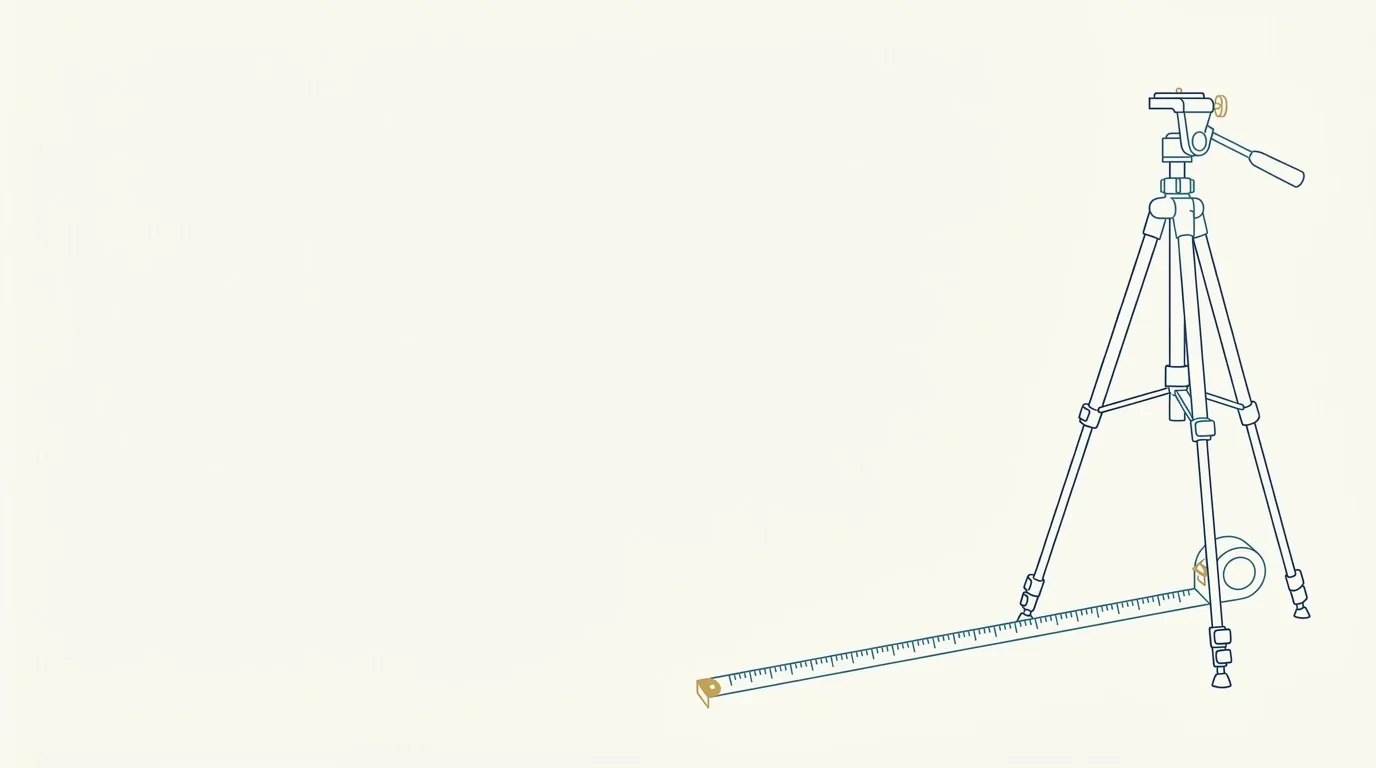
- Mark the photographer's spot, or use a tripod in a fixed position.
- Measure the distance with a tape measure and note it.
- Test with a team member and check the framing.
- Record distance and lens in the clinic protocol and in the patient's chart.
For floor marking, see marking a floor position for clinical photos and, for stability, tripod for clinical photos.
What about a small office?
Not every office has 2 free meters. Alternatives:
- use the telephoto lens and the distance available, even if it is 1 m;
- shoot in the hallway, always in the same place;
- use a corner of the room with the mirror covered and a dedicated space;
- accept a shorter distance, as long as it is always the same.
A constant distance slightly shorter than ideal is better than an "ideal" distance that varies.
What changes for Harmy's front-facing photo?
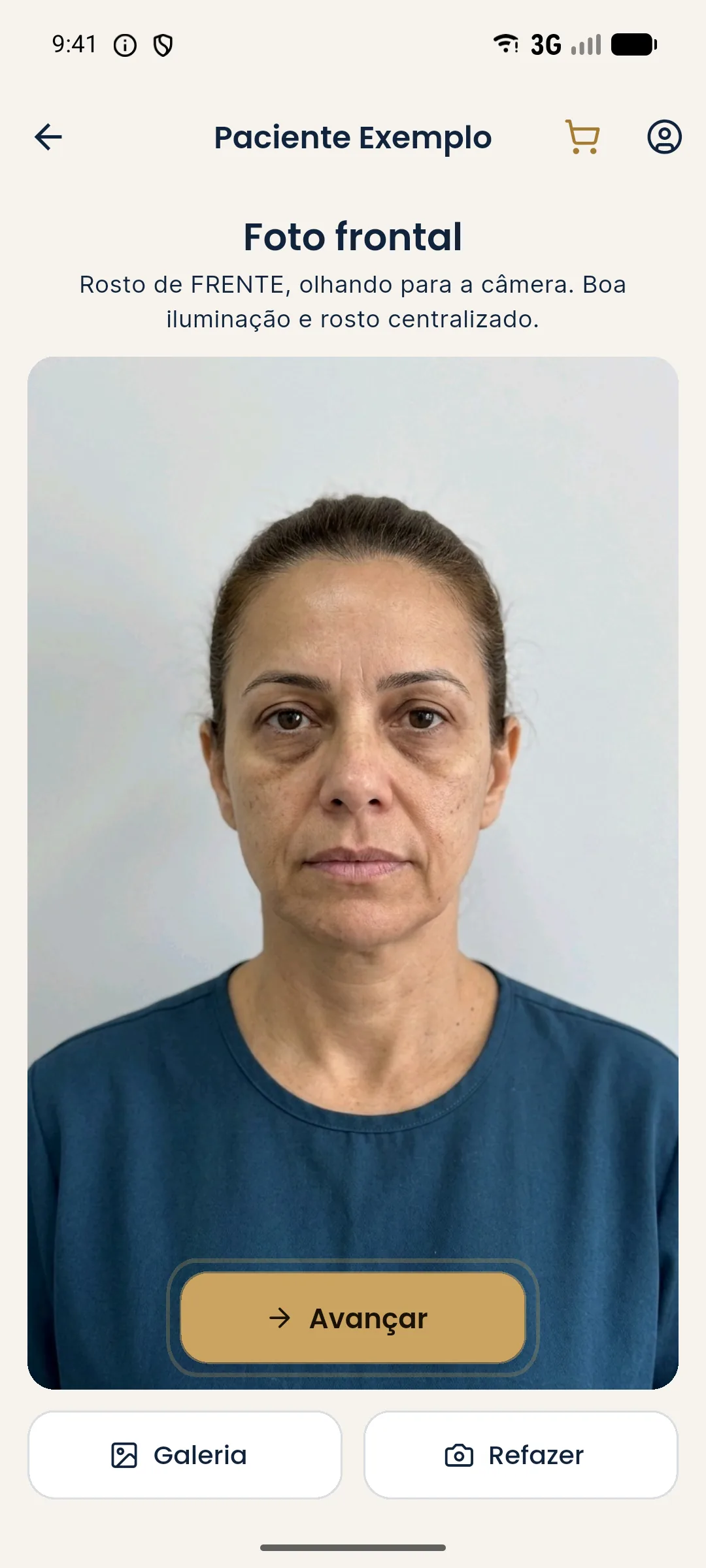
In Harmy, the projection starts from one front-facing photo. A photo taken from very close brings distortion of the nose, cheekbone and chin, and the illustrative simulation inherits that distortion. The marked areas (Cheekbone, Chin, Jawline, Lips) are also read with less precision. The recommended distance for the app photo is the same as for the clinical photo: around 1 to 1.5 m, with the tightest lens available.
What about the follow-up visit?
Take the follow-up photo at exactly the same distance and with the same lens as the before photo. If the patient comes back after months, the floor mark and the chart note are what guarantee that. For the other parameters, see standardizing photos between visits.
Summary for your routine
Shoot from about 1 to 1.5 m with the tightest lens you have, mark the positions and note the combination in the chart. The correct distance is the one that reduces distortion and, above all, the one you repeat. All other care, such as camera height (see camera height) and light, depends on this stable base.
How do you test your distance before adopting it?
Ask a team member to pose and shoot at 1 m, 1.5 m and 2 m, with the same lens. Compare the size of the nose relative to the ears and the sharpness of the face. Choose the distance where the nose looks most natural and the face still fills the frame well, and document the choice. This five-minute test avoids months of off-standard photos and serves as a reference to train any new team member.
Frequently asked questions
What distance should I use to photograph the patient's face?
Generally 1 to 1.5 meters, preferring the phone's telephoto lens. What matters most is keeping the same distance and the same lens between visits.
Why does shooting up close distort the face?
Because the parts closest to the lens (nose, center of the face) appear larger and the farthest (ears, sides) appear smaller. The effect grows the closer you are and the wider the lens.
Can I shoot from far away and zoom in?
Optical zoom (telephoto) works well. Digital zoom loses sharpness, and cropping afterward also reduces facial resolution. Prefer moving a little closer or using the 2x or 3x lens.
How do I guarantee the same distance every time?
Mark the patient's position and the photographer's position on the floor with tape, or fix the phone on a tripod in a constant position. Note the distance and lens in the chart.
Harmy images are illustrative simulations generated by AI from the patient's photo to support the conversation between practitioner and patient. They are not a promise of results. Indication, technique, product and volume are solely the decision of the licensed practitioner. This content is for information only and does not replace a clinical assessment.