
Wide-angle lenses distort the face in clinical photos
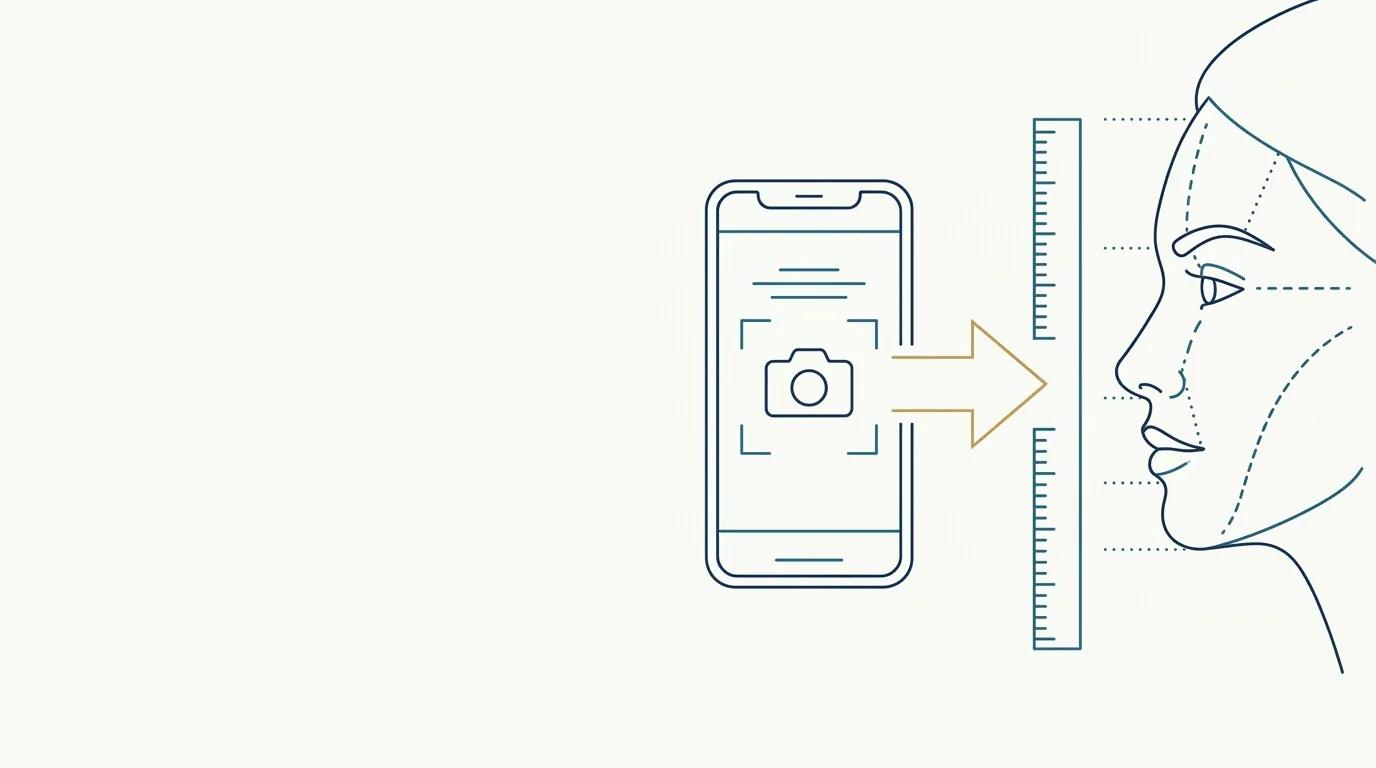
Quick facts
- Effect
- Up close, whatever is nearest the lens (nose, forehead) looks bigger; the ears and the sides of the face look smaller.
- Cause
- Short distance with a wide-field lens, like the phone's main and front cameras.
- Solution
- Move the phone back, use the mild telephoto lens (when available) and crop afterward.
- Rule
- Same lens and same distance at every visit.
Have you ever seen a selfie in which the nose looks huge and the ears have disappeared? It is not the face: it is perspective. The wide-angle lens common on phones "sees" a broad field, and when you bring it close to an object, whatever is nearest looks disproportionately bigger. In a portrait, the nose sits a few centimeters closer to the lens than the ears, and that small difference, at close range, becomes a large difference in size.
For clinical photography, this effect is a direct problem. The nose, forehead and chin look bigger. Proportions such as face width change. The patient sees a face that is not theirs and the professional, if they do not notice, plans on top of that distortion. This page explains the cause and what to do.
How does distance change the face?
Distortion depends on the distance between camera and face, not on the camera itself. When the camera is very close, the difference in distance between the nearest point (the tip of the nose) and the farthest (the ears) is large in proportion. When the camera moves back, the same difference becomes small relative to the total distance, and the perspective flattens.
| Camera distance | Approximate effect on the face |
|---|---|
| Very close (selfie, 30 to 50 cm) | Nose and forehead enlarged, sides of the face shrunk |
| Close (one meter) | Moderate distortion, still visible on the nose |
| Medium (1.5 to 2 meters) | Perspective greatly reduced |
| Far, with cropping | Little distortion, but less detail |
The values are approximate and vary by device. What matters is the principle: moving the camera back reduces distortion, and the lens's equivalent focal length defines the field of view. "Tighter" lenses (mild telephoto) distort less at equal distances. The phone distance is the practical adjustment.
Which areas are most affected?
- Nose: looks wider and more projected, and the tip more bulbous (nose photo for nonsurgical rhinoplasty).
- Forehead: looks broader and more prominent.
- Chin: looks bigger if the camera is below; smaller if it is above.
- Ears and sides of the face: look smaller, which narrows the apparent width.
- Profile: the facial profile and the nasolabial angle are read differently.
- Lines and relief: look more pronounced in the areas near the lens.
For analysis by thirds (facial assessment by thirds), proportions need to be faithful. A distorted photo compromises the reading of all three thirds.
What should I do in practice?
Cropping afterward is the most useful technique: shoot from farther away, with the face smaller in the frame, and crop. You lose a few pixels but gain fidelity. Just watch the minimum resolution, as in resolution and format of clinical photos.
How do I tell which lens is being used?
Many phones have two or three lenses: ultra-wide, main and telephoto. The camera app shows buttons like "0.5x", "1x", "2x". The ultra-wide (0.5x) distorts the most and should never be used for the face. The main lens (1x) is wide-field and distorts up close. The 2x or 3x lens, when there is one, comes closest to a portrait lens.
Be careful: some cameras "switch" lenses on their own depending on the light, and 2x zoom may be digital (a crop) rather than optical. Check the device manual or run a test: photograph the same person at the same distance with each lens and compare the shape of the nose.
What about consistency between visits?
Most important: same lens and same distance in all of the same patient's photos. If the before photo was taken at 1 meter with the 1x lens and the after at 2 meters with the 2x lens, the perspective is different and the face seems to change. A record with lens and distance solves this. See also standardizing photos between visits and aligning photos by the eyes (alignment corrects scale, not perspective).
How does distortion affect the projection in Harmy?
The projection starts from the photo as it arrives. A face distorted by the lens enters the app with distorted proportions, and the marking and the projection follow those proportions. The result is a simulation faithful to the photo, but not to the patient.
What should I tell the patient?
Many patients are used to selfies and think "the close-up camera" shows how they look. Explain it without criticizing.
Which mistakes should I avoid?
- Photographing with a selfie.
- Using the ultra-wide lens.
- Moving the phone closer to "capture more detail".
- Switching lenses or distance between visits.
- Not noting what was used.
Lens distortion is invisible to whoever shoots and obvious to whoever compares. Moving the camera back, locking the distance and cropping afterward is the simplest path to a faithful face.
Frequently asked questions
Does the phone's wide-angle lens distort the face?
Yes, especially up close. It exaggerates whatever is nearest the lens: the nose and forehead look bigger and the ears and sides of the face look smaller. It is a perspective effect, not a feature of the face.
Which distance avoids the distortion?
The greater the distance, the lesser the distortion. In general, about 1.5 to 2 meters (5 to 6.5 feet) from the patient, with the camera at eye level, already reduces it a lot, and then you crop the image.
Is the front camera (selfie) worse?
It usually is, because the distance is short and the lens is wide-field. For clinical photos, prefer the rear camera, with a tripod or an assistant, as in front or rear camera in clinical photos.
Why does this matter for comparison?
If the before and after photos are taken with different lenses or distances, the face changes proportion with no real change. That misleads both the professional and the patient.
Harmy images are illustrative simulations generated by AI from the patient's photo to support the conversation between practitioner and patient. They are not a promise of results. Indication, technique, product and volume are solely the decision of the licensed practitioner. This content is for information only and does not replace a clinical assessment.