
Camera Height for Patient Photos: Level With the Eyes
- Nerve
- Highlighted area
Quick facts
- Rule
- Lens at the patient's eye level, device upright and parallel to the face.
- High camera
- Widens the forehead, shortens the chin and thins the lower third.
- Low camera
- Enlarges the chin and the base of the nose, shortens the forehead and gives the look of a double chin.
- How to adjust
- Change the height of the patient's stool or the tripod, not the angle of the phone.
Among all the parameters of the clinical photo, camera height is one of the ones that most changes the appearance of the face and one of the least remembered. Light and background are obvious. Height slips by because, in daily practice, it depends on how much the photographer is leaning, who is sitting and how tall the patient is. The problem is that the same face photographed from above and from below seems to have different proportions.
For anyone documenting the before and after of a filler treatment, that difference is dangerous: it lands exactly on the chin, nose and folds, the areas the procedure changes.
Why does camera height matter so much?
The phone or camera sees the face as a surface with relief. When the lens goes up, the parts closer to it (forehead, top of the head) take up more space, and the parts farther away (chin, the area under the chin) take up less. When the lens goes down, the opposite happens. It is pure perspective, unrelated to the treatment.
In practice, this affects four common readings:
- Chin and profile: from above, the chin looks recessed; from below, it looks projected.
- Nose: from below, the tip and nostrils stand out and the nose looks longer or wider.
- Nasolabial fold: light and perspective change the apparent depth of the nasolabial fold (smile lines).
- Lower third: from below, the line under the chin looks more voluminous, which can suggest a double chin that does not exist in the same way.
What is the right height?
The lens should sit at the patient's eye level, more precisely at the center of the face, between the eye line and the tip of the nose. The phone should be upright and parallel to the face, with no upward or downward tilt. The patient sits or stands with the head in a natural position, with the Frankfurt plane parallel to the floor.
A simple check: look at the image on the screen. If both ears appear at the same height and the jaw contour is sharp on both sides, the camera is well positioned. If one ear appears higher or you see a lot of the top of the head, the camera is too high.
How do I standardize height in the office?
The most reliable solution is to take the height out of the photographer's hands. Three ways, from simplest to most fixed:
| Option | How it works | Limit |
|---|---|---|
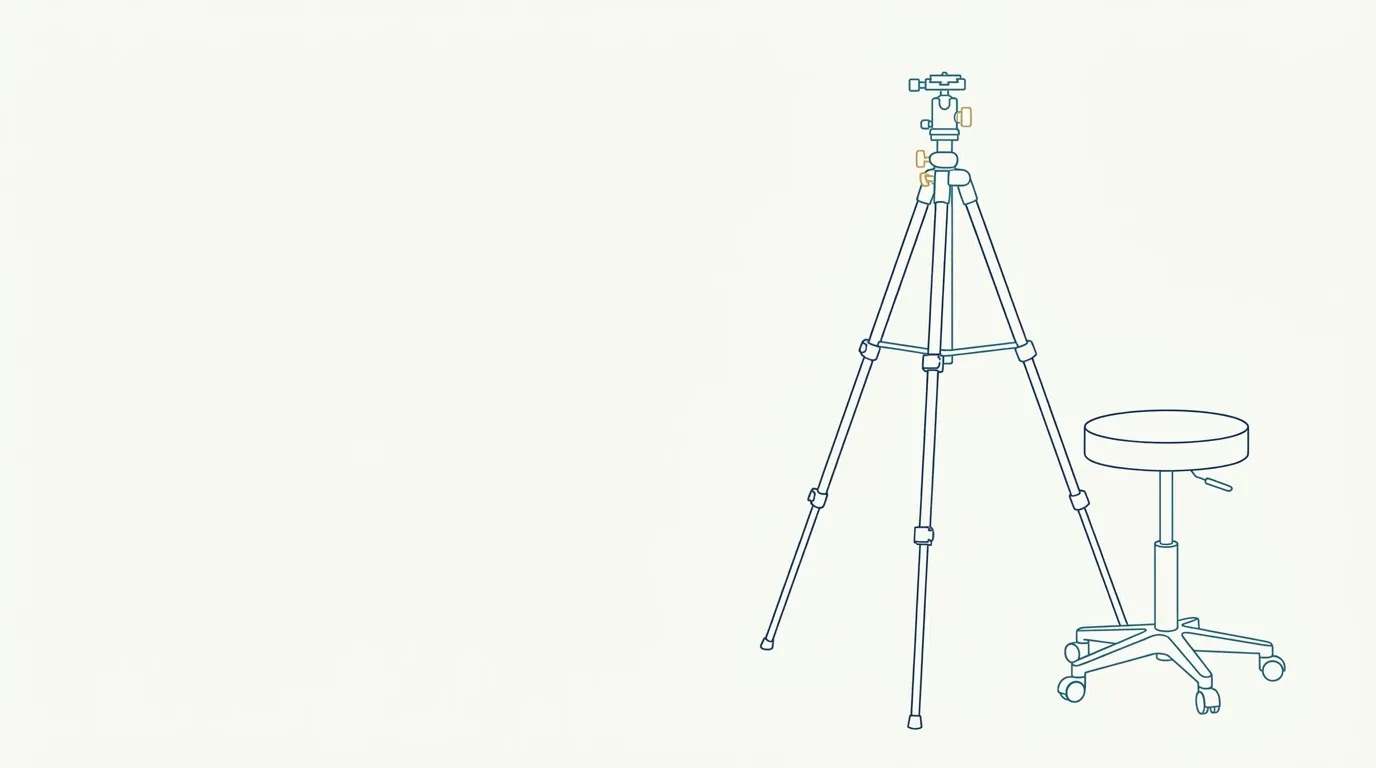
| Tripod with a height scale | Mark the height used on the tripod and repeat it | Requires a tripod with an adjustable column |
| Adjustable patient stool | Raise or lower the patient until the eyes line up with the lens | Requires a stool with height adjustment |
| Wall mark | Tape or sticker at the eye level of the seated patient | Only works for people of the same height |
In every case, the adjustment is made on the stool or the tripod, never by tilting the phone. Tilting the device fixes the framing but leaves the perspective wrong.
What about a patient who lifts or lowers the chin?
Correcting the camera height does not help if the patient compensates with the neck. Someone who lifts the chin "to look good" produces the same effect as a low camera; someone who tucks the chin produces that of a high camera. Use a fixed point ahead, at eye level, and ask the patient to look at it without moving the neck. More on this in looking at the horizon in the clinical photo.
How does this affect before and after comparison?
Imagine the before photo was taken with the camera slightly below and the after photo slightly above, following a chin filler. The after will seem to have less chin than it really has, and the result will be underestimated. In the opposite situation, the professional may overestimate the result and create an expectation that real life does not support.
What if the patient is very different from the standard?
Very tall or very short patients, with a short neck or a marked posture, call for adjusting the stool, not the method. For someone who uses a wheelchair, for example, the tripod should come down to the patient's eye level in the chair. The rule remains the same: lens at eye line.
How does camera height show up in Harmy?
Harmy uses one frontal photo per session, which can be taken with the app camera or chosen from the gallery. Because the projection keeps the rest of the face as it is, a photo taken from below or from above will be simulated with its own perspective: a chin that looks recessed because of the camera will still look recessed in the after. It is worth following the same height recommended for the clinical record, as described in standardized frontal photo. See also phone distance in the patient photo, another parameter that works together with height.
Summary for the routine
Fix the lens height at the eye line, keep the phone upright and adjust the stool, not the device. Write the tripod height in the patient record to repeat it at the follow-up visit. With constant height, the difference that shows up between the before and the after becomes, for the most part, the difference in the face.
Frequently asked questions
At what height should the camera be for a clinical face photo?
At the patient's eye level, with the phone upright and parallel to the face. That way the face appears without upward or downward tilt.
What happens if the camera is above the face?
The forehead looks larger, the chin looks smaller and the lower third looks thinner. In someone with a small chin, the effect can be mistaken for retrognathia.
What changes when the camera is below the face?
The chin and the base of the nose stand out, the forehead shortens and the area under the chin looks fuller. That can suggest a double chin or a nose larger than it is.
Do I need a tripod to get the height right?
It is not mandatory, but it helps a lot. It fixes the height, frees your hands to guide the patient and repeats the same position at every visit.
Harmy images are illustrative simulations generated by AI from the patient's photo to support the conversation between practitioner and patient. They are not a promise of results. Indication, technique, product and volume are solely the decision of the licensed practitioner. This content is for information only and does not replace a clinical assessment.