
Nasolabial fold (smile lines): anatomy and filler
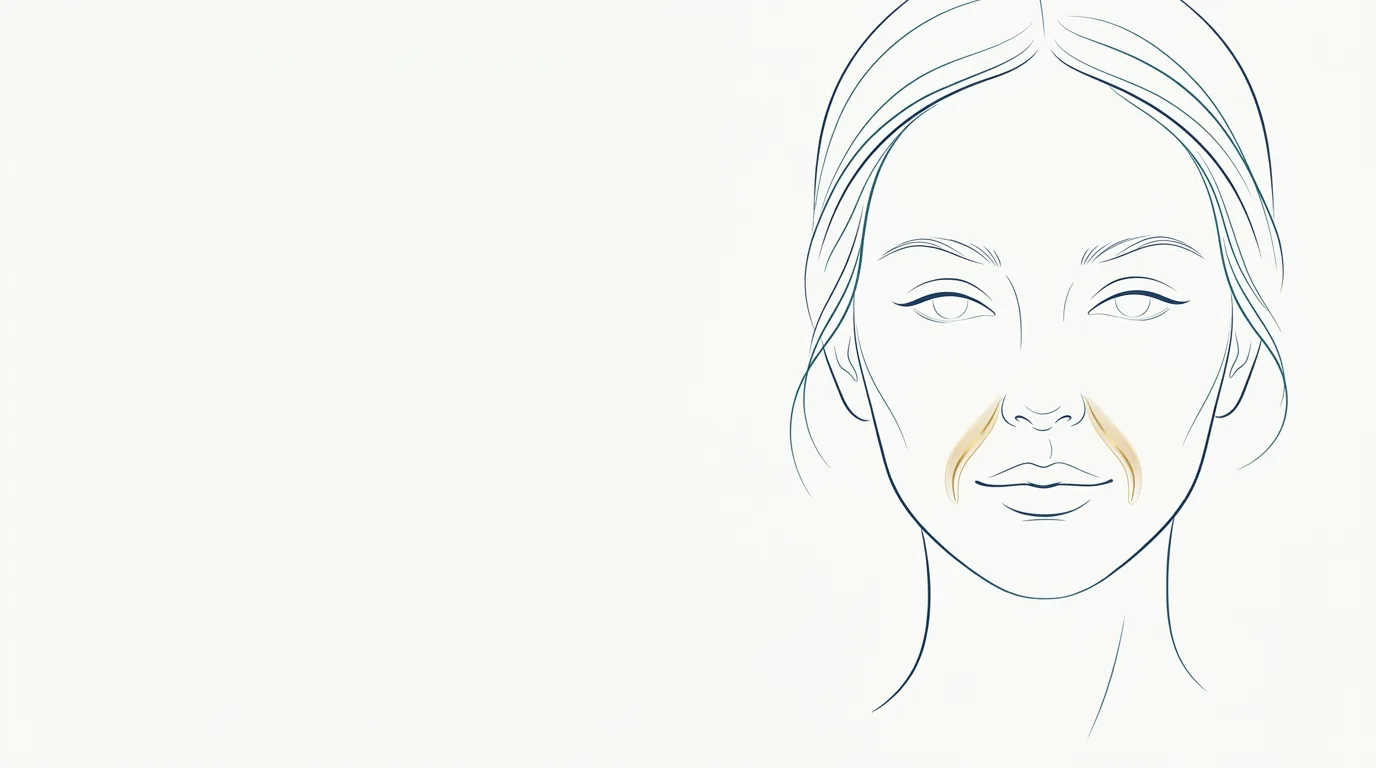
The nasolabial fold (popularly, "smile lines") is the crease that runs from the side of the nose to the corner of the mouth, on both sides. It exists in every face and is part of expression, but when it deepens it becomes one of the most cited concerns of midface aging. The popular term, "Chinese mustache" in Portuguese (bigode chinês), is what Brazilian patients use in the consultation.
What are the anatomical boundaries of the nasolabial fold?
The fold starts next to the nasal ala, in the paranasal region, and descends diagonally to the side of the oral commissure. It marks the border between the cheek, which lies above and lateral, and the upper lip, which lies medial.
The structures that explain its formation are:
- Midface fat compartments, which lose volume and descend with age.
- Lip elevator muscles (levator labii superioris, levator labii superioris alaeque nasi, zygomatic muscles), which insert in the region and accentuate the fold when smiling.
- Bony support of the maxilla in the paranasal region, which can diminish with aging.
- Skin and adhesions between skin and muscle along the fold.
Vessels and nerves to watch
The nasolabial fold is a high vascular risk zone. In the anatomical review, consider:
- Facial artery, which rises from the mandible toward the nose and crosses the region in a variable way.
- Angular artery, the continuation of the facial artery next to the nasal ala, with anastomoses to the orbital circulation.
- Lateral nasal artery, which supplies the nasal ala.
- Infraorbital artery and nerve, higher up.
The upper portion of the fold, next to the nasal ala, concentrates the greatest risk. A vascular occlusion there can cause necrosis of the nasal ala and, in rare cases, a visual complication.
What do patients usually ask for?
The request is usually direct:
- "I want to get rid of my smile lines."
- "That line from my nose to my mouth makes me look older."
- "I look sad in photos."
- "When I smile, the fold is very pronounced."
In the assessment, look at the patient at rest and smiling, from the front and in three-quarter view. In many cases, a deep fold is a consequence of loss of cheekbone support. Filling only the fold in that scenario can leave the upper lip heavy and the face looking artificial.
What procedures can be done in the nasolabial fold?
The direct procedure is nasolabial fold filler with hyaluronic acid of a G' suited to the chosen depth and area. Technique, plane and instrument are the decision of the qualified professional, according to the rules of their professional council in Brazil.
The treatments most often combined with the fold:
- Cheekbone filler, to treat the support cause.
- Mouth corner filler, when the fold continues into the marionette line.
A common approach is to treat the midface first and reassess the fold afterward, applying less product directly.
What are the usual volumes in the fold?
Usual ranges in ml of hyaluronic acid, at the discretion of the qualified professional, after assessment:
| Situation | Usual range per side | Note |
|---|---|---|
| Mild fold | 0.5 ml | Often enough |
| Moderate fold | 0.5 to 1 ml | Assess cheekbone support first |
| Deep fold | 1 to 1.5 ml, in sessions | Combine with the midface |
| Durability | Generally 9 to 12 months | Area with a lot of movement |
The goal is not to erase the fold. A softened fold keeps the smile natural, while a "zeroed" fold tends to look artificial.
Precautions, contraindications and complications
General contraindications: active infection or active herpes in the perioral region, pregnancy and breastfeeding, uncontrolled autoimmune disease, allergy to the components and unrealistic expectations. Record the use of anticoagulants and antiplatelet drugs.
Reported complications:
- Swelling and bruising.
- Excess volume, with a "sagging cheek" look or a heavy upper lip.
- Nodules and irregularities.
- Asymmetry between the sides.
- Vascular occlusion, with risk of necrosis of the nasal ala and the skin in the region.
Hyaluronidase must be available in the office, with a defined complication protocol. See the safety and complications overview.
Why should the fold not be treated in isolation?
The nasolabial fold is the classic example of a region where the concern and the cause are in different places. The patient points to the fold, but a good part of the deepening usually comes from loss of support above it.
Some signs that the midface should be part of the plan:
- The cheekbone has lost projection in the three-quarter view.
- The fold improves when you gently lift the cheek with your fingers.
- The under-eye hollow is also more pronounced.
- The patient reports that the face has "dropped" overall, not only at the fold.
When these signs appear, starting with the cheekbone and reassessing the fold afterward usually uses less product in the highest-risk area and gives a more natural result. Facial assessment by thirds helps organize this reading.
How does the nasolabial fold appear in Harmy?
In Harmy, the region is the Nasolabial Fold point of the marking. After the frontal photo, the app detects the face on the device and shows the points with labels. Tap Nasolabial Fold to include it in the plan.
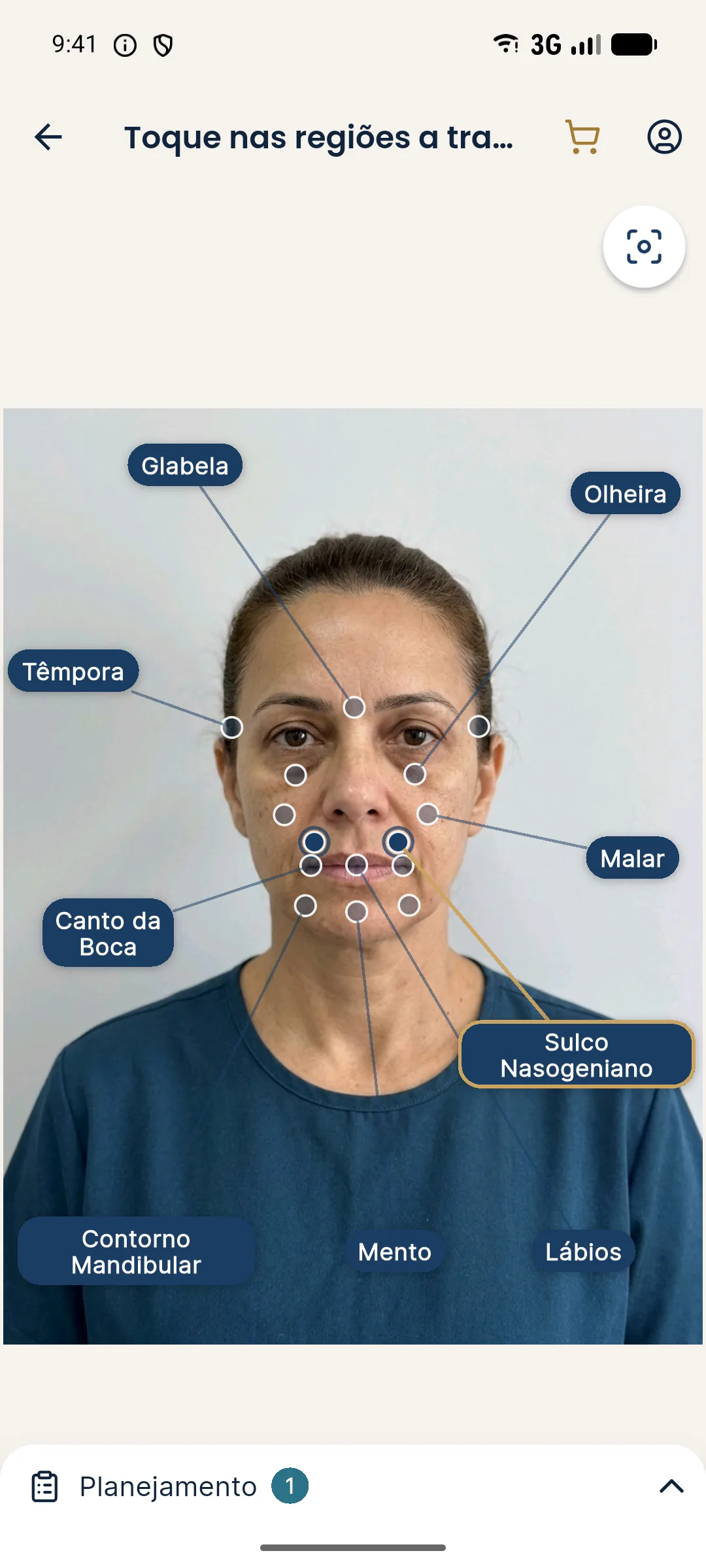
In the Plan, set the volume in ml (0.5 ml steps, from 0.5 to 5 ml). Because it is a bilateral area, the value is the total, split between the two sides. In the simulation on this site, 2 ml in total were used. The AI respects the volume: the more ml, the more noticeable the smoothing. It also does not alter skin, makeup, expression or lighting.
A good practice is to generate one projection with the cheekbone and another with the fold, to compare approaches with the patient. See the step by step in marking areas and volumes.
How to talk to the patient about smile lines
The patient often arrives asking to "erase" the fold. An illustrative simulation with a moderate volume shows that softening already changes how the face reads, and helps explain why you propose starting with the cheekbone.
Present the projection as support, never as a promise. To structure that conversation and the proposal, see how to increase plan acceptance.
Frequently asked questions
What causes smile lines?
The fold exists in everyone and is part of the anatomy. It deepens with loss of midface support, descent of the fat compartments, skin laxity and repeated muscle action.
Is filling smile lines the best solution?
Not always. In many patients, restoring cheekbone support softens the fold with less product placed directly in the area. The plan is defined by the qualified professional after assessment.
How much filler is used in the nasolabial fold?
Generally 0.5 to 1.5 ml per side, at the discretion of the qualified professional after assessment. The fold should not be erased completely, so as not to leave the face looking artificial.
Is the nasolabial fold a risk area?
Yes. The facial artery and the angular artery run through the region, which is considered high vascular risk. Hyaluronidase must be available in the office.
How do I simulate smile lines in Harmy?
Mark the Nasolabial Fold point on the frontal photo and set the volume in ml in the Plan. The value is the total, split between the two sides.
Harmy images are illustrative simulations generated by AI from the patient's photo to support the conversation between practitioner and patient. They are not a promise of results. Indication, technique, product and volume are solely the decision of the licensed practitioner. This content is for information only and does not replace a clinical assessment.