
Mirror, selfie and photo: why patients see themselves differently

Quick facts
- Topic
- Self-image in the mirror, in a selfie and in a photo
- Causes
- Lateral reversal, lens distortion, familiarity
- Clinical use
- Calibrate the concern before planning
- Caution
- Neither dismiss the concern nor feed it
"I look crooked in photos." "I look better in the mirror." "My selfie doesn't look like me." These comments are not whims: they reflect real perception and optics phenomena. Understanding why a patient sees themselves differently in each image is one of the most useful planning tools, because it changes how you listen to the concern and how you respond to it.
Why does the image change?
Three mechanisms add up.
- Mirror reversal. The mirror swaps left and right. Since every face has some asymmetry, the mirrored version looks "normal" to someone who sees it every day, and the photo looks strange. Other people, however, see the photo version.
- Camera distortion. In a selfie, the camera is close and uses a wide-angle lens, which enlarges the center of the face (the nose) and shrinks the sides. See distance and lens in the assessment photo.
- Familiarity. We like what we see often. The familiar mirrored image becomes the preferred one, and the photo looks like "someone else".
How does this affect the concern?
What the patient describes as asymmetry, a large nose or a narrow face may come, in part, from the image they use as a reference. This does not cancel the concern, but it changes the plan. Before proposing treatment, it is worth asking in which image they notice the problem.
| Situation | Possible origin | Approach |
|---|---|---|
| "I look crooked in photos" | Mirror reversal and natural asymmetry | Show the mirrored version and explain |
| "My nose looks huge" | Close-up selfie | Photograph to a standard and compare |
| "My face looks thinner" | Real change or different lighting | Compare with an older standardized photo |
| "I look worse every day" | Altered self-perception | Screen for signs of body dysmorphic disorder |
The table is a listening guide, not a diagnosis. When the concern is disproportionate and persistent, see body dysmorphic disorder in HOF and patient with suspected dysmorphia.
How do you use this in the consultation?
See also how to use the mirror in the consultation, how to use the front-facing photo in the conversation and the patient who researched too much.
What if the concern continues?
If, even after the explanation, the patient keeps a concern that is consistent with the finding, the plan goes ahead as usual. If the concern is disproportionate to the finding, the approach may be to observe, talk more or refer. The decision to say no belongs to the professional: see when to say no to the aesthetic plan and how to say no to a patient in HOF.
And the Harmy simulation?
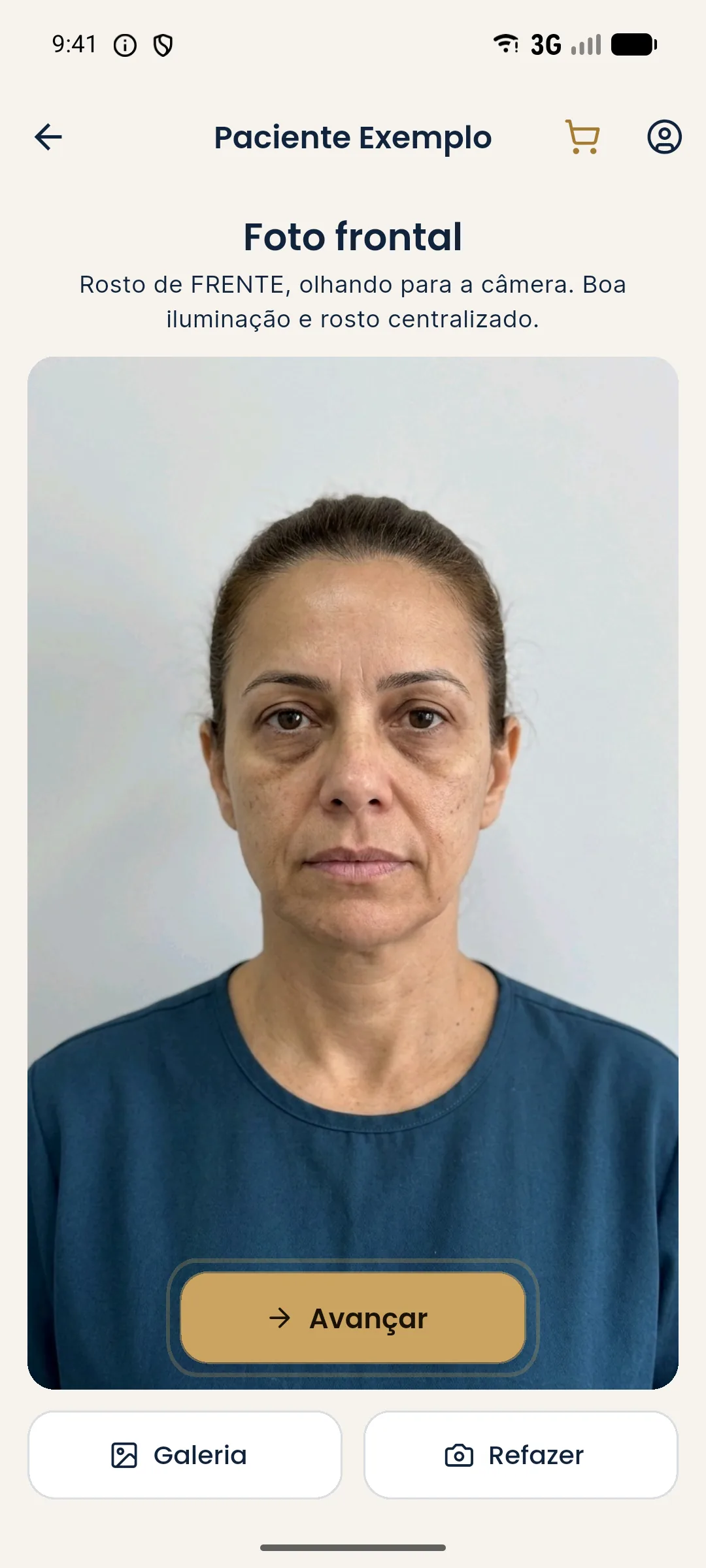
Harmy uses a front-facing photo of the patient and shows an illustrative projection in the Before/After slider. It does not reverse or mirror the image, and the AI does not change the expression or the background. This allows a useful conversation: the patient sees their face as others see it, with the possible change in the marked areas. To avoid selfie bias, use a standardized photo taken with the rear camera at the right distance, as in standardized front-facing photo.
How do filters and social media factor in?
Today, part of a patient's self-image comes from filters and editing apps. A filter smooths the skin, slims the nose, enlarges the eyes and makes the face symmetrical. Someone who sees themselves with a filter for hours a day may find it hard to accept their own unedited face, and the concern may come from that gap rather than from a real feature. This is covered in filter face: how to handle unrealistic references.
A useful approach is to ask: "Do you use a filter? Which one?" and have the patient show you. Compare the filtered image with the standardized photo and talk about what is possible and what is an app effect. It does not have to be a confrontation: it is a way to anchor expectations in something real.
The opposite also happens: the patient who avoids photos and mirrors out of discomfort. In these cases, the standardized photo can be a delicate moment, and how you handle it matters. Explain why the photo is needed, show only what is necessary and respect their pace. If the discomfort is intense and persistent, consider psychological distress and a referral, as covered in HOF plan and the patient's mental health.
Finally, remember that self-image changes during the plan. After the procedure, the patient may start noticing other areas. This is common, and worth discussing early to avoid an endless chain of new concerns.
Summary
Mirror, selfie and photo are different images. Understanding this helps you listen to the concern, calibrate expectations and avoid treatments based on distortion. Use standardized photos, talk without dismissing the patient and decide together. The decision belongs to the licensed professional, in line with the rules of their professional council.
Frequently asked questions
Why does a patient look different in the mirror and in a photo?
The mirror reverses left and right, and the patient gets used to that version. A photo shows the image as others see it, and a close-up selfie distorts proportions. These differences change how asymmetry and proportion are perceived.
Does a selfie show the real face?
Not faithfully. A close camera and a wide-angle lens change proportions, especially of the nose and the center of the face.
Does this invalidate the patient's concern?
No. The concern is real to the person who feels it. Understanding where the perception comes from helps calibrate it and decide whether the plan is appropriate.
Can I use the mirror during the consultation?
Yes, as a conversation tool. Showing the mirror next to the standardized photo helps the patient understand why they see themselves differently.
Harmy images are illustrative simulations generated by AI from the patient's photo to support the conversation between practitioner and patient. They are not a promise of results. Indication, technique, product and volume are solely the decision of the licensed practitioner. This content is for information only and does not replace a clinical assessment.