
Digital Rulers and Photo Scale: Common Mistakes in HOF

Quick facts
- Topic
- Measurements in the photo and scale
- Core problem
- A 2D photo without a reference does not give real millimeters
- Sources of error
- Distance, lens, head tilt and expression
- Safe use
- Proportions and relative ratios, not absolute values
- Scale reference
- A ruler or object of known size in the plane of the face
Every photo of a face seems to contain measurements. Just open a ruler app, draw a line between two points and a number in millimeters appears. The number is precise on the screen and almost always imprecise in reality. In facial harmonization planning, treating that number as fact leads to wrong decisions. This page explains why scale fails, where the most frequent errors are and how to use photographic measurement honestly.
Why can't a photo measure millimeters on its own?
A photo is the projection of a three-dimensional object onto a two-dimensional plane. The relationship between size in the image and real size depends on the distance between the camera and the face, the focal length of the lens and the angle between the two. Without knowing those three values, it is impossible to convert pixels to millimeters with confidence. Even with them, the face is not flat: the nose is closer to the camera than the ears, so structures in different planes have different scales in the same image.
That is why the digital ruler's number should be read as an estimate, never as clinical data. The logic of this limitation is a close relative of the one in limits of 2D simulation and reference lines on the frontal photo.
What are the most common mistakes?
| Mistake | What happens | How to avoid it |
|---|---|---|
| Photo taken too close | Nose and chin look larger and the sides smaller | Increase the distance and use moderate zoom |
| Camera above or below eye level | Forehead or chin looks elongated | Camera at eye level |
| Face slightly turned | One side looks wider | Align by the eyes and the Frankfurt plane |
| Uncalibrated digital ruler | Numbers unrelated to reality | Calibrate against a known object in the plane of the face |
| Different expression between photos | Distances change with facial movement | Standardize a neutral expression |
| Comparing photos from different devices | Different lenses, different perspectives | Keep the same device and the same settings |
The lens is a separate point. Phones with a wide-angle camera distort the edges, and the effect is greater the closer the patient is. See distance and lens in the assessment photo and camera height in the patient photo.
How do you use a scale reference?
If you need approximate measurements, place an object of known size in the same plane as the face, near the area of interest. It can be a rigid ruler held against the side of the face or a sticker of known dimensions on the forehead. The object's distance from the camera must be the same as the point you want to measure, otherwise the scale does not hold. Even so, the result remains approximate.
When is a proportion better than a measurement?
The proportion between two distances in the same photo cancels out much of the scale error. If the distance between the eye corners and the width of the base of the nose are in the same image, the ratio between them is far more stable than either value alone. That is why the most useful planning tools work with ratios: facial thirds, fifths, the relationship between upper and lower lip. See neoclassical canons of the face and how to measure facial symmetry.
Even so, proportion is not a goal. The canons are historical references, not mandatory targets, and they vary between populations, as discussed in facial proportions vary between populations.
What does this mean for the simulation?
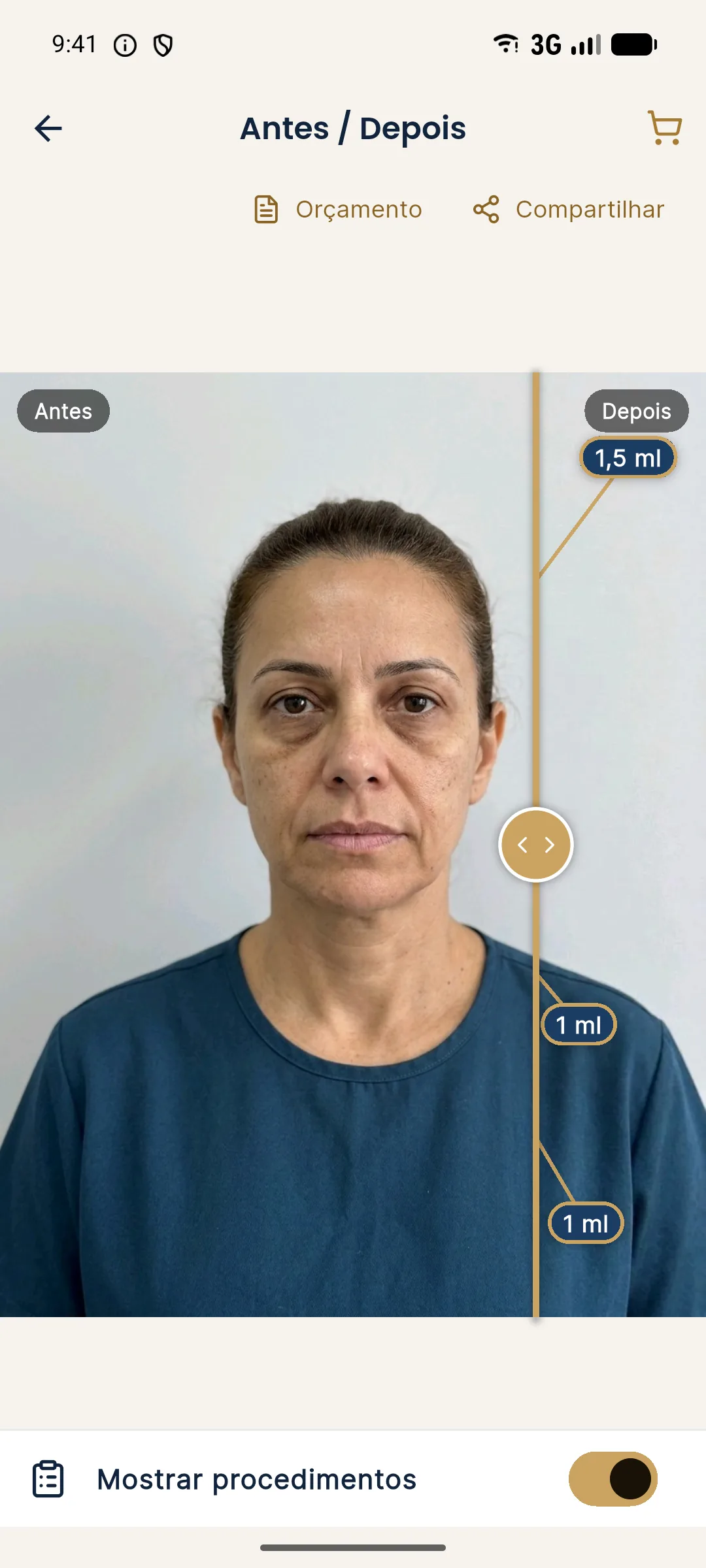
Harmy's projection does not depend on a measurement in millimeters. The app detects the face on the device, shows the points of the areas, and the volume is entered in ml per area, in steps of 0.5, from 0.5 to 5 ml. The AI respects the volume proportionally and changes only what was marked. That means ml is an intended volume, and the visual result in the image is an illustration, not a measure of what will be delivered in millimeters of projection.
How do you talk about measurements with the patient?
Patients like numbers, and that can be used carefully. Instead of talking in millimeters, talk about proportions and the direction of change. Avoid precision that the photo cannot support.
Practical summary
Use the photo to compare, not to measure. When you need measurements, choose proportions, control distance and lens, and add a scale reference. Always record that the value is approximate and act on the in-person exam. This habit protects the patient from decisions based on a number that looks precise and is not.
What precautions apply to AI facial analysis?
Programs and apps that promise to "measure the face" with artificial intelligence usually detect landmarks in the photo and calculate distances between them. The calculation is reliable as image geometry, but the image inherits all the errors described above. A photo taken up close, slightly tilted, returns measurements consistent with the photo and inconsistent with the face. When using this kind of tool, treat the report as one more annotated photo, not as a diagnostic report. See what this kind of analysis does and does not measure in AI facial analysis: what it measures.
How do you document an approximate measurement?
If you record a measurement in the patient record, also write the conditions: approximate distance, device, whether a reference was used and the fact that it is approximate. A line like "approximate intercanthal distance of 33 mm, estimated on a frontal photo with a ruler in the plane of the face" is honest. Without those conditions, the bare number may be read years later as a clinical measurement. This care ties in with reference lines on the frontal photo and eye width and intercanthal distance.
Finally, remember that many facial harmonization decisions do not depend on any millimeter at all. Almost always, what decides is the volume lost, the cast shadow and the relationship between areas, and all of that is better assessed with the patient in front of you, at rest and in motion, than with a ruler over a screen.
Frequently asked questions
Can I measure the face in millimeters on a phone photo?
Only with a scale reference in the same plane as the face and controlled conditions. Without that, the millimeter value is approximate and can lead to wrong decisions. Relative proportions are more reliable.
Are app-based digital rulers reliable?
They depend on calibration. If the scale was not set against an object of known size at the same distance as the face, the number shown does not represent the real measurement.
Does Harmy measure millimeters of the face?
No. The app detects the face on the device to mark the areas and sets volumes in ml. It does not provide measurements in millimeters or replace a clinical exam.
Which counts for more, the absolute measurement or the proportion?
The proportion between two distances in the same photo suffers less from scale error, because both are affected the same way. That is why it is usually more useful in planning.
Harmy images are illustrative simulations generated by AI from the patient's photo to support the conversation between practitioner and patient. They are not a promise of results. Indication, technique, product and volume are solely the decision of the licensed practitioner. This content is for information only and does not replace a clinical assessment.