
Face at rest vs in motion: what changes in the plan

Quick facts
- Topic
- Static and dynamic assessment in the facial harmonization plan
- Static finding
- Visible at rest, tied to volume, skin and support
- Dynamic finding
- Appears with expression, tied to muscle action
- Impact on the indication
- Determines toxin, volume or a combination
- Simulation limit
- The projection uses a still photo and does not show movement
Two patients point to the same line on their face. In the first, it is there with the face completely relaxed. In the second, it only shows up when they smile or frown. At first glance, it is the same concern. In practice, they are two different problems, with different causes, that call for different reasoning. Assessing the face at rest and in motion is one of the steps that most changes the indication in facial harmonization.
What are static and dynamic findings?
Static findings are those that exist with the face at rest: deep folds, hollows, volume loss, laxity, bags and spots. They are usually tied to volume, skin quality and support, the position of fat compartments and bone structure. Dynamic findings are those that appear or intensify with facial expression: expression lines on the forehead, glabella, around the eyes and around the mouth. They relate to the action of the muscles of expression.
In real life, the two blend. A dynamic line that repeats for years can become static. And a static hollow can deepen during movement. That is why the professional looks at both and works out which one predominates. See the glossary entries on dynamic wrinkles and static wrinkles.
How do you assess at rest?
Ask the patient to relax the face, without smiling, with the mouth in a natural position, eyes forward and head in a neutral position. Observe with diffuse light and, if possible, with side light too, which shows relief. The standardized frontal photo documents this state. The timing of the assessment affects the outcome: right after waking up or after crying, the face looks different. Standardize.
See the basics in neutral expression in the planning photo and lighting for the planning photo.
How do you assess in motion?
Ask for a simple sequence of expressions: raise the eyebrows, frown, squeeze the eyes shut, smile with the mouth closed, smile showing the teeth and say a few words. Observe the symmetry between sides, the intensity of each movement and which muscles dominate. Short videos, with specific consent, help with later review and with showing the patient. See dynamic facial analysis in expression and consent for clinical video.
How does each finding change the indication?
| Finding | Interpretation | Usual direction of reasoning |
|---|---|---|
| Line only in motion | Muscle action predominates | Consider modulating muscle action |
| Line at rest and in motion | Mix of action and static mark | Combine approaches, depending on the assessment |
| Hollow at rest, no movement | Volume or support loss | Consider volume replacement |
| Fold that deepens with a smile | Volume, ligaments and facial expression | Assess the cause before treating the fold |
| Asymmetry only in motion | Difference in action between sides | Caution, especially with muscle treatment |
| Thin skin with a persistent mark | Skin quality | Consider skin quality approaches |
The table shows a direction of reasoning, not a product or technique indication. The decision belongs to the qualified professional, after assessment, according to their professional council's rules. For the reasoning between toxin and filler, see toxin or filler first and muscle map for botulinum toxin.
Why does this matter for natural-looking results?
A plan that corrects only what is static can leave the face "frozen," with reduced expressions. A plan that corrects only what is dynamic can leave volume marks unresolved. The balance between the two is what gives naturalness. Anyone who watches the patient talk, laugh and react during the consultation can tell which face type is in front of them. See expressionless face: how the plan avoids the effect and natural-effect plan.
What does the simulation show, and what does it not?
Harmy's projection uses a still frontal photo and simulates only the marked areas. This makes it good for discussing volume and contour, and limited for discussing movement. The app does not show how the face looks when smiling, frowning or talking, and the AI does not alter expression. So showing the After image says nothing about muscle behavior after the plan.
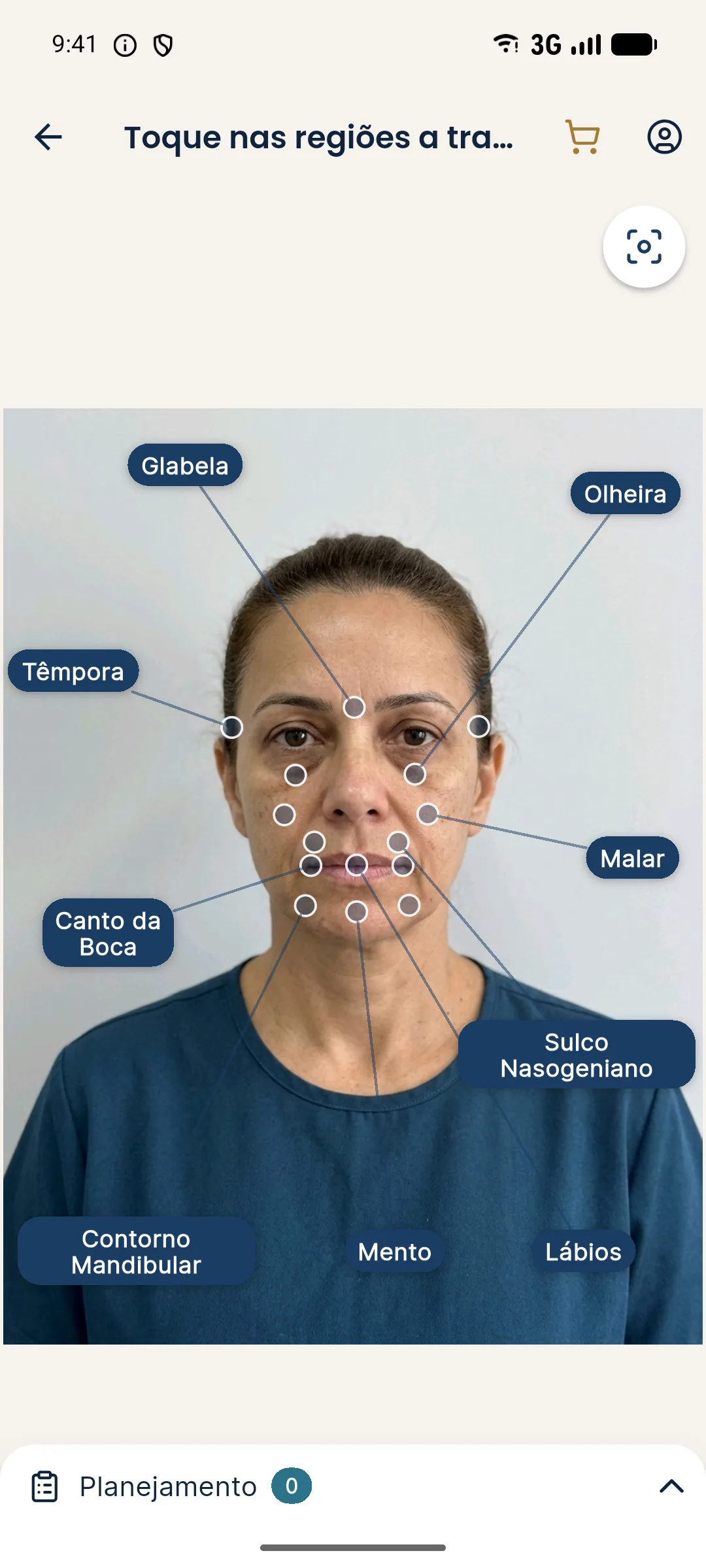
To compensate, read the simulation does not show movement: how to compensate and limits of 2D simulation.
How do you explain it to the patient?
Use their own photo. Show the image at rest and ask them to make the expression, so they can see what changes. Explain that the plan has to address what is still and what moves, and that the app's image shows only the still part.
What mistakes should you avoid?
The most common are assessing only at rest, assessing only in forced expression and relying on the photo alone. The expressive face in the consultation, in conversation, differs from the face in a pose. Another mistake is planning from exaggerated expressions, which show a movement the patient never makes day to day. Record what is habitual and what is provoked, and plan for the habitual.
Frequently asked questions
What is the difference between a static and a dynamic finding?
A static finding is visible with the face at rest, such as a fold or a hollow. A dynamic one only appears or deepens during expression, such as the forehead line when raising the eyebrows.
Why assess in motion before planning?
Because the same line can have different causes, and the indication changes. Observing at rest and in expression helps decide between muscle action, volume loss or both, at the professional's discretion.
Does the Harmy simulation show the face in motion?
No. The projection uses a still frontal photo and changes only the marked areas. To assess movement, observe the patient and, if you like, record short videos with their consent.
How do I explain to the patient that a line at rest and in motion calls for different approaches?
By showing the line in the still photo and during expression, and explaining that the cause may be muscular, volume-related or both. The image supports the conversation, and the decision is the professional's.
Harmy images are illustrative simulations generated by AI from the patient's photo to support the conversation between practitioner and patient. They are not a promise of results. Indication, technique, product and volume are solely the decision of the licensed practitioner. This content is for information only and does not replace a clinical assessment.