
Expressionless face: how the plan avoids the effect

Quick facts
- Topic
- Avoiding the expressionless face in the facial harmonization plan
- Common cause
- Excess muscle modulation or volume in expression areas
- Warning sign
- A face that does not follow emotion
- Strategy
- Treat what bothers the patient and preserve useful expression
- Tool
- Assessment in motion before and after
There is a kind of result the patient describes with the phrase "my face doesn't feel like mine." It is not an obvious change, and hardly anyone points it out. But the face no longer follows emotion: the forehead does not move, the smile is restrained, the gaze looks fixed. This is the so-called expressionless face, and it is one of the most uncomfortable effects of a poorly calibrated plan. This page shows how planning prevents it.
What is the expressionless face?
It is the loss of part of the facial expression that gives the face its ways of communicating. It can result from excessive muscle modulation, from combining toxin with volume in areas of heavy movement, or from a plan that prioritizes the absence of lines over the comfort of the face in action. Generally, it is not the effect of a single decision but of a sum of decisions that each, taken alone, seemed reasonable.
The topic connects with natural-effect plan, pillow face and dynamic facial analysis in expression. All of them defend the same idea: the face lives in motion, and the plan must serve that motion.
Which decisions lead to this effect?
If several items show up in your plan, it is worth reviewing. The logic of avoiding build-up is the same as in when total volume becomes excess and risks of a facial harmonization plan that is too long.
How do you balance toxin and volume?
Toxin and filler act on different problems. Toxin acts on muscle action, and filler acts on volume and support. When used without balance, one can compensate for the excess of the other, producing a face that looks too "done." The question that helps is: what actually bothers the patient? If it is the line that appears with movement, the answer tends to differ from that for the fold that exists at rest. See toxin or filler first and face at rest vs in motion.
| Situation | Risk of an expressionless face | Direction of care |
|---|---|---|
| Several expression areas treated at maximum intensity | High | Prioritize the areas of greatest concern and reassess |
| Light toxin and conservative volume | Low | Keep the pattern and observe |
| Volume in lips and mouth corners plus perioral toxin | Moderate to high | Plan in steps and assess speech and smile |
| Plan focused on a single concern | Low | Reassess before adding |
| Frequent touch-ups without a pause | Increases over time | Set intervals and photograph expression |
The table points to directions, not doses. The choice of product, dose and technique belongs to the qualified professional, according to their professional council's rules.
How do you assess expression before the plan?
Watch the patient talking, laughing and reacting, not just posing. Ask for expressions: raise the eyebrows, frown, smile with the mouth closed and open. Ask which movements they consider characteristic and want to keep. Many people have gestures that are part of their identity, like raising one eyebrow when asking a question. If the plan erases that gesture, the patient will notice the loss. See facial identity: how to preserve it.
How can the plan be designed to preserve expression?
A few guidelines help, always subject to clinical assessment. Treat fewer areas at a time, starting with the one that bothers the patient most. Reassess with the patient in motion before adding more. Accept a result with some residual line, rather than aiming for zero. Avoid combining toxin and volume in the same highly mobile area without a clear need. Explain to the patient that the goal is to soften, not paralyze. See also treating from top to bottom or bottom to top.
What does the simulation show on this topic?
Harmy's projection is made on a still frontal photo with a neutral expression and changes only what was marked. This means the After image does not tell you whether the face will keep its expression. The app is useful for discussing volume and contour at rest, not for predicting movement. If you show the projection to the patient, say clearly what it does not show, so a pretty image does not replace the conversation about expression.
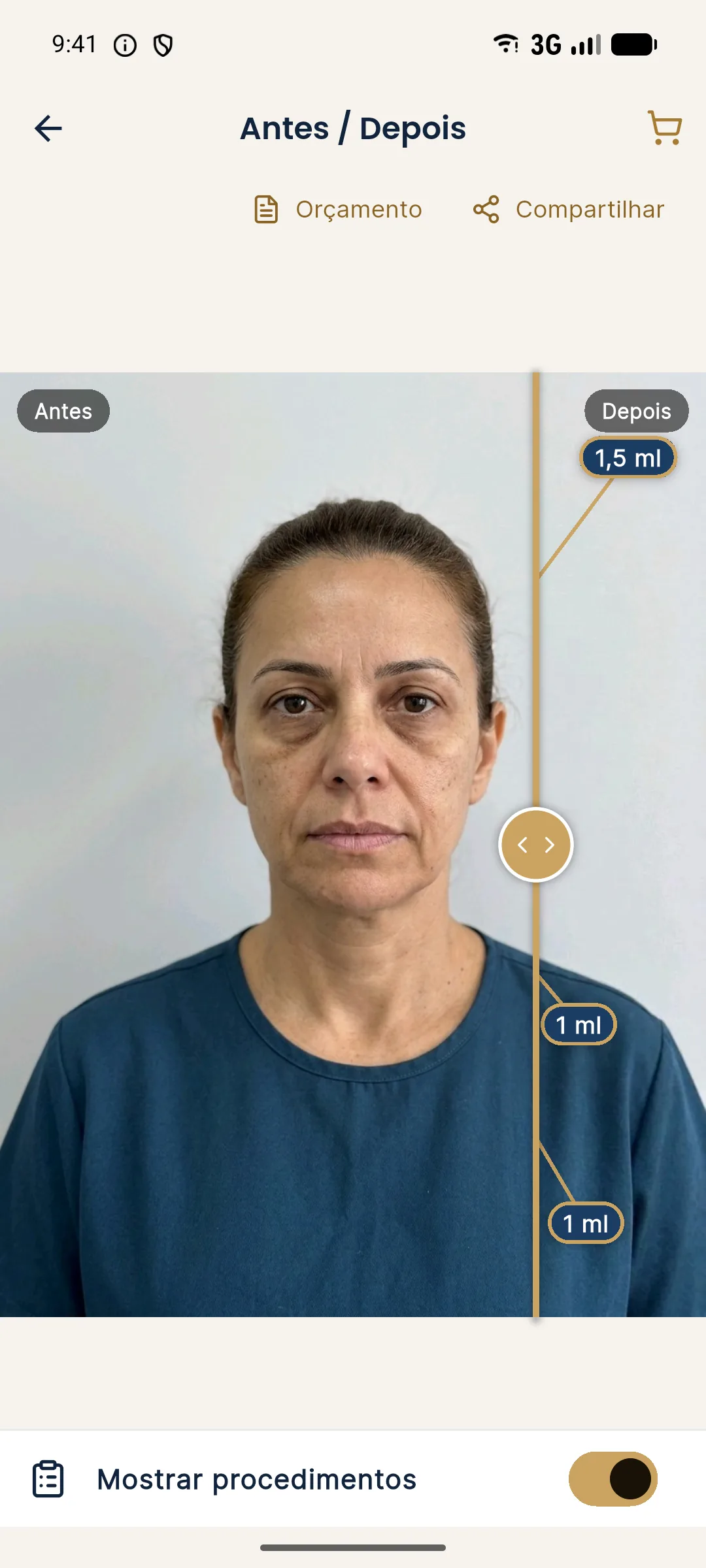
See the simulation does not show movement: how to compensate and limits of 2D simulation.
How do you talk with the patient?
Explain that the goal of the plan is to preserve naturalness. Many patients ask to "get rid of everything," and talking through what that implies prevents regret. Offer the gradual path: treat less, assess and add if needed. It is easier to add than to undo.
And after the procedure?
At follow-up, watch the patient talk and laugh, ask them to describe what they feel and compare with the before videos or photos. Ask specifically: "do you feel your face follows what you feel?" The answer matters more than the still photo. If there is a sense of a heavy or expressionless face, record it and adjust the plan in the following steps. See what to reassess at plan follow-up.
Frequently asked questions
What causes the expressionless face in facial harmonization?
Generally the combination of excessive muscle modulation and volume placed in areas of heavy movement. The result is a face that barely follows emotion, and the patient may feel unlike themselves.
How do I avoid it in planning?
By assessing the face in motion, treating a few areas at a time, preserving the expression the patient actually uses and reassessing before adding more. The decision and the dose belong to the qualified professional.
Does toxin leave the face expressionless?
Not necessarily. The effect depends on the assessment, the dose and the areas chosen, at the professional's discretion. Planning can aim to soften without paralyzing.
Does the Harmy simulation show whether the face will end up expressionless?
No. The projection uses a still photo and does not alter expression, so it does not show movement. Use clinical observation and conversation to address this risk.
Harmy images are illustrative simulations generated by AI from the patient's photo to support the conversation between practitioner and patient. They are not a promise of results. Indication, technique, product and volume are solely the decision of the licensed practitioner. This content is for information only and does not replace a clinical assessment.