
Mouth with a stern or angry look: what to assess

 BeforeSimulation
- Muscle
- Highlighted area
Quick facts
- Concern
- Mouth that looks closed, tense or angry, even when not angry
- Contributors
- Mentalis, depressor anguli oris, orbicularis, mentolabial fold and lines
- Useful test
- Observe at rest, in silence and distracted, not only posed
- Risk
- Toxin in this area can affect the smile and speech
There is a kind of concern that patients describe with humor: "they say I always look angry." With a closed-looking mouth, the expression says something the person does not feel, and the social consequence is bothersome. The HOF professional needs to turn that impression into anatomical findings: muscle tension, position of the mouth corner, volume of the lip and mentolabial fold, surrounding lines.
This page organizes that assessment and lists the options, with their limits. It relates to sad mouth, downturned mouth corners and angry resting face.
What makes a mouth look angry?
The expression at rest is the result of a balance between muscles that lift and muscles that lower the mouth. When the depressors predominate, the mouth corner drops and the chin tightens, and the reading is one of seriousness or irritation.
| Factor | Role | How it appears |
|---|---|---|
| Depressor anguli oris | Pulls the mouth corner down | Downturned corners, marionette lines |
| Mentalis | Lifts and contracts the chin skin | "Orange peel" chin and pushed-up lower lip |
| Depressor labii inferioris | Lowers and pulls the lower lip sideways | Tense or everted lower lip |
| Orbicularis oris | Closes the lips | Pursed lips, vertical lines around them |
| Mentolabial fold | Crease between the lower lip and the chin | Shadow that hardens the expression |
| Loss of lip and chin volume | Removes support | Thinner, "closed" mouth |
In general, more than one factor contributes, and a good assessment identifies which is dominant. The modiolus at the mouth corner, where several of these muscles meet, is the balance point.
How to assess
The expression at rest can only be seen when the patient does not know they are being watched. That shapes the method.
What HOF can do
The options come from combining the findings, always at the discretion of the licensed professional.
Dominant muscle. Botulinum toxin in small doses in the depressor anguli oris and the mentalis can soften the tension that stiffens the expression. The area demands respect: the depressor labii inferioris and the orbicularis are close by, and diffusion can affect the smile and speech. See toxin in the depressor anguli oris, mentalis toxin and lip ptosis after toxin.
Volume loss. When the corners and the mentolabial fold have lost support, mouth corner filler can help visually lift the mouth. See also deep marionette lines.
Lips and chin. In some cases, the closed mouth is part of a thin lip and a recessed chin. A plan that includes chin filler and lips can soften the apparent tension. See lips and chin: combining in the plan.
Surrounding skin. Vertical orbicularis lines respond better to skin approaches, such as injectable hydration or biostimulation, than to volume. See lips with barcode lines.
Risks
Toxin in the perioral region can cause smile asymmetry, difficulty pronouncing certain letters, lip drooping and a "heavy" mouth sensation, temporarily. Mouth corner filler carries risks of nodules, asymmetry and irregularity, plus swelling and bruising. The area receives branches of the facial artery and hyaluronidase must be available when hyaluronic acid is used. In both cases, the consent form should cite these risks.
How to show it in Harmy
In Harmy, the Mouth Corner point simulates the visual lift and the softening of the marionette lines, and the Chin point simulates chin projection. The projection uses only the resting frontal photo and changes only what was marked, without altering expression, skin or lighting. The app does not simulate the effect of toxin in the mouth area.
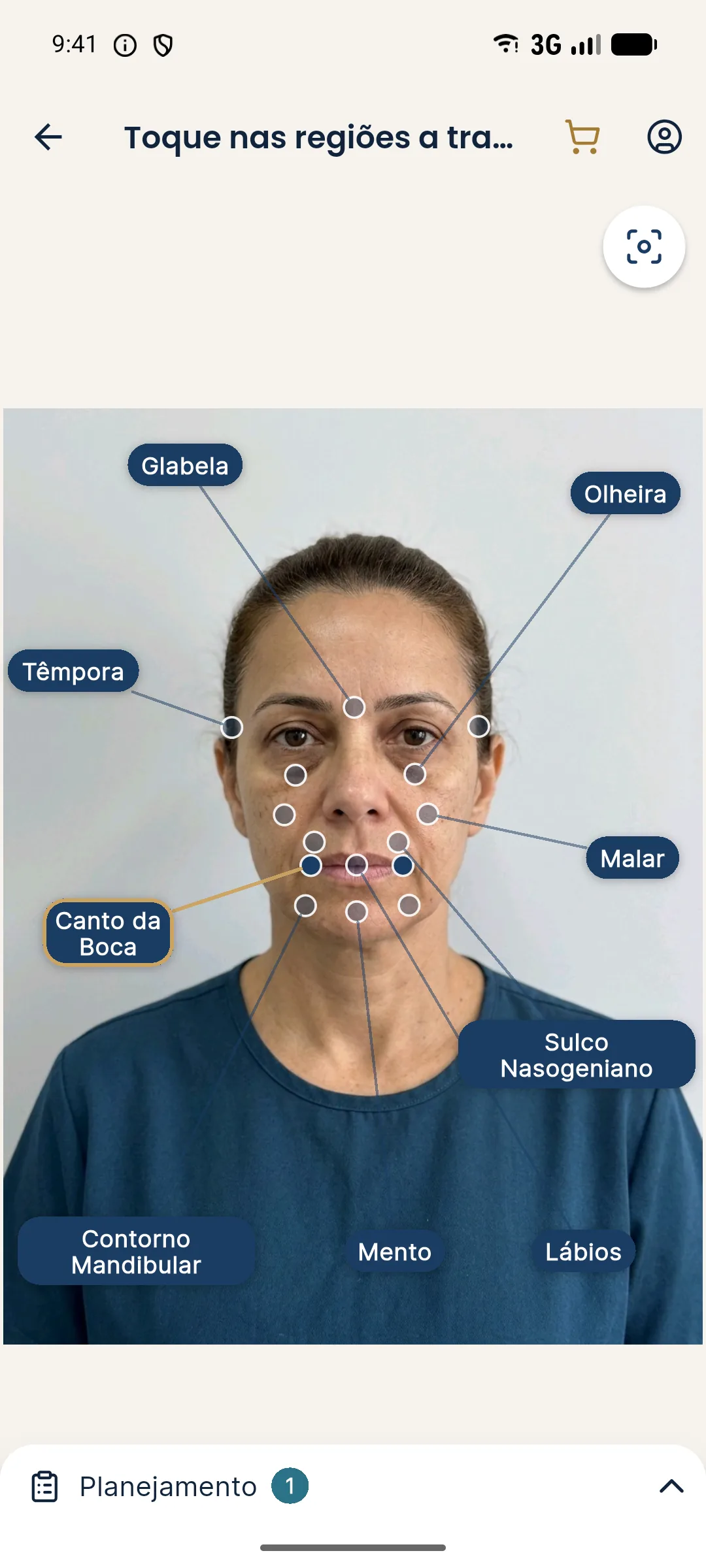
An honest way to use it is to simulate the corners at Subtle intensity and show the patient how much difference volume makes, with the caveat that muscle tension does not appear in the simulation. This avoids the expectation that filler treats muscle.
The role of the gaze and the forehead
A closed mouth rarely explains an angry expression on its own. The gaze weighs heavily: low brows, a frowning glabella at rest and tense eyelids make the face look irritated even with a neutral mouth. So before planning the mouth, look at the upper third. If the patient frowns the forehead and glabella all the time, the conversation about the mouth should come after, or together with, an assessment of the glabella and lines between the eyebrows.
It is also worth asking the patient how they feel in photos and video calls. Many people discover their own resting expression by watching recordings, and the concern is born from that shock. Showing the video in the office, calmly, helps identify what really draws attention, which is sometimes the forehead frown and not the mouth. Document what was shown and what the patient chose to prioritize.
Closing
Record the expression at rest, the predominant cause and what was agreed, with a photo and a short video. If the problem is global, involving the gaze and forehead, consider heavy gaze. Volumes and techniques are left to the discretion of the licensed professional, in line with the rules of their professional council in Brazil, and the plan is usually staged, with reassessment.
Frequently asked questions
Why does my mouth look angry even when I am relaxed?
The expression at rest depends on the position of the mouth corners, the tone of muscles such as the depressor anguli oris and the mentalis, the mentolabial fold and lip volume. Small differences change how the expression reads.
Does botulinum toxin fix an angry-looking mouth?
In some patients, small doses in muscles that pull the mouth down or tense the chin can soften the expression. The indication requires assessment, because the area affects the smile and speech. The decision belongs to the licensed professional.
Does filler help a mouth with a closed expression?
It can help when there is volume loss at the corners, in the mentolabial fold or in the chin. It does not replace muscle balance. In many cases, the plan combines approaches.
Are an angry mouth and a sad mouth the same concern?
They share points, such as downturned mouth corners, but an angry mouth usually has tension in the chin and lower lip, and a sad one has drooping corners. Assessment separates the two.
Harmy images are illustrative simulations generated by AI from the patient's photo to support the conversation between practitioner and patient. They are not a promise of results. Indication, technique, product and volume are solely the decision of the licensed practitioner. This content is for information only and does not replace a clinical assessment.