
Facial harmonization plan with dental lenses and veneers

 BeforeSimulation
Quick facts
- Idea
- Lenses and veneers change the position and exposure of the teeth, and that changes how the lips read
- Rule of thumb
- Plan the smile as a whole, defining who goes first
- Partnership
- Align with the dentist who will do the rehabilitation
- Caution
- Lip support and incisor exposure change after the dental work
Patients getting dental contact lenses or veneers change more than the color and shape of their teeth. They change the position, volume and exposure of the incisors, and the teeth are the support of the lips. As a result, the smile, the upper lip and the relationship with the lower third can read differently after the rehabilitation.
The theme of the plan is order and partnership: who goes first, how much to change and how to coordinate with the dentist.
What do lenses and veneers change in the face?
Depending on the design, dental treatment can alter:
- the incisor exposure at rest and when smiling;
- the upper lip support, which moves forward or back as the teeth advance or recede;
- the smile arc and its relationship with the lower lip;
- the buccal corridor, the dark space at the sides of the smile.
These items appear in buccal corridor and smile, smile arc and lower lip curve and smile analysis in harmonization. The patient's view is in dental contact lenses and harmonization.
What is the safest order?
There is no single rule, but the reasoning below usually organizes the conversation:
| Scenario | General stance | Reason |
|---|---|---|
| Dental rehabilitation planned | Wait and align with the dentist | Tooth position changes lip support |
| Rehabilitation already done | Assess lips and smile with the new support | New base, new concern |
| Lip with an evident functional or aesthetic concern | Discuss treating in parallel, with care | The patient may have urgency |
| Doubt about the tooth design | Ask the dentist for a digital plan or a provisional | Visualize before deciding |
In general, dental support comes first because it defines the base the lip rests on. This is not a rule, and your clinical judgment and the dentist's prevail. See the view on order in order of procedures in the same session and veneers and smile planning in harmonization.
How is the lip reassessed afterward?
After the teeth change, reassess with photos and with the patient in motion:
- Rest. How much of the incisor shows, and how does the upper lip sit?
- Smile. Is there excess gum or tooth exposure? Does the smile arc follow the lower lip?
- Speech. Does the lip move harmoniously with the new design?
- Proportion. Do the vermilion and the Cupid's bow follow the whole?
It is common for patients to feel that "the lip got thin" after rehabilitation, because the tooth takes up more visual space. Before increasing, check whether the problem is lip volume or proportion with the tooth. See lip filler and lips and mouth corners: combining in the plan.
What about the simulation?
Harmy's simulation is made on the frontal photo and changes only the marked areas; it forbids changing expression and does not redesign teeth. So it has a specific role: showing the illustrative effect of a lip volume on the current smile. When the smile changes, redo the photo and the projection.
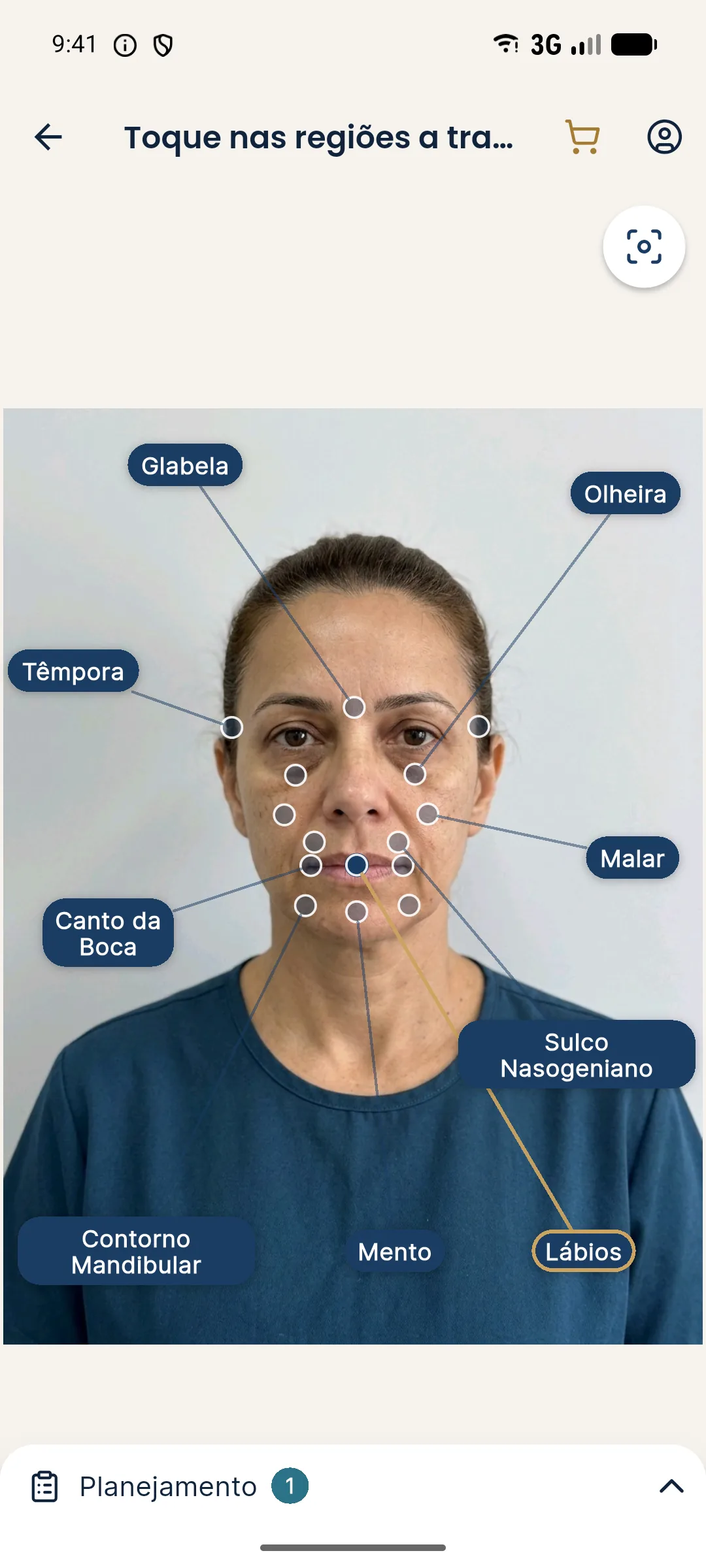
For planning the dental design, the right tool is the dentist's. Use Harmy's simulation as a complement, not a replacement. See the limits of 2D simulation.
How do you align with the dentist?
Simple, documented communication avoids most conflicts:
- ask the patient's permission to share information;
- send standardized frontal and smile photos;
- ask for the expected finish date and whether a change in lip support is expected;
- agree on who does each stage and in what order;
- record everything in the patient record.
What should you record in the plan?
Note the date of the rehabilitation, the type (lens, veneer, resin), the expected finish date and the responsible professional. Also record the incisor exposure measurements at rest and when smiling, and the standardized photos. This gives a basis for comparing before and after and for justifying the order chosen. See plan diary: session-by-session progress record.
What mistakes appear in this combination?
The most common are: enlarging the lip to compensate for teeth that are too large, treating the lip before the dental design is defined, and forgetting that the upper lip rests on the incisors. Another mistake is assuming the patient wants more lip volume after the lenses, when sometimes they want less: the new tooth already draws attention and a full lip can compete with it.
What should you show the patient before the lenses?
When the dentist offers a mock-up, photograph the patient with it at rest, smiling and speaking. These photos show the lip support to come. If the patient approves the design, assess the lip on top of it; if not, the adjustment is the dentist's, and your plan waits. Avoid giving opinions on the dental design beyond what falls within your field.
What about maintaining the whole?
Lips and teeth age at different rates. Schedule periodic reviews of the whole smile, with photos at rest and smiling, and adjust lip volume only if the proportion changes. A rehabilitated, well-balanced smile usually needs little lip intervention over the years.
Practical summary
Treat teeth and lips as a whole. Align the order with the dentist, use a mock-up or provisional when possible, reassess lip support after the rehabilitation and redo the simulation with the new smile. Avoid enlarging the lip to compensate for a dental design that can still be adjusted.
Frequently asked questions
What comes first, harmonization or lenses?
There is no single rule. In general, dental rehabilitation defines the position of the teeth and the lip support, and lip adjustment comes afterward, but the plan should be agreed with the dentist.
Do lenses and veneers change the lips?
They can change the support and exposure of the teeth, which alters how the lip and smile read. The effect is individual.
Can I fill the lip before getting the lenses?
You can, but there is a risk of rework if the lip support changes. The decision depends on the dental plan and should be discussed with the dentist.
Does the simulation show the smile with lenses?
No. Harmy's simulation changes only the marked areas and forbids changing expression and teeth. It is not a diagnostic wax-up.
Harmy images are illustrative simulations generated by AI from the patient's photo to support the conversation between practitioner and patient. They are not a promise of results. Indication, technique, product and volume are solely the decision of the licensed practitioner. This content is for information only and does not replace a clinical assessment.