
Lips and Mouth Corners: Why to Combine Them in the Plan

 BeforeSimulation
- Muscle
- Highlighted area
Quick facts
- Core idea
- A downturned corner makes the lip look smaller and the face sadder, even with adequate volume
- Risk of treating only the lip
- More lip volume without treating the corner can accentuate the imbalance
- Structures
- Modiolus, depressor anguli oris, zygomaticus major, orbicularis oris
- Warning
- The perioral region carries vascular and asymmetry risk: conservative plan
A lip with good volume can look small when the corner of the mouth is downturned. The face takes on an expression of sadness or tiredness, even when the patient is relaxed. On the other hand, a well-positioned corner gives the smile a more open look and makes the lip look more proportionate. The two are so closely related that treating them separately usually leads to partial results.
This page explains why lips and mouth corners should be planned together, which structures determine corner position, how to assess at the consultation and what care the area requires. It is a planning discussion, with no application protocol.
How does the mouth corner change how the lip looks?
The eye reads the lip as a whole: the vermilion, the border, the position of the corners and the relationship with the chin. When the corner drops, the line of the mouth points downward, the upper lip looks shorter and the lower one heavier. Patients often describe this as a "thin lip" or an "angry face," without noticing that the problem is corner position.
A patient with good lip volume and downturned corners may leave a lip filler session dissatisfied, because the volume went where the concern was not. That is why the first question in the assessment is: is the problem the lip or the corner?
| Finding | Possible reading |
|---|---|
| Thin lip, level corner | Concern mainly about lip volume |
| Full lip, downturned corner | Concern mainly about corner position |
| Thin lip and downturned corner | Both contribute: assess priority |
| Evident marionette lines | Descent of the corner and tissue: assess the cause |
| Asymmetric smile | Assess muscles and structure before deciding |
Reading the lip on its own is covered in thin lip: assessment and asymmetries in asymmetric lips: assessment.
Which structures determine corner position?
The corner of the mouth is the meeting point of several muscles, and its position results from the balance between those that lift it and those that pull it down.
- The modiolus is a fibromuscular node beside the commissure, where several muscles converge.
- The zygomaticus major lifts the corner when smiling.
- The depressor anguli oris pulls it down, and is one of the main players in a downturned corner.
- The orbicularis oris closes and projects the lips.
Beyond the muscles, there is loss of volume and support around the area, descent of midface tissue and loss of chin support. This explains why a downturned corner often comes with marionette lines and a deeper nasolabial fold. The full design of the area is in mouth corners, marionette lines and chin: combining them.
Why may treating only the lip not be enough?
The lip is the element that draws the most attention, so it is what the patient asks for. But the plan needs to look at the context. Three situations illustrate the risk:
- More volume with a downturned corner. The lip gets bigger, the corner still points down, and the face looks like it has a large, sad mouth.
- Volume above the fold. Enlarging the lip without treating the marionette lines can highlight the transition and leave the area heavy.
- Imbalance with the chin. A larger lip with a retruded chin throws off the profile (see lips and chin: balancing the lower profile).
How do you assess at the consultation?
Assessing the perioral region combines observation at rest, in motion and in photos.
The smile comes in through smile analysis in HOF, and the buccal corridor and smile arc appear in buccal corridor and smile and smile arc and lower lip curve.
How do you think through the combined plan?
The reasoning, without a protocol, can follow four steps:
- Define the main concern. Is it volume, definition, corner position or a sad look?
- Identify the cause. Lip volume, muscle tone, loss of midface or chin support.
- Prioritize. Put first the area that weighs most in the concern, in stages.
- Reassess. See the effect of the first step before the second.
In many cases, the plan combines a support or corner stage with a lip stage, never everything at once. The order can change depending on the case, as discussed in treating the fold or the cause of the fold.
What role does toxin play in this area?
Some patients have a very active depressor anguli oris, which pulls the corner down when talking and at rest. In certain cases, the professional may consider addressing the muscle, and the assessment decides. The area carries functional risk (speech, smile, chewing), so greater care is needed. The discussion is in botulinum toxin: depressor anguli oris and asymmetric smile after toxin.
How do you explain it to the patient?
Patients usually ask for lip and do not think about the corner. A visual explanation works: show, on their photo, the line joining the corners and how it curves downward. Often the patient notices right away and begins to understand the plan.
The conversation about the lip and the corner specifically appears in explaining the lip to the patient and explaining the mouth corner to the patient.
How does Harmy simulate lips and corners?
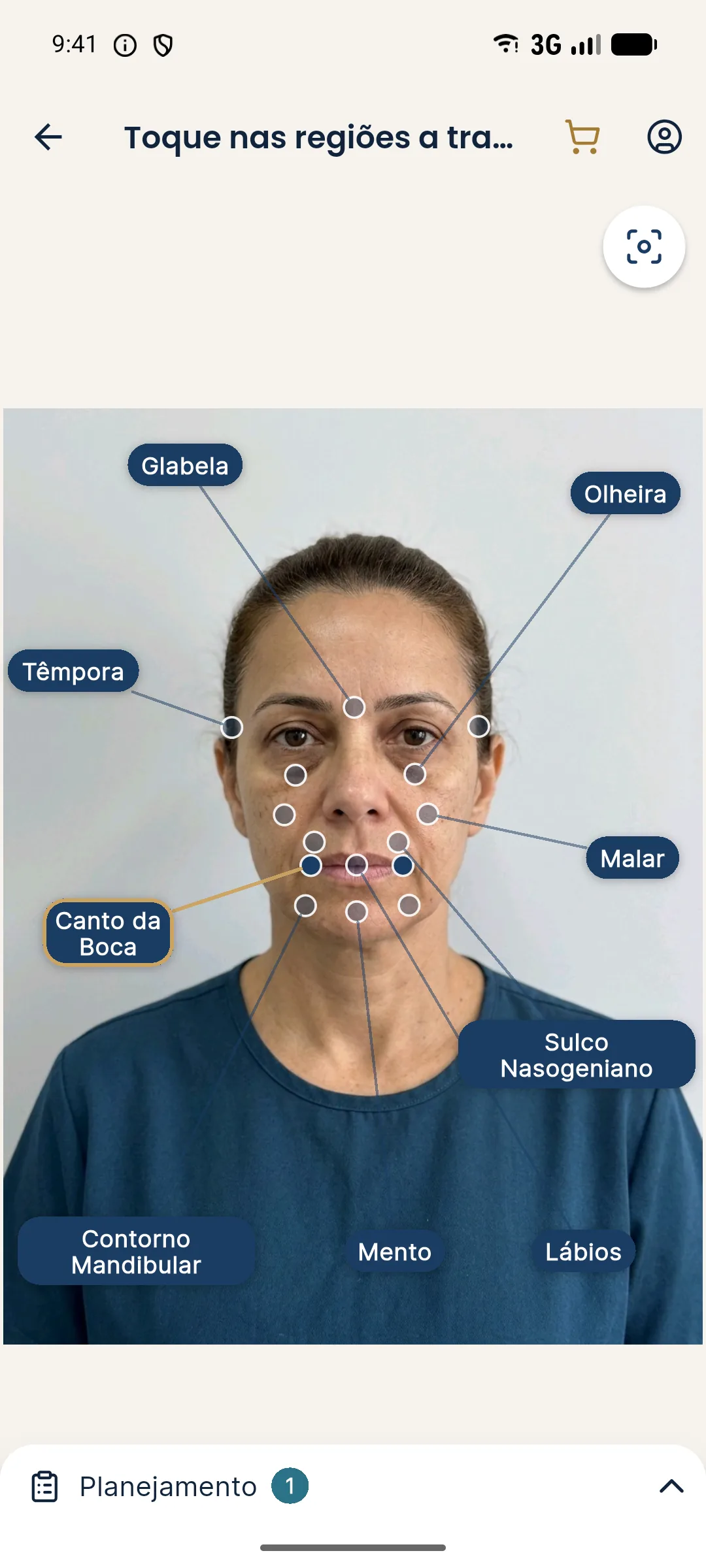
Combining the two areas in the projection helps the patient see the difference the corner makes to how the lip looks. The steps in the app are in marking the mouth corner in Harmy and marking the lips in Harmy.
Quiz: lips and corners
Summary
- A downturned corner changes how the lip looks and the expression of the face.
- The modiolus, depressor anguli oris, zygomaticus major and orbicularis oris define corner position.
- Treating only the lip may not resolve it, and excess accentuates tiredness.
- Assess at rest and smiling, and plan in stages.
- The region carries vascular and asymmetry risk: conservative plan, hyaluronidase on hand.
- Harmy lets you mark Lips and Mouth Corner in the same projection.
Frequently asked questions
Why plan lips and mouth corners together?
Because a downturned corner changes how the lip is perceived and the overall expression. Treating only the lip may not resolve the concern of a sad face or a small lip.
Does enlarging the lip fix a downturned corner?
Generally not. The corner depends on support, muscles and the surrounding tissue. The assessment should tell apart what is lip volume from what is corner position.
What are marionette lines?
They are the lines that run down from the corner of the mouth toward the chin. They are usually tied to the corner dropping and to loss of support in the area, and management depends on the case.
Does Harmy simulate the mouth corner?
Yes. Among the app's marking points are Lips and Mouth Corner, each with ml and intensity. The projection is an illustration and does not promise a result.
Harmy images are illustrative simulations generated by AI from the patient's photo to support the conversation between practitioner and patient. They are not a promise of results. Indication, technique, product and volume are solely the decision of the licensed practitioner. This content is for information only and does not replace a clinical assessment.