
How to explain the lip plan to the patient

 BeforeSimulation
- Nerve
Quick facts
- Core message
- The goal is proportion and contour, not just more volume
- Expression to avoid
- Duck lips and similar
- Key choice
- Contour, volume, hydration or a combination
- Risk to mention
- Swelling, bruising, asymmetry, nodules and vascular complication
The lip is the area where patients most often ask for "just a little" and where "too much" is most often delivered. The difference lies in the conversation: when the professional does not align what the patient imagines by "natural," each side has a different idea, and the follow-up becomes uncomfortable. This page proposes a way to explain the plan for the lips, focused on proportion and respectful language.
How do you start the conversation?
Ask what the patient would like to change and request a reference: a photo of their own lips at another stage, a shape they admire, or a word that describes what they imagine. Avoid using other people as a goal, because the plan should start from their own face. Then explain the principle.
What should you explain about proportion and contour?
In a few words, three elements guide the plan. Lip proportion describes the relationship between the two lips, the Cupid's bow gives the upper lip its shape, and the vermilion marks the visible part. The philtrum and the contour line also come into play.
| Element | How to explain it |
|---|---|
| Proportion | The balance between the upper and lower lip |
| Contour | The definition of the border, which shapes the mouth |
| Volume | The body of the lip, which should suit the face |
| Hydration | The quality of the surface, with or without volume |
These references are guidelines, not fixed rules. The decision is at the professional's discretion after assessment.
How do you talk about excess without saying "duck lips"?
The patient's fear is looking artificial. Instead of labeling, describe: "When the lip gains too much volume for the face, the mouth can look artificial. That is why I prefer to go gradually and adjust." The phrase "duck lips" should be avoided because it offends those who have already had treatment and puts the patient on the defensive. The conversation about naturalness goes deeper in aligning expectations of naturalness.
When the patient asks for a volume you consider excessive, the answer is the one in how to say no to the patient in facial harmonization: explain the reason, offer a staged alternative and use the simulation as support.
How do you use the Harmy simulation?
Harmy marks the Lips point on the front-facing photo and simulates volume in ml. It is useful for showing a discreet change to a patient who fears overdoing it. The "First time" shortcut applies lips 1 ml Moderate, and "Maintenance" applies lips 0.5 ml Subtle.
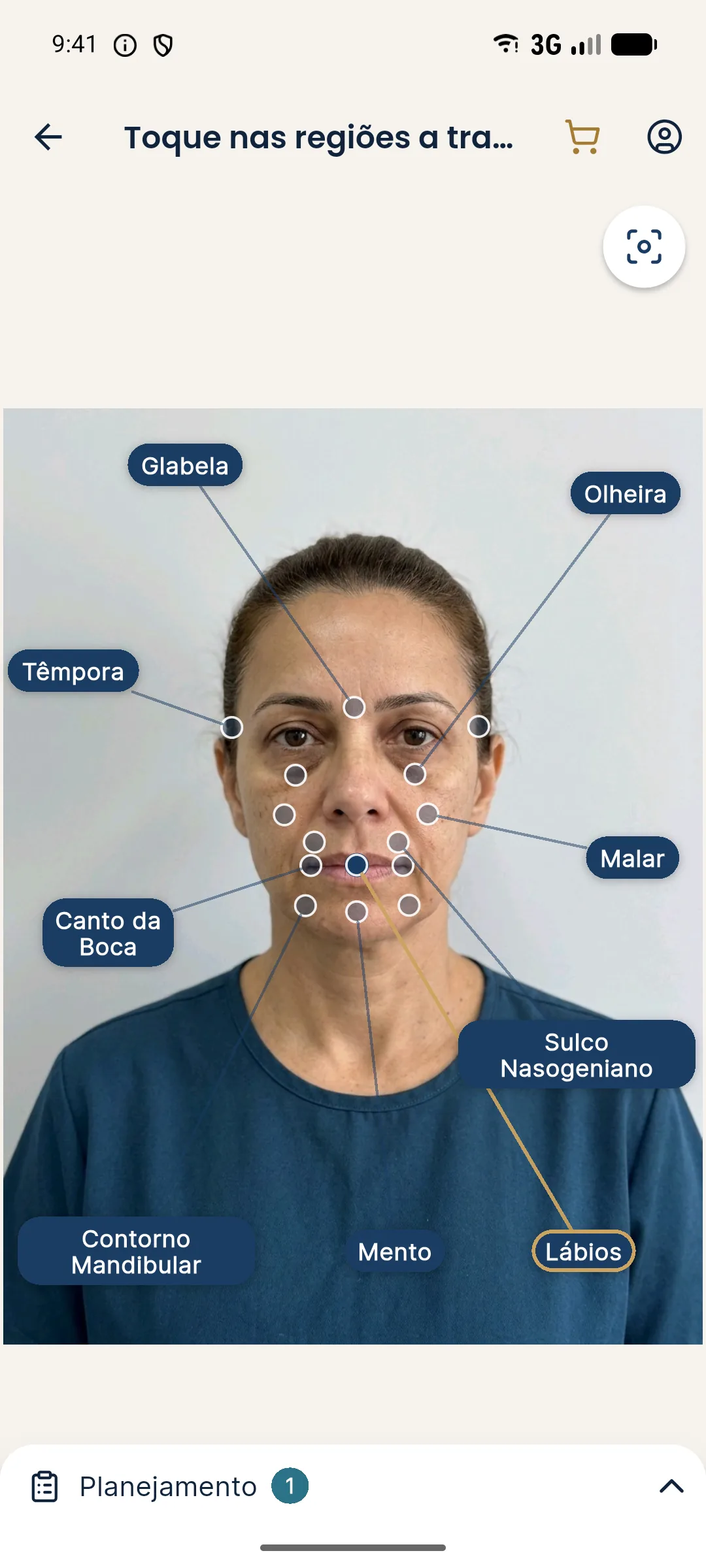
Show the same area at two levels and ask which one is closer to what they imagine (see how to explain subtle, moderate or pronounced intensity).
Which risks should you explain?
Be frank, in proportion. The lips have large-caliber vessels and are an area of heavy movement. Mention:
- swelling and bruising, which tend to be more obvious than in other areas;
- temporary asymmetry;
- nodules or irregularities;
- reactivation of cold sores in those with a history;
- more rarely, a vascular complication, which requires prompt care.
When hyaluronic acid is used, hyaluronidase should be available. For the professional, see cold sores and filler and the lip filler procedure.
How do you guide aftercare and timing?
Explain that swelling in the first days can make the lip look larger than the final result, and that the right time to assess is once the product has settled.
Timeframes vary by product and patient. A scheduled follow-up prevents the urge to adjust during the swelling.
Which questions should you expect?
What should you record?
Record the concern, the patient's reference, the proportion observed, the volume plan, the risks mentioned and the informed consent. A standardized photo at rest and smiling helps assess the result. The consent form reinforces the risks and the temporary nature of the effect.
A well-explained lip begins with the right question and ends with a patient who knows that "natural" was agreed on, not assumed.
Frequently asked questions
How do I explain the goal of lip filler to the patient?
Say the focus is proportion and contour, respecting the shape of the mouth and the face. Volume is only one of the tools, and more is not always better.
Can I use duck lips to warn the patient?
Avoid it. The expression is offensive and puts the patient on the defensive. Prefer to say that excess can make the mouth look artificial and ask what they consider natural.
What should I say about the proportion between the upper and lower lip?
Explain that there is a balance between the two, in which the lower lip usually has a little more volume than the upper. It is a reference, not a rigid rule.
Is lip filler appropriate for someone who only wants hydration?
There can be an approach focused on hydration and quality, with little or no volume. The indication belongs to the professional after assessment.
Harmy images are illustrative simulations generated by AI from the patient's photo to support the conversation between practitioner and patient. They are not a promise of results. Indication, technique, product and volume are solely the decision of the licensed practitioner. This content is for information only and does not replace a clinical assessment.