
Mouth Corners, Marionette Lines and Chin in the HOF Plan

 BeforeSimulation
Quick facts
- Topic
- Vertical chain of mouth corner, marionette line and chin
- Central question
- Is the fold a cause or a consequence?
- Usual range
- Small volumes per area, at the practitioner's discretion
- Caution
- Area with labial and mental arteries
A drooping mouth corner, a marionette line and a flat chin rarely show up alone. They form a vertical chain in the lower third, and the concern the patient describes as "angry look" or "sad mouth" is usually the sum of these three points. Planning one area without looking at the others is the most common mistake in this region.
What chain is this?
From top to bottom, the eye travels over the mouth corner (commissure), the line of the marionette line and the labiomental fold with the chin just below. In many faces, one area influences the next:
- Pull from the depressor anguli oris drags the commissure downward.
- Loss of volume and support along the jawline deepens the marionette line and can form the pre-jowl sulcus and the jowl.
- A poorly projected chin (see retrogenia) reduces support for the whole area.
That is why the professional reads the face as a system. An example of the same logic in the midface is in domino effect between facial areas.
How do you assess each point?
Ask the patient to stay at rest and then smile, observing the photo and the face in person. The five steps below organize the observation.
- Commissure. Is the corner below the lip line at rest? Does it change with a smile?
- Marionette line. Is the line only skin, or is there a hollow (volume loss) and shadow?
- Chin. Is there little projection, laxity, or excess contraction of the mentalis muscle?
- Jawline. Is the lateral contour defined, or does the jowl compete with the marionette line?
- Dynamics. Does the expression pull the corner down more than static anatomy suggests?
Dynamic observation is covered in face at rest vs. in motion and dynamic facial analysis in expression.
How do you tell cause from symptom?
Treating the fold may, in practice, mean treating the effect. The discussion in treating the fold or the cause of the fold applies here in full. The table below helps organize the reasoning.
| Finding | Likely cause | Area to consider first |
|---|---|---|
| Drooping corner with visible pull | Overactive depressor anguli oris | Assess toxin and/or commissure support |
| Marionette line with hollow and shadow | Volume loss lateral to the chin | Chin and jawline, then the marionette line |
| Recessed chin and deep labiomental fold | Lack of chin projection | Chin |
| Marionette line and jowl together | Laxity and loss of contour support | Jawline, when indicated |
The table is a reasoning guide, not a rule. The final combination is up to the licensed professional, after assessment, and may include more than one stage. The order between toxin and filler is in toxin or filler first.
What is the logic of volume in this area?
In lips, commissures and chin, volumes tend to be small and the limit of naturalness is short. The typical mistake is adding up three areas that, treated together, go beyond what the patient would have asked for. To think in ranges per area, see ml per area: ranges in planning, and for the total, total volume per session.
How does Harmy help in this conversation?
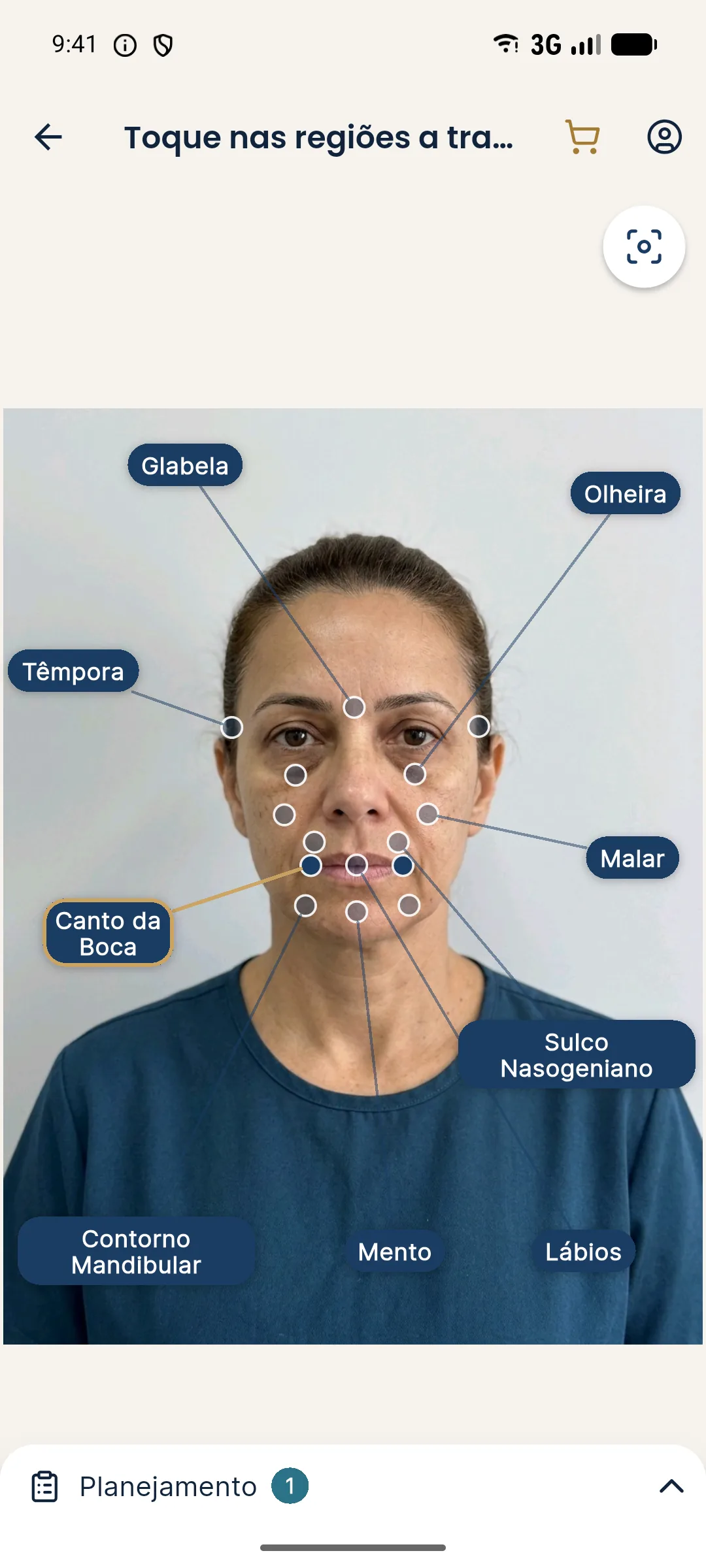
Harmy marks the Mouth Corner, Chin and Jawline points, and each accepts a volume in ml (0.5 ml steps, from 0.5 to 5 ml) and an intensity of Subtle, Moderate or Pronounced. You can create a projection with a single point, then another with two, and show the patient the effect of each stage on the Before/After slider. The simulation is illustrative, and the app neither measures muscle pull nor predicts results.
For capturing the areas, read marking the mouth corner in Harmy, marking the chin in Harmy and marking the jawline.
How do you talk to the patient?
Avoid pointing out the "flaw" and describe the mechanism. The concern is often not about the mouth corner itself, but about the impression it gives.
The criteria for communicating without offending are in how to point out asymmetry without offending, and the language for explaining the area is in explaining the mouth corner to the patient.
What signs call for extra caution?
Some findings change the approach in this area and deserve to be recorded.
- History of cold sores. Procedures near the mouth can reactivate the virus, and prevention is agreed with the professional. See cold sores and filler.
- Unknown previous procedure. A prior product with no record makes planning harder. See patient with unknown previous filler.
- Marked commissure asymmetry. Before attributing everything to the corner, confirm the cause is not muscular or skeletal.
- Patient who talks and smiles a lot. The area is highly mobile, and the result depends on naturalness in motion, not only at rest.
- Expectation of "lifting" the corner. Filler can soften the shadow, but it does not replace acting on muscle pull. Aligning on this avoids frustration.
At reassessment, always compare at rest and while smiling, using the same standardized photo, and ask the patient how it feels when talking and eating. If the area feels stiff or too bulky, that is a sign to reassess the plan, not to add another area. Duration and maintenance follow maintenance of toxin, filler and biostimulator.
Practical summary
- Read the whole chain before deciding on any point.
- Separate cause from symptom, and prioritize the cause.
- Start conservatively and reassess before adding areas.
- Record the plan in stages and review it with the patient.
- Hyaluronidase must be available whenever the product is hyaluronic acid.
Any product, volume and technique are decided by the licensed professional, according to the rules of their professional board in Brazil. The simulation is illustrative and does not promise results.
Frequently asked questions
Can I treat only the marionette line without looking at the mouth corner and the chin?
You can, but the result is often limited if the cause lies elsewhere in the chain, such as lack of chin support or muscle pull at the mouth corner. Reading the whole chain avoids treating only the symptom.
Does a small chin make the marionette line worse?
It can contribute. A poorly projected chin leaves the skin of the lower third with less support, and the lateral shadow line becomes more evident. Assessing the chin is part of planning for the marionette line.
Which area comes first in the plan?
There is no single order. In general, you start from where the most likely cause is and from what the patient notices most, with a reassessment before adding another area.
Does toxin belong in this combination?
When the depressor anguli oris muscle is pulling, toxin may be considered, at the discretion of the licensed professional, after an individual assessment.
Harmy images are illustrative simulations generated by AI from the patient's photo to support the conversation between practitioner and patient. They are not a promise of results. Indication, technique, product and volume are solely the decision of the licensed practitioner. This content is for information only and does not replace a clinical assessment.