
Complete lower third: which areas go together in the plan

 BeforeSimulation
- Nerve
- Highlighted area
Quick facts
- Areas in the set
- Lips, mouth corners, chin and jawline
- Logic
- From the center to the periphery, watching the proportion between the pieces
- Greatest risk of excess
- Adding full lips, a projected chin and a heavy jawline in the same plan
- Simulation in Harmy
- Lips, Mouth Corner, Chin and Jawline points
- Who decides
- A licensed professional, after assessment
The lower third is where the conversation with the patient tends to become most emotional: smile, chin, jawline, expression. It is also where the most mistakes come from adding up, because each piece seems to ask for just a little and, in the end, the lower face is too full. Planning the complete lower third is, first of all, deciding which pieces go in, in what order and with what proportion between them. This page offers a map of reasoning, not a protocol.
What makes up the lower third?
The lower third runs from the base of the nose to the lowest point of the chin. Within it, four areas are part of most plans: lips, mouth corners, chin and jawline. Other pieces may appear, such as the mentolabial fold, the marionette line and the submental region. The definition of the third and its proportions is in lower third and in one-third, two-thirds proportion in the lower third.
What is particular about the lower third is that the pieces influence one another: a more projected chin changes how the lower lip reads; a more defined jawline changes how the double chin and the chin read; lifted mouth corners change the expression at rest. That is why the plan has to look at the lower face as a whole.
Which combinations come up most often?
| Combination | Logic | Planning caution |
|---|---|---|
| Lips and mouth corners | Expression and smile contour | Avoid a "wide" or artificial mouth; see lips and mouth corners |
| Lips and chin | Proportion between lip projection and chin projection | Watch the profile; see lips and chin |
| Chin and jawline | Structure and contour definition | Avoid a contour that is too square; see chin and jawline |
| Chin and double chin | Transition to the neck | Tell submental fat apart from lack of projection; see chin and double chin |
| Corners, marionette and chin | Shadow lines of the lower face | Treat the cause, not just the fold; see corners, marionette and chin |
Each pair has its own page. This page brings everything together to answer the question of whoever plans the set: what really needs to go in and what can wait?
What is the most prudent order?
The order depends on the goal. When the concern is contour and definition, many professionals start with structure (chin and jawline) and only then refine lips and corners. When the concern is the smile and the lips, the path is the reverse. In any case, the general logic of treating structure before detail is in structure before detail in the facial harmonization plan.
A decision order that protects the result is:
- Define the main concern in the patient's own words.
- Assess the proportion between lips, chin and jawline in profile and from the front.
- Choose one or two pieces of greatest weight for the first stage.
- Reassess with standardized photos and decide the next one.
More on prioritizing in prioritizing by visual impact in the plan and what to treat first in facial harmonization.
What volume range is useful for conversation?
Ranges are starting points for conversation, not a protocol. In Harmy, the marking shortcuts bring values that help illustrate: "First time" uses lips 1 ml at Moderate; "Maintenance" uses lips 0.5 ml and fold 1 ml, both at Subtle; "Full harmonization" uses cheekbone 2 ml, jawline 2 ml, chin 1.5 ml, lips 1 ml and fold 1 ml at Moderate, with tear trough 1 ml at Subtle. These values are a starting point inside the tool, not a clinical dose recommendation.
To think about the total and how it is distributed, see percentage distribution of volume between areas and ml per area: ranges in planning. The line between good and excess is in when total volume becomes excess.
Which risks call for attention in the lower third?
In the lips: pronounced swelling, asymmetry, nodules and, rarely and seriously, vascular occlusion because of the proximity of the labial arteries. At the mouth corners: risk of irregularity and an artificial look. In the chin: excessive projection and irregularities. In the jawline, depending on the area: proximity to vascular and nerve structures. When hyaluronic acid is used, hyaluronidase must be available and the team trained to recognize warning signs.
Filling the area around the mouth has the particularity of mobility: the area moves all the time and any irregularity is noticed. Planning should take this into account and tell the patient that there is an adaptation period. More on complications in safety and complications, overview.
How do you simulate the lower third in Harmy?
In Harmy, you mark the Lips, Mouth Corner, Chin and Jawline points on the frontal photo, set the ml and the intensity (Subtle, Moderate or Pronounced) for each and create the projection. The AI respects the volume and changes only what was marked.
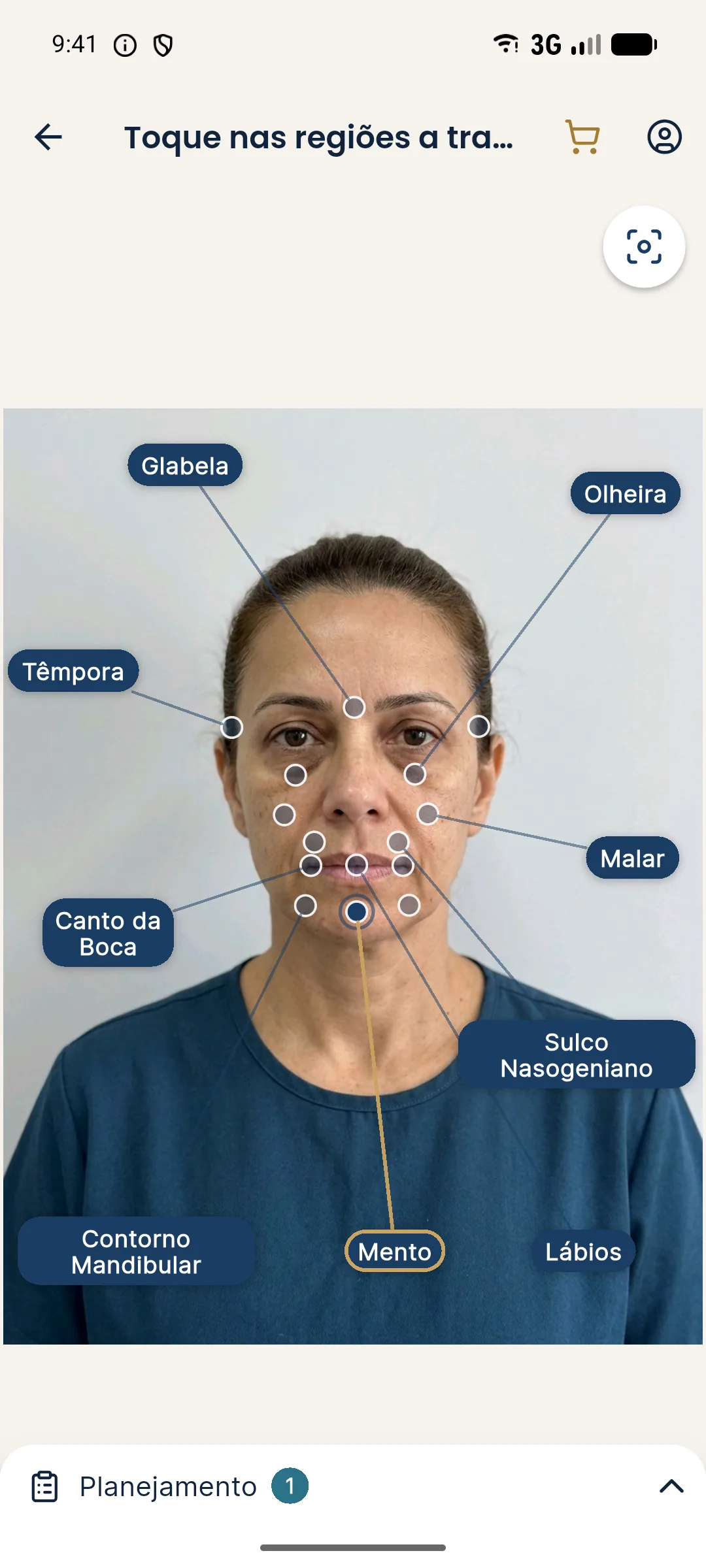
A good use is to compare two projections: one with only the piece of greatest weight and another with the whole set. This shows the patient that the set does not need to be done on the same day and that each piece adds little. For bilateral areas, such as the jawline, the ml is the total split between the two sides.
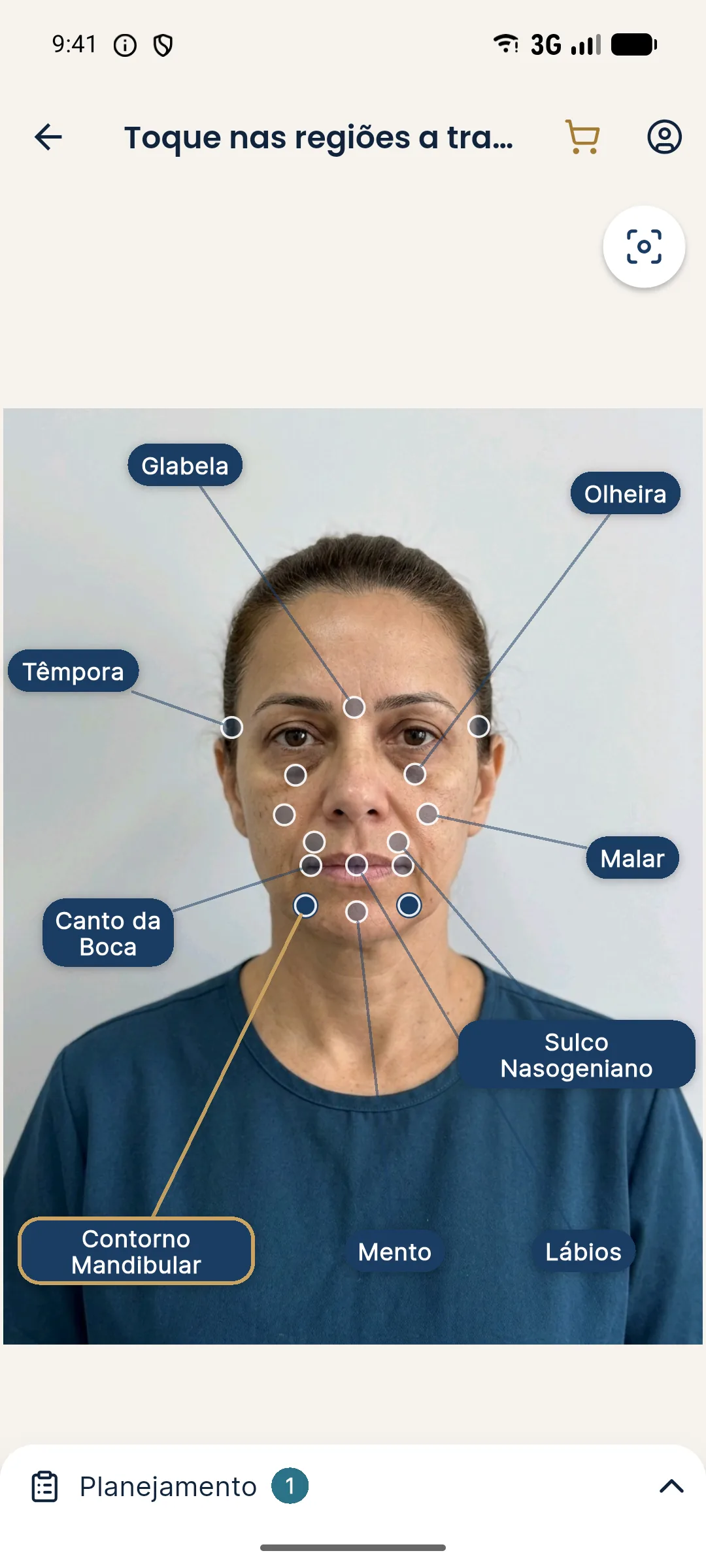
The main limitation: the projection uses a frontal photo, and the chin and profile are in another plane. Harmy does not simulate the profile, so do not use the image to promise chin projection in profile. More in limits of the 2D simulation.
How do you organize the stages?
See also facial harmonization plan in three sessions and facial contour definition plan.
What should you tell the patient?
If the patient wants everything at once, return to the point about the risk of excess and recovery, and record the decision. For a quote per stage, see linking plan and quote in facial harmonization.
Check before closing the lower third plan
Quick review
Summary
Planning the complete lower third means choosing the pieces that really go in, defining the order, controlling the sum of volume and reassessing between stages. Lips, corners, chin and jawline influence one another, and the main risk is excess from adding up. The Harmy simulation helps show each piece and the set, always as an illustrative simulation of a frontal photo.
Frequently asked questions
What is part of the complete lower third?
In general lips, mouth corners, chin and jawline, sometimes with the mentolabial fold and the double chin area. Not every patient needs every piece.
Which area should be treated first in the lower third?
There is no single order. Many professionals start with structure (chin and jawline) and refine afterward with lips and corners, but the concern and the anatomy decide.
Can the whole lower third be treated in one session?
It can, but it is usually less prudent. Splitting into stages lets you observe the response of each area, adjust the volume and avoid excess.
Does Harmy simulate the complete lower third?
It simulates the areas marked on the frontal photo, with ml and intensity for each. The Full harmonization shortcut already includes jawline, chin, lips and fold, all adjustable.
Harmy images are illustrative simulations generated by AI from the patient's photo to support the conversation between practitioner and patient. They are not a promise of results. Indication, technique, product and volume are solely the decision of the licensed practitioner. This content is for information only and does not replace a clinical assessment.