
Smile Arc and the Curve of the Lower Lip

 BeforeSimulation
- Nerve
- Highlighted area
Quick facts
- Goal
- Assess whether the curve of the upper teeth follows the curve of the lower lip in the smile
- Described ideal
- Incisal edge parallel to the lower lip, with light contact or minimal gap
- What influences it
- Teeth, lip, muscle and age; filler acts on the lip, not on the teeth
- Limit
- A flat or reversed smile arc usually calls for a dental assessment
A beautiful smile does not depend only on the size of the lip or the color of the tooth. It depends on a relationship between curves: that of the edges of the upper teeth and that of the lower lip. When those two lines run together, the smile tends to look harmonious. When they drift apart, the patient feels that "something is off" without knowing what.
This page explains how to assess that parallelism in a facial harmonization plan, what lip filler can influence, what belongs to dentistry and how to talk about it with the patient. The broader smile assessment is in smile analysis in facial harmonization.
What is the smile arc?
It is the curve drawn by the incisal edges of the upper teeth when the patient smiles, compared with the curve of the lower lip. The parallelism between the two is the most cited feature. In general, the arc is described as consonant when the edge of the upper incisors follows the curvature of the lower lip, with light contact or a minimal gap.
The arc can be:
- Consonant: the curves are parallel.
- Flat: the edge of the teeth is straighter than the lip.
- Reversed: the curve of the teeth is opposite to that of the lip.
A flat or reversed arc usually involves wear, tooth position or jaw growth, and calls for a dental assessment. This is where the relationship with incisor display at rest and in the smile comes in.
Why does the curve of the lower lip matter?
The lower lip is the "frame" at the bottom of the smile. Its curve depends on three elements: the shape of the vermilion, the position of the lip relative to the teeth and the activity of the muscles that move it. Changes in volume or eversion alter how much of the tooth edge shows and how the curves line up.
For this reason, lip planning has to consider the smile, not only the image of the lip at rest. An overfilled lower lip can cover teeth that used to show well; a retracted lip can expose too much. The proportion between the lips is covered in lip proportion.
How do you assess the arc in the consultation?
The assessment needs two conditions: a spontaneous smile and neutral light. Ask the patient to laugh at something real, not to "do the smile." Photograph from the front and in three-quarter view, and compare with the resting position.
It is worth recording the smile on a short video, because the arc changes during movement. The general recording routine is in standardized clinical photography.
What can filler influence and what can it not?
Lip filler acts on soft tissue. It can change the shape, projection and eversion of the lower lip, which alters the relationship between the lip curve and the teeth. But it does not change the position or shape of the teeth.
| Finding | What filler can influence | What depends on dentistry |
|---|---|---|
| Thin, retracted lower lip | Volume and eversion, at the professional's discretion | Position of the incisors |
| Very projected lower lip | Little or nothing; may worsen with volume | Maxillomandibular relationship |
| Flat arc from incisal wear | Nothing directly | Restoration, replacement, orthodontics |
| Downturned mouth corners | Support at the corners, in selected cases | Vertical dimension and occlusion |
| Lip asymmetry when smiling | Volume adjustment between sides | Midline and occlusal plane |
How do age and muscle shift this curve?
With age, the upper lip tends to lengthen and show less tooth, while the lower lip starts showing more. The smile arc flattens, and the patient says that "the smile has aged." Part of this is dental wear; part is loss of lip support.
Muscles take part as well. The depressor anguli oris pulls the corner of the mouth down, which changes the curve of the smile. See botulinum toxin in the depressor anguli oris and botulinum toxin for gummy smile. Any approach that affects the smile musculature calls for assessing the smile in motion beforehand and watching for asymmetries afterward.
How do you show the parallelism to the patient?
A photo of the smile with the two lines drawn on top (the edge of the teeth and the curve of the lip) is more convincing than a spoken explanation. The patient understands right away that the problem is one of relationship, not of an "ugly lip."
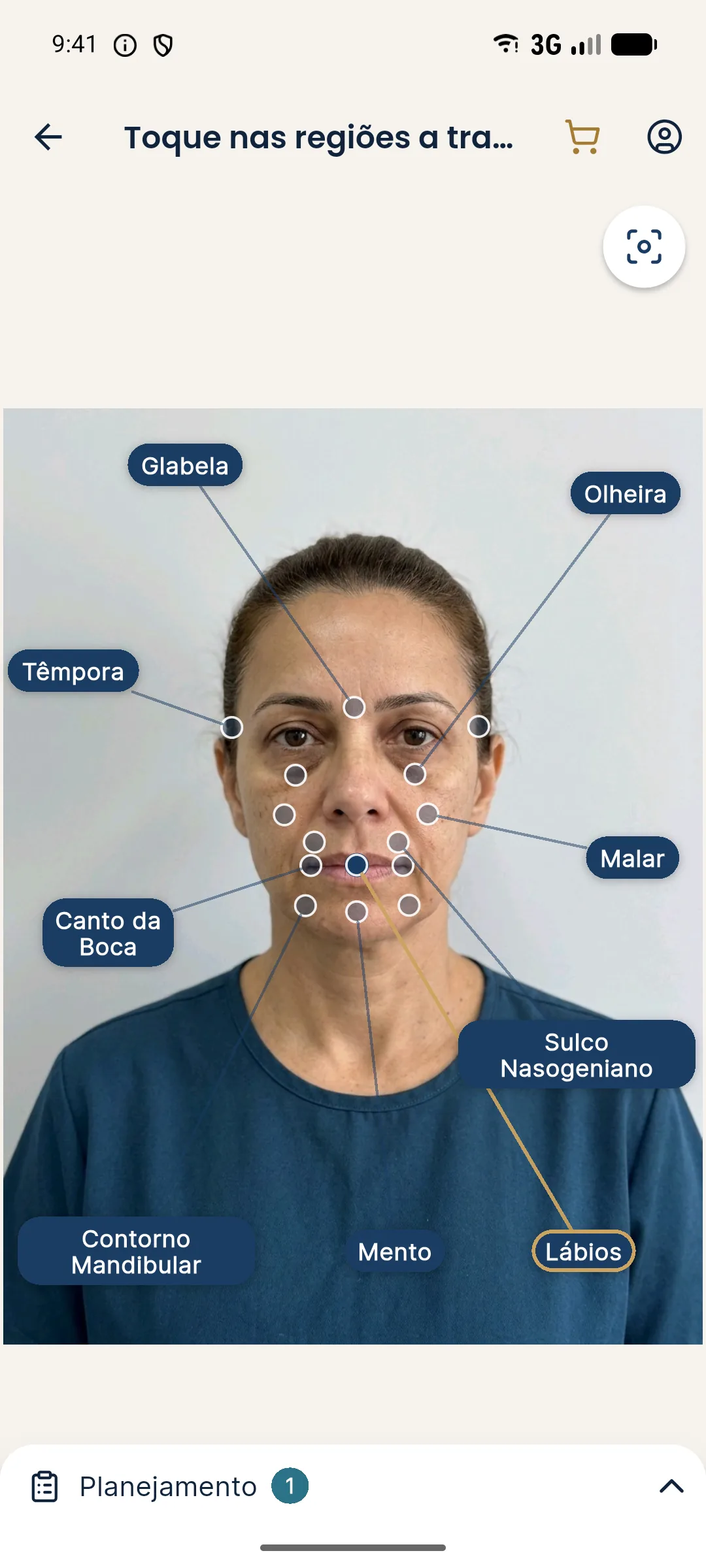
In Harmy, the Lips point lets you simulate the volume in ml with Subtle, Moderate or Pronounced intensity. The projection uses only the frontal photo and does not simulate the smile. Use it to discuss lip volume and proportion, and leave the arc to the clinical assessment.
Decision sequence in the plan
For procedure planning, see lip filler and mouth corner filler.
Quick quiz
Frequently asked questions
What is the smile arc?
It is the curve formed by the edges of the upper teeth in the smile, in relation to the curve of the lower lip. When the two are parallel, the arc is usually called consonant.
Does lip filler change the smile arc?
It can alter the shape and position of the lower lip and, with that, the apparent relationship with the teeth. It does not change tooth position, which depends on a dental assessment.
Is a flat smile arc a problem?
A flat or reversed arc is read as less youthful and is usually treated by dentistry. Facial harmonization can complement the harmony of the lip but does not correct tooth position.
Does Harmy simulate the smile?
The projection uses a frontal photo and simulates the marked areas, such as the lips. The smile and the teeth are not simulated, and the analysis of the arc remains clinical.
Harmy images are illustrative simulations generated by AI from the patient's photo to support the conversation between practitioner and patient. They are not a promise of results. Indication, technique, product and volume are solely the decision of the licensed practitioner. This content is for information only and does not replace a clinical assessment.