
Shadow under the lower lip: the labiomental fold

 BeforeSimulation
- Highlighted area
Quick facts
- Concern
- A marked shadow between the lower lip and the chin that gives a tired or serious look
- Structure
- Labiomental fold, defined by the labiomental angle and the chin
- Causes
- Recessed chin, projected lower lip, overactive mentalis and volume loss
- Approach
- Start with the cause (chin projection) rather than the fold alone
In many photos, a small shadow settles just below the lower lip and gives the face a more serious, tired or aged look. The patient cannot name the area. They say: "I have a shadow on my chin" or "my mouth looks sad because there is a line underneath".
The structure responsible for that shadow is the labiomental fold. It exists in every face, and the question is when it becomes an aesthetic problem and what produces it. This page organizes that assessment.
The labiomental fold and the angle that defines it
The labiomental fold is the horizontal depression between the lower lip and the chin prominence. Its depth depends on the so-called labiomental angle, measured in profile between the lower lip and the chin. A more open angle indicates a shallow fold; a more closed angle, a deep fold.
That angle is the result of a sum: chin projection, lower lip projection, muscle tone in the area and tissue thickness. That is why the shadow is rarely "about the fold". It is a consequence of the whole. See reference lines of the aesthetic profile and aesthetic profile: lips, nose and chin.
Where the shadow comes from
| Cause | What happens | How to recognize it |
|---|---|---|
| Recessed chin (retrogenia) | Lack of projection deepens the fold | Profile: chin behind the lower lip |
| Projected lower lip | The lip moves forward and the shadow appears | Lip more prominent than the chin |
| Overactive mentalis | The mentalis muscle contracts and pulls the chin | "Puckered" chin when speaking, orange-peel skin |
| Volume loss | Atrophy of tissues and support | Fold that deepens with age |
| Lighting | Overhead light creates shadow | Changes with the photo's light |
| Teeth and bite | Occlusion alters lip position | See deep bite and recessed chin |
The important conclusion is that the fold is the symptom. Filling the fold without understanding the cause is like painting the wall without fixing the leak.
How to assess
It is worth assessing dynamics too: the shadow may be discreet at rest and accentuated when smiling or speaking. The eye perceives the variation, and the still photo deceives.
What HOF offers
The approach is decided by the dominant cause and carried out in steps.
Chin projection. When the chin is recessed, chin filler can open the labiomental angle and soften the shadow naturally. It tends to be the most logical first step in these cases. See ideal chin projection by sex and plan to project the chin.
Hyaluronic acid in the fold. Hyaluronic acid in the labiomental fold can be considered in selected cases, with care not to create excess volume or a rounded chin.
Toxin in the mentalis. Mentalis toxin can soften the contraction that deepens the shadow and the orange-peel texture. See botulinum toxin for orange-peel chin and dimpled or orange-peel chin.
Lower lip. If the lip is very projected or very full, lip filler can worsen the fold, and the decision calls for care. See projected lower lip and lips and chin: combining in the plan.
Mouth corners. Drooping corners and marionette lines add to the read of shadow in the lower mouth area. See mouth corners, marionette lines and chin: combining.
Timeline of a plan
Between steps, wait for the swelling to resolve. A swollen chin and lip hide the real shape, and the decision about the next step is compromised.
Risks
The chin has relevant vascular and nerve structures, such as the mental nerve and branches of the submental and inferior labial arteries. Risks include swelling, bruising, asymmetry, nodules, paresthesia and, more rarely, serious vascular complications. Hyaluronidase must be available when using hyaluronic acid. With toxin, there is a risk of smile asymmetry and difficulty speaking. See vascular occlusion in the chin and paresthesia after an HOF procedure.
How Harmy helps
Harmy's Chin point simulates the volume effect on the chin in the frontal photo. The labiomental fold area, seen from the front, shows up as a change in light and projection under the lip, but the projection gain in profile is not shown.
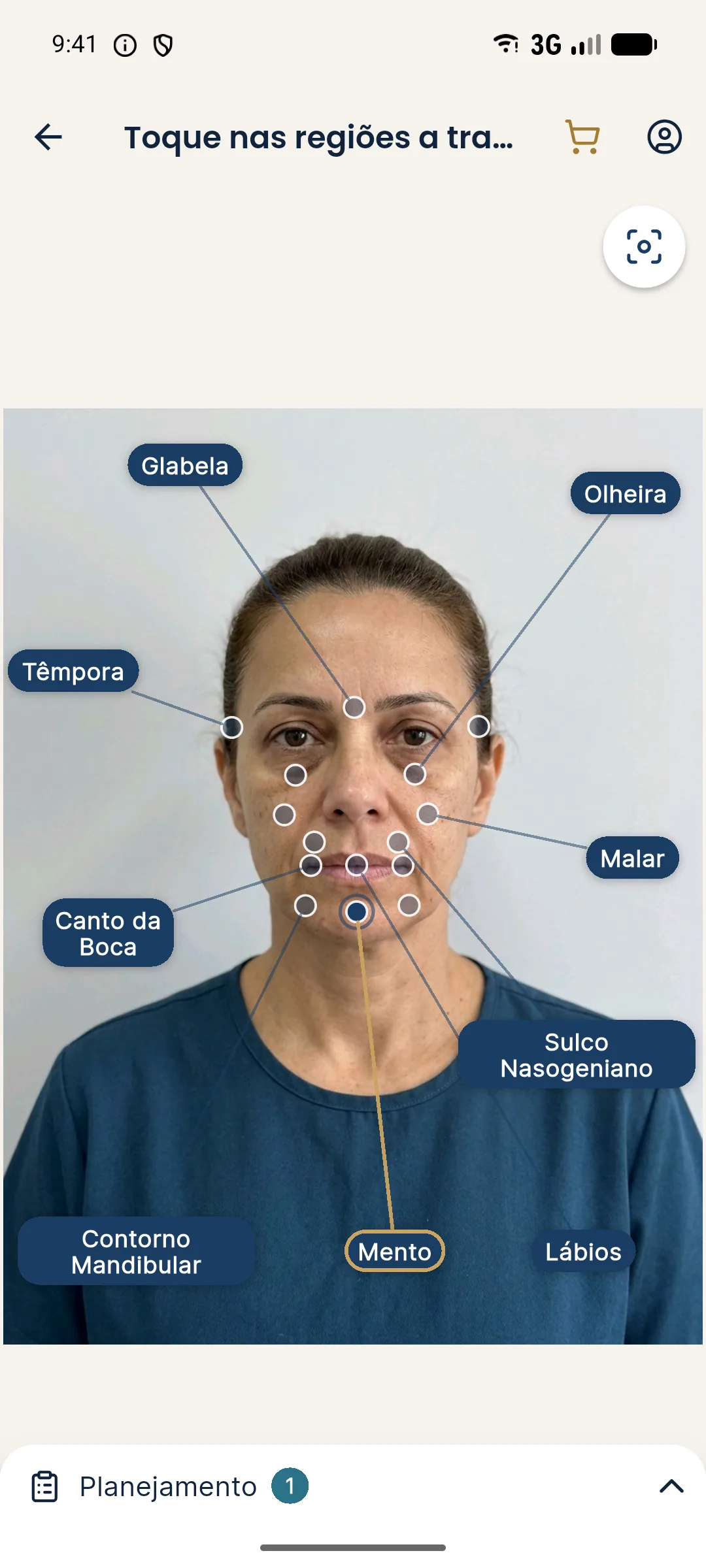
Explain that the app does not show the profile angle, where the cause is usually identified. The projection helps the conversation about volume, and the profile assessment remains clinical.
Record
Record the profile, the cause classification, the proposed steps and the guidance on limits. Volumes and techniques are at the discretion of the qualified professional, after assessment and in line with the rules of their professional council in Brazil.
Frequently asked questions
What is the labiomental fold?
It is the depression between the lower lip and the chin. Every face has some degree of it, and its depth depends on chin projection, lip projection and the tension of the muscles in the area.
Does filling the labiomental fold fix the shadow?
In some cases, yes. In others, the cause is a recessed chin or a projected lip, and filling the fold on its own may not solve it, or may create an unnatural face.
Does toxin help with the shadow under the lip?
If the mentalis muscle is overactive and tightens the chin, toxin can soften the look. In other cases, the effect is limited.
Why does the shadow show up more in photos?
Overhead lighting casts shadows under the lower lip. With poorly placed light, the fold looks deeper than it is on the moving face.
Harmy images are illustrative simulations generated by AI from the patient's photo to support the conversation between practitioner and patient. They are not a promise of results. Indication, technique, product and volume are solely the decision of the licensed practitioner. This content is for information only and does not replace a clinical assessment.