
Overprojected lower lip: vermilion and chin position
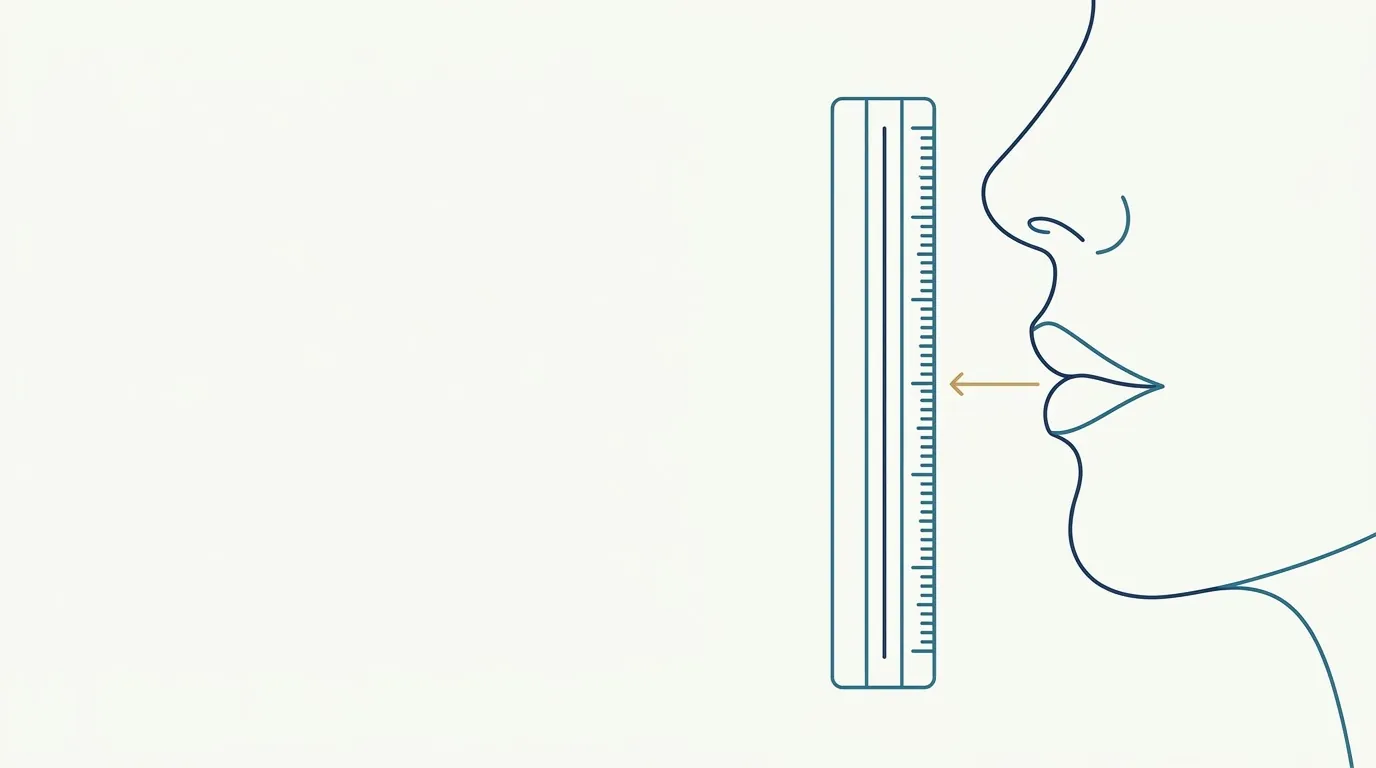
- Nerve
- Highlighted area
Quick facts
- Concern
- Lower lip that looks forward, too thick or everted
- Key question
- Does the projection come from the vermilion, a recessed chin or tooth position?
- References
- Profile, Steiner and Holdaway esthetic lines, labiomental angle
- Limit
- No injectable reduces the natural volume of the lip
"My bottom lip sticks out too much." This concern is usually read in profile, in a phone mirror or a side photo, and it is often tied to something else: the chin. A perfectly normal lower lip looks projected when the chin sits back. That is why the assessment starts with the profile, not the mouth.
If the lip looks drooping and heavy rather than projected, the topic is different, covered in drooping lower lip. Here the focus is forward projection.
What does a projected lower lip mean?
Projected means ahead of a reference line in profile. Two widely used esthetic lines are the Steiner S line and the Holdaway H line. They compare the position of the lips with the nose and chin and give an idea of how far forward or back the lip sits. They are conversation guides, not rigid norms, and vary with body type.
Three kinds of situation come up in practice:
| Situation | What shows in profile | Question it raises |
|---|---|---|
| Thick vermilion | Full, rounded lower lip | Natural volume, previous filler or both? |
| Chin with little projection | The lip looks ahead of the chin (retrogenia) | Is the chin the reason for the reading? |
| Tooth position | Projected lower incisors, altered bite | Does dental support explain the projection? |
How the chin changes the reading
The labiomental angle shows the transition between the lower lip and the chin. When it is very closed, with a deep labiomental fold, the lip seems to project by contrast. When the chin moves forward, the angle opens and the lip gains support. The most anterior point of the bony chin is the pogonion, and its position relative to the lip is part of the conversation.
This means that, in many cases, the approach for a lip concern lies in the chin. See chin filler and recessed chin.
Step-by-step exam
What facial harmonization can do
What fits depends on the cause. Always at the discretion of the qualified professional, after assessment.
- If there is previous product in the lip: dissolving with hyaluronidase can be considered, with specific consent and an explanation of the expected swelling and the need for reassessment.
- If a recessed chin is the cause: chin support can change the relationship and soften how projected the lip reads.
- If the mentalis is hyperactive: modulating muscle action can be discussed in selected cases.
- If the vermilion is natural and full: no injectable reduces it. The conversation is about acceptance, proportion of the whole and, in some cases, a surgical procedure outside the HOF office.
Careful not to accentuate
The most common mistake is enlarging the chin without looking at the relationship with the upper lip and the nose, or, worse, enlarging the upper lip to "balance" the lower one and ending up with a big mouth. Each addition needs a visual justification in profile. The page on thin upper lip and thick lower lip covers the ratio between the two lips specifically.
Safety and limits
Both the lip and the chin have rich blood supply. Possible complications include swelling, bruising, asymmetry, nodules and, rarely, vascular occlusion. With hyaluronic acid, keep hyaluronidase available and review lip vascular occlusion and the vascular danger zones of the face. Dissolving also carries risks and should be treated as a procedure, not a trivial act.
How to show it to the patient in Harmy
Harmy projects the change from a frontal photo. It does not show the profile, so it does not replace the lateral analysis. But it works to illustrate a chin or lip simulation with modest volume.
For the verbal approach, see explaining the lip to the patient and the support from assessing the retrognathic profile.
How to measure without fooling yourself
Profile photography needs standardization to be comparable. The head must be in a natural position, with the gaze on the horizon, and the camera distance must be the same on both sides and at later visits. A tilt of a few degrees changes how the chin and lip projection reads. If the photo is not standardized, any conclusion about the lip is fragile. The page on standardized clinical photography describes the precautions.
Also record what the patient sees when you show their profile. Many have never seen their own profile objectively, and the surprise changes the conversation: the concern that looked like a lip concern becomes a chin concern, or a nose concern, or neither.
How to talk about the chin without creating a new dissatisfaction
An ethical caution: pointing out a recessed chin to a patient who was not bothered by it can create a new dissatisfaction. Language matters. Instead of "your chin is small", prefer "chin support influences how the lip looks in profile". Describe the relationship, not the flaw. And make clear that the decision to treat the chin is the patient's, and that not treating is a legitimate option.
When the conversation touches on a disproportionately perceived appearance or intense distress, it is worth remembering body dysmorphic disorder; see body dysmorphic disorder in HOF.
When the dentist comes first
If the lower or upper incisors are tilted, or the bite is altered, the lip follows the position of the teeth. In those cases, treating the soft tissue without looking at the skeleton and the teeth means fixing the effect without touching the cause. Orthodontics can change the profile significantly, as described in orthodontics and profile change, and it is worth agreeing on timing: harmonizing before or after orthodontic treatment is a joint decision.
Summary
An overprojected lower lip is, almost always, a conversation about profile and chin. Measure with standardized photos, separate vermilion, chin and teeth, be clear about what does not exist as an injectable, and use the simulation as an illustration, not a promise. Approaches and volumes belong to the qualified professional, following the rules of their professional council in Brazil.
Frequently asked questions
Why does my lower lip look so projected?
The projection can come from the volume of the vermilion, from a chin with little projection that leaves the lip prominent in the profile, or from tooth position. Separating these causes is the first step of the assessment.
Can facial harmonization make the lower lip smaller?
Not directly when the volume is natural. If there is previous filler, dissolving it with hyaluronidase can be discussed. In other cases, balancing the chin can change the perception.
Does filling the chin help an overprojected lower lip?
It can help when the cause is a recessed chin, because the lip stops looking ahead of the whole. It is the qualified professional's decision, after assessing the profile.
Is a projected lower lip the same as an everted lip?
Not necessarily. Projected refers to the forward position in profile; everted refers to the vermilion turned outward. The two can coexist and call for different readings.
Harmy images are illustrative simulations generated by AI from the patient's photo to support the conversation between practitioner and patient. They are not a promise of results. Indication, technique, product and volume are solely the decision of the licensed practitioner. This content is for information only and does not replace a clinical assessment.