
Drooping lower lip: assessment, depressor and labiomental fold
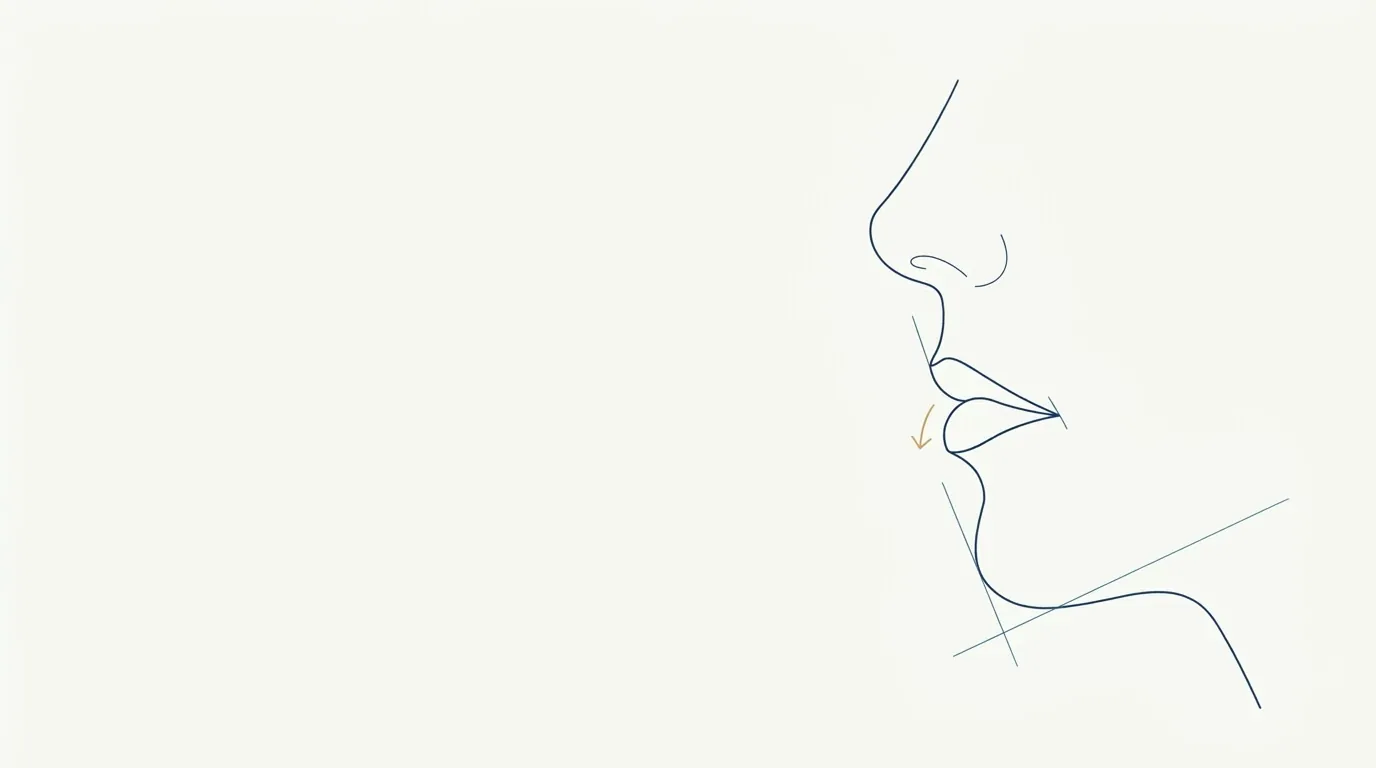
- Muscle
- Highlighted area
Quick facts
- Concern
- Lower lip that hangs, turns outward or looks detached from the upper lip
- Structures involved
- Depressor labii inferioris, mentalis, labiomental fold and chin position
- Key question
- Does the lip droop because of volume, muscle pull, loss of support or chin position?
- Plan risk
- Filling a lip that is already heavy and accentuating the eversion
A drooping lower lip is a concern that comes with many descriptions: "my bottom lip hangs", "it looks heavy", "it sticks out", "it looks separated from the top one". The professional's eye needs to translate that into structures: vermilion volume, muscle pull, chin support and tooth position.
This page organizes that reading so the plan does not start with filling the lip itself, which is usually the least suitable step for this concern. For the opposite problem, see overprojected lower lip.
Anatomy that matters for this concern
The lower lip is supported and moved by a set of structures that balance each other:
- The orbicularis oris forms the sphincter of the lip and provides the base of the vermilion.
- The depressor labii inferioris pulls the lip down and to the side, and is part of the lower smile.
- The mentalis lifts the chin and projects the lower lip; when hyperactive, it can produce an orange-peel look on the chin skin.
- The depressor anguli oris pulls the corner of the mouth down and can contribute to a sad look.
- The labiomental fold defines the lip-to-chin transition; when it is deep, the lip looks more pendulous.
A drooping lip can result from too little containment (chin and fold without support) or too much downward pull. In some faces, both add up.
Causes you need to separate
| Cause | How it presents | Direction of the conversation |
|---|---|---|
| Natural or previous volume in the vermilion | Thick, everted lip that hangs at rest | Lower the expectation of adding volume; consider dissolving if there is previous product |
| Depressor pull | The lip drops a lot when smiling and speaking | Assess the dynamics before any decision |
| Loss of chin support | Deep labiomental fold, recessed chin | Look at recessed chin and the labiomental angle |
| Aging of the lower third | Loss of definition, thin lip and loose skin | See sagging along the facial contour |
| Tooth position | Tilted lower incisors, altered bite | Coordinate with dentistry |
How to examine
The exam needs movement. Ask the patient to speak, smile, say "oo" and "ee", and record it. Observe at rest, while smiling and while speaking. A still photo can mislead: the lip looks droopy because the patient has the chin raised, or looks normal because the mentalis is contracted.
What the plan usually considers
In general, the reasoning follows an order of priority, always at the discretion of the qualified professional and after assessment.
Chin and fold support. When a recessed chin or a deep fold explains the concern, working on the chin area can change how the lip reads without touching it. See chin filler.
Muscle dynamics. When downward pull or a hyperactive mentalis contributes, modulating muscle action can be discussed. The mentalis toxin page covers this area. The main risk is an asymmetric smile and loss of function if the reduction is excessive.
Lip volume. This is the last step and, often, the least indicated. If the lip is full, adding more does not solve it. If it is thin and droops from loss of support, a modest addition can be considered after the support is treated.
Safety in this area
The lower lip is supplied by the inferior labial artery, and the chin has its own vessels. Possible complications include swelling, bruising, asymmetry, nodules and, rarely, vascular occlusion. Hyaluronic acid requires hyaluronidase available in the room, and your review of lip vascular occlusion should be up to date. With toxin, incorrect distribution can alter the smile and lip function, which justifies conservative doses and follow-up.
How Harmy fits into the conversation
The app shows the change at the Chin point and the Lips point from a frontal photo. This lets you compare, on the same patient, a chin-only simulation with a lip-only one, which illustrates the idea that support can matter more than the volume of the lip itself.
Timeline of a cautious approach
When to refer
If tooth position or the bite seems to be the dominant cause, an assessment with a dentist or orthodontist is indicated before any injectable. The protruding mouth page covers a neighboring scenario, and orthodontics and profile change shows how tooth position shows up in the soft tissue.
For communication with the patient, it helps to pair this with explaining the lip to the patient and to put in writing what was proposed and what was advised against, following the rules of your professional council in Brazil.
Questions that help separate the causes
In the conversation, a few simple questions prevent a plan built on assumptions. Ask since when the patient has noticed the drooping lip, whether it changed after a procedure, whether they notice it more when speaking or at rest, and whether anyone in the family has the same shape. A full lower lip that runs in the family is different from a lip that changed after filler or weight loss.
Ask about habits too: biting the lip, mouth breathing, resting the chin on the hand, wearing a removable denture. Some of these habits affect the tone and position of the lip and are not solved with injectables.
Common mistakes
Filling the lower lip first. This is the most frequent mistake. If the cause is support or pull, the lip ends up heavier and the concern gets worse.
Ignoring the lower third. The lip is the tip of the problem; the chin, the labiomental fold and the chin skin are the base. Assessing only the mouth means assessing half the picture.
Not discussing the possibility that nothing is needed. Some lower lips are naturally full and beautiful, and the patient rejects them by comparison with filtered photos. In those cases, listening and guidance are worth more than an injection. See patient brings a filter photo.
Combining everything on the same day. Chin, toxin and lip in the same session make it impossible to know what each step did. Staging lets you learn from the patient's face.
What to record
Photograph at rest, from the front and in profile, and record a short video with consent. In the patient record, describe the cause you consider dominant, what was proposed, what was set aside and why, and what the patient understood about limits and risks. For clinical photos, follow standardized photography and consent for photos.
Summary
A drooping lower lip is, most of the time, a concern about the whole picture: chin support, muscle pull, vermilion volume and tooth position. Examine in movement, separate the causes, start with what supports before touching what hangs, and leave the lip for last and in a modest amount. The approach and doses are at the discretion of the qualified professional, following the rules of their professional council in Brazil, with no promise of results.
Frequently asked questions
What makes the lower lip look droopy?
It can be natural or previous volume, pull from the depressor labii inferioris, loss of support from the chin and labiomental fold, or eversion of the vermilion. The cause changes the approach and must be separated during the assessment.
Does toxin in the chin or the depressor help a drooping lip?
In selected cases, the qualified professional may discuss modulating muscle action. The risks include an asymmetric smile and functional difficulty, and the decision requires assessing movement.
Does filling a drooping lower lip improve its appearance?
Not always. If the lip is already full or everted, more volume tends to accentuate the concern. Often the focus is the support of the chin and the labiomental fold, not the lip itself.
Is a drooping lower lip related to the teeth?
It can be. The position of the lower incisors, the bite and a lack of dental support all affect how the lip is supported. An assessment shared with dentistry avoids blaming everything on soft tissue.
Harmy images are illustrative simulations generated by AI from the patient's photo to support the conversation between practitioner and patient. They are not a promise of results. Indication, technique, product and volume are solely the decision of the licensed practitioner. This content is for information only and does not replace a clinical assessment.