
Protruding Mouth: Assessment and Referral

- Nerve
- Highlighted area
Quick facts
- Concern
- Lips and mouth projected forward in profile
- References
- Steiner S line, Ricketts line and Holdaway H line
- Origins
- Protruding teeth, skeletal base, recessed chin or full lips
- Refer
- When the cause is dental or skeletal, to orthodontics or surgery
"My mouth sticks out too much." The protruding-mouth concern is, almost always, a profile concern, not a frontal one. The patient sees it in side photos, in the phone mirror or when looking to the side. What produces it can be lip volume, tooth position, the skeletal base or a lack of chin projection. And harmonization can play a useful, but limited, role.
This page shows how to assess the profile, which reference lines to use and when to refer. It connects with convex profile, projected lower lip and retrognathic profile: assessment.
Why does the mouth look protruding?
| Origin | What you see | Who treats it |
|---|---|---|
| Protruding teeth | Incisors tilted forward, lips pushed out | Orthodontics |
| Protrusive skeletal base | Maxilla or mandible set forward | Orthodontics and orthognathic surgery |
| Recessed chin (retrogenia) | Mouth looks forward by contrast | Harmonization can project the chin |
| Full lips | Thick vermilion, with or without prior filler | Assess excess product |
| Combination | More than one factor | Interdisciplinary plan |
Telling apart what is dental, skeletal and soft tissue is the most important part of the assessment. Treating with harmonization something that is a significant dental protrusion usually leads to a partial result and a difficult conversation afterward.
Reference lines
In profile, lines are used that compare the position of the lips with the nose and chin. They help turn what seems like an impression into something objective.
- Steiner S line: from the midpoint of the curve of the nose to the pogonion. The lips tend to touch or sit close to this line.
- Ricketts line: from the tip of the nose to the pogonion. In many profiles considered harmonious, the lips sit slightly behind it.
- Holdaway H line: from the upper lip to the pogonion, it relates the lip to the chin.
- Nasolabial angle and mentolabial angle: describe the relationship of the upper lip with the nose and of the lower lip with the chin.
These references vary with sex, age and ethnicity, and the current trend is toward fuller profiles than the older standards. Use them as a guide, not a verdict. The general method is in reference lines of the aesthetic profile and facial profile analysis: checklist.
What harmonization can do
Chin. When the chin is recessed, chin filler can project the pogonion and reduce the impression that the mouth is forward. It is the most useful tool for this concern when the cause is the chin. See recessed chin and deep bite and recessed chin.
Lips. If there is excess volume from prior filler, partial dissolution with hyaluronidase can be considered. If the lips are naturally full, no injectable reduces them. Any new injection in the lips should be reconsidered, and often the plan is not to inject the lips.
Midface and nose. In profiles with little midface projection, maxillary and cheekbone support can rebalance the profile and reduce the sense of a forward mouth. See profile without midface projection.
What it does not do: it does not correct dental or skeletal protrusion. In those cases, the path is orthodontics and, in significant skeletal cases, surgery. Harmonization can follow along as a complement. See orthodontics and profile change.
Risks
The risks of chin and lip filler include swelling, bruising, asymmetry, nodules and, less often, vascular complications. The chin area has branches of the submental artery and the mental nerve, which call for care. Hyaluronidase must be available for hyaluronic acid procedures.
What Harmy shows and what it does not
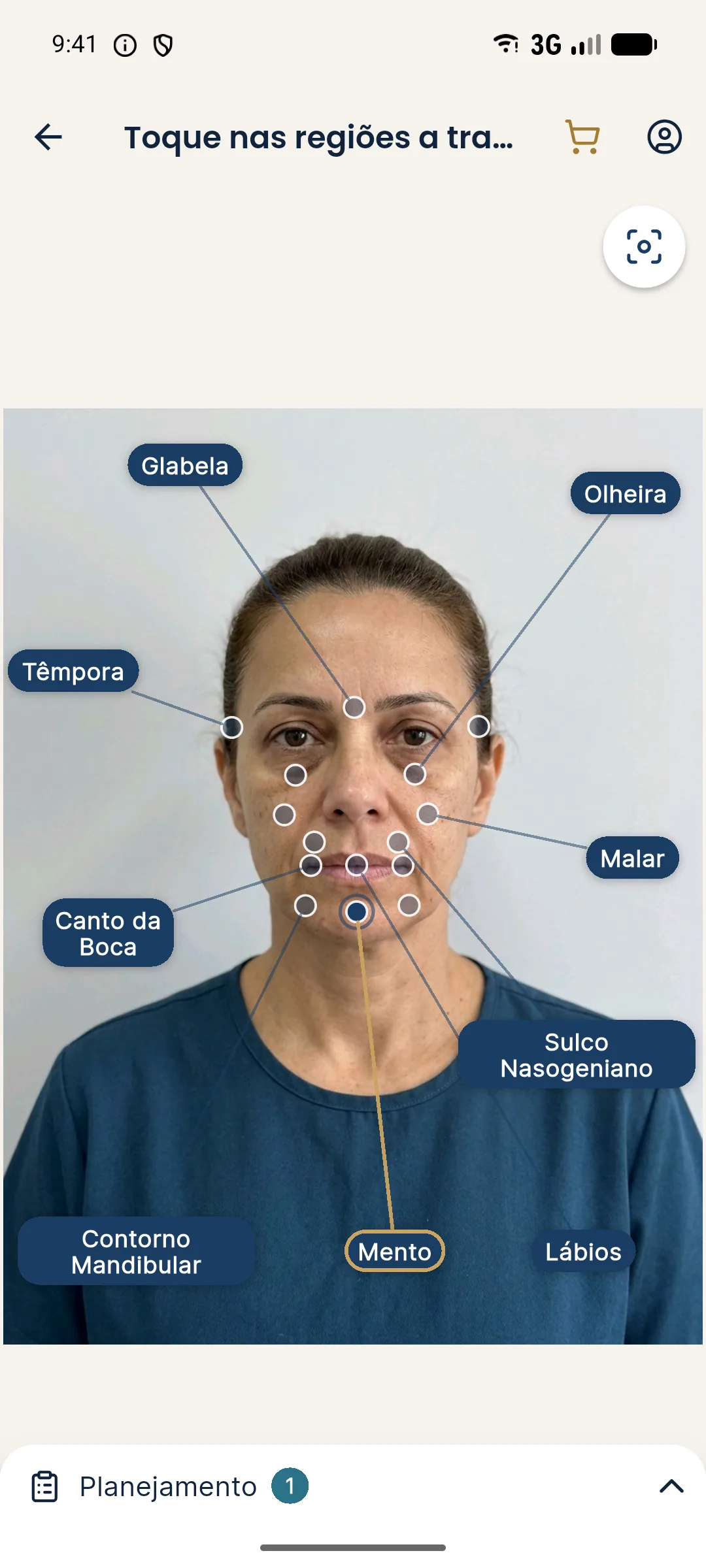
Harmy uses only the frontal photo. It does not show the profile and therefore does not simulate the projection of the lips or chin in the anteroposterior direction. What the projection shows is the frontal effect of the marked areas. This needs to be clear to the patient: the simulation does not replace the profile assessment.
When the profile is within the expected range
Not every profile that the patient considers protruding is outside the norm. The references of facial aesthetics have changed over the decades, and today fuller lips are considered harmonious in many profiles that, by the old lines, would be "protrusive." If the measurements are close to the references and the chin is proportionate, the best service to the patient may be to explain that their profile is normal and that the dissatisfaction comes from comparison.
Showing their profile in a standardized photograph, next to the reference lines, helps make it objective. Some patients are reassured to see that the mouth touches or sits close to the line, others keep wanting change, and then the conversation turns to what is possible. In both cases, record the measurements and the conversation. This approach avoids unnecessary procedures and builds trust.
Wrap-up
Record the profile with a standardized photo, the reference lines and the likely cause, and document the referral when there is one. For profile planning, see plan to balance the profile and aesthetic profile: lips, nose and chin. Volumes and techniques are at the discretion of the licensed professional, in accordance with the rules of their professional council in Brazil.
Frequently asked questions
Is a protruding mouth a problem of the lips or of the teeth?
It can be both, or neither. Protruding teeth, a protrusive skeletal base and a recessed chin make the mouth look protruding. Only profile assessment and dentistry separate the causes.
Does chin filler improve a protruding mouth?
When the chin is recessed, projecting it can improve the relationship with the mouth and reduce the perception of lip projection. It does not correct dental or skeletal protrusion.
Can harmonization make the lips smaller?
Not directly. There are procedures to dissolve hyaluronic acid when the excess is product, but there is no injectable that reduces a natural lip.
How do I measure lip projection in profile?
With reference lines, such as Steiner's S line and Ricketts' line, which compare the position of the lips with the nose and chin. They are assessment guides, not goals, and they vary with sex and ethnicity.
Harmy images are illustrative simulations generated by AI from the patient's photo to support the conversation between practitioner and patient. They are not a promise of results. Indication, technique, product and volume are solely the decision of the licensed practitioner. This content is for information only and does not replace a clinical assessment.