
Midface without projection in profile: how to assess

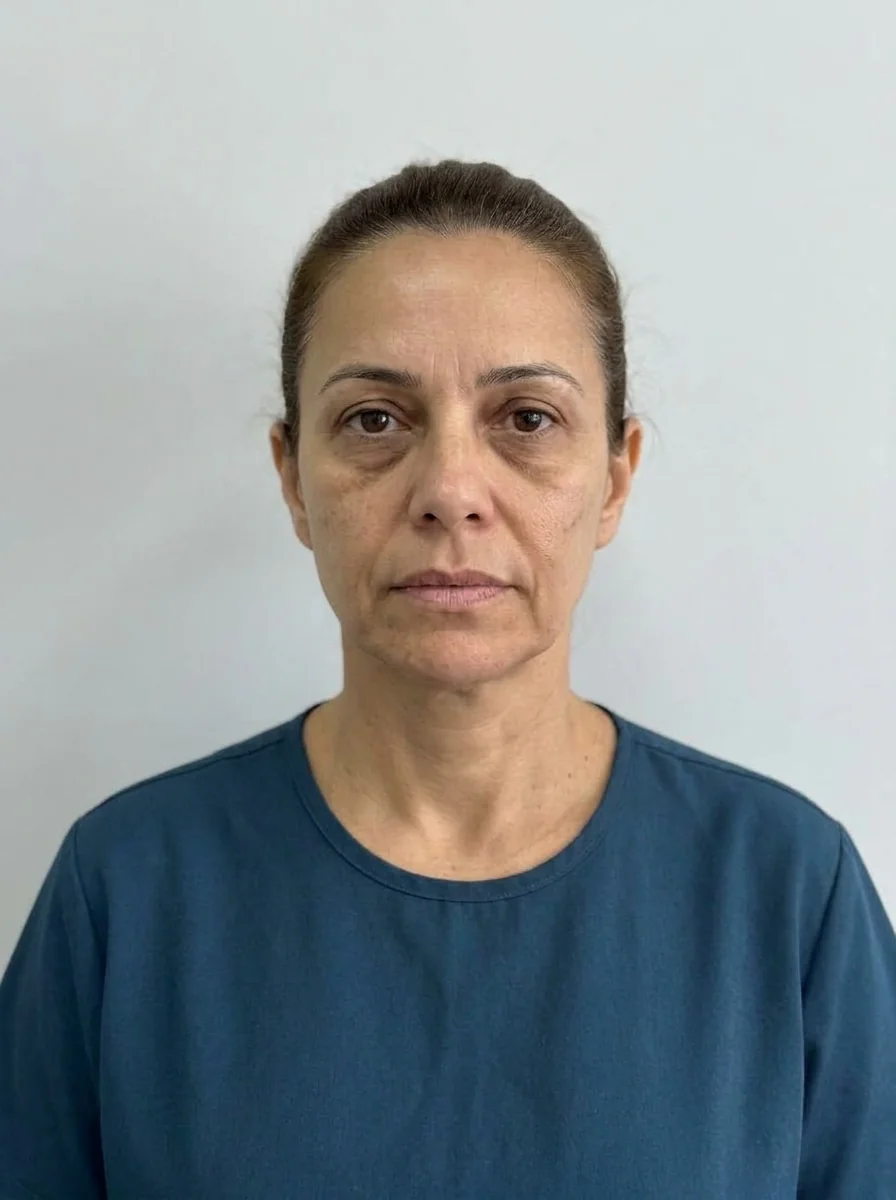 BeforeSimulation
- Highlighted area
Quick facts
- Concern
- Face "flat" from the side, cheekbone without projection, sunken eyes and an unsupported upper lip
- What to look at
- Zygomatic bone, maxilla, premaxilla and inferior orbital rim
- Associated effects
- More pronounced nasolabial fold and tear troughs, recessed upper lip
- Pitfall
- Projecting only the cheek apple and ignoring the maxilla, leaving the midface looking odd
The midface is the center of the face: cheek apples, maxilla, base of the nose and the upper part of the lip. When this region has little projection, the face looks flat from the side, the light falls without relief, and the consequences show up in seemingly distant places: deeper tear troughs, a more pronounced nasolabial fold, an unsupported upper lip. Patients rarely talk about "projection". They say the face looks "lifeless", "tired" or "sagging".
This page shows how to assess midface projection in profile and three-quarter view, and how to project without looking overdone. It complements concave profile, flat cheekbone and maxillary projection and the midface in profile.
What is midface projection?
Projection of the midface is determined mainly by the skeleton: the zygomatic bone, the maxilla and the premaxilla. Fat and skin cover these structures and give the final shape. When the bone is poorly projected (hypoplasia) or has undergone resorption, the covering is left without support. See malar hypoplasia and facial bone loss.
The region can be understood through three support points:
- Cheekbone (cheek apple): defines the "curve" of the midface and the light of the face.
- Maxilla and paranasal region: support the base of the nose, the upper lip and the nasolabial fold.
- Inferior orbital rim: the boundary between eye and cheek, which influences the groove and the tear trough.
A classic clue is the relationship between the eyeball and the cheek: when the cheek sits behind the line of the eye, the midface is "set back". See Hinderer lines in cheekbone assessment and ideal cheekbone projection.
What lack of projection causes
Chain effects help explain why so many concerns are better resolved by working on the midface.
| Effect | Why it happens | Where the patient notices it |
|---|---|---|
| Tear trough and sunken look | Little support under the orbital rim | Shadow under the eye; see sunken eyes and low cheekbone |
| Pronounced nasolabial fold | Lack of support from the maxilla and cheek fat | Line between nose and mouth |
| Unsupported upper lip | Recessed premaxilla | Thin or "turned-in" lip |
| Face flat from the side | Flat cheekbone | Profile without relief |
| Sagging cheek | Midface without support for the tissues | Heavy lower contour |
This does not mean every concern in these areas comes from the midface, but that it should enter the hypothesis. See cheekbone and tear trough: combining in the plan and tear trough and nasolabial fold: combining.
How to project without overdoing it
The midface is a region where excess is quickly noticed: the face becomes "full", round or looks operated on. That is why prudence is part of the planning technique. A few principles, without forming a protocol:
- Look at the whole. Cheekbone, maxilla and paranasal area form a unit. Treating only one point throws the others off balance.
- Advance in stages. Smaller volumes, reassessment in profile, fine adjustment in the next session.
- Respect the bone. In significant skeletal hypoplasia, soft-tissue support has a limit, and the ideal result may require another approach.
- Consider sex and ethnicity. The desired projection varies. See ideal cheekbone projection and differences between the female and male face.
- Preserve expression. The smile changes the position of the cheekbone. Assess at rest and in smile.
See cheekbone filler, zygomatic filler and biostimulator in the midface.
When it is bone and when it is soft tissue
A decisive question: is the lack of projection inherited (skeletal) or acquired (age, fat loss, weight loss)? In the first case, the face has always been this way, and soft-tissue compensation has limits. In the second, the patient remembers having a different projection, and replacement may give back part of what was lost.
Old photos help a lot. Compare the cheekbone projection from five or ten years ago with the current one. If there is a significant change, think of fat and support loss. If there is not, the design is structural. See deep facial fat loss, aging of the midface and when bone is the problem and not volume.
The conversation with the patient
A patient with a poorly projected midface usually complains about other areas. "My smile lines are deep", "I have tear troughs", "my lip is thin". Showing the relationship between these concerns and the support of the middle of the face helps prioritize. Use the three-quarter photo, with side lighting, to show the relief.
Also make clear that midface projection, when done well, changes the features subtly, and that the goal is to restore a rested look and proportion, not to create prominent cheekbones. See explaining facial aging to the patient and plan for a rested look.
What the simulation shows
The Harmy frontal photo shows the cheekbone and the volume change in the frontal view, but projection is a profile concept. The simulation helps the patient see an improvement in light and cheek support, not the final profile. Make this explicit and use profile photography to track progress.
In summary
Assessing midface projection means looking at the support of the face: cheekbone, maxilla, premaxilla and orbital rim. Doing this in profile and three-quarter view, comparing with old photos and projecting in stages avoids an overdone face and resolves seemingly distant concerns. Results vary from person to person and depend on individual factors. The choice belongs to the licensed professional, according to the rules of their professional council.
Frequently asked questions
What is lack of midface projection?
It is when the cheekbone area, the maxilla and the base of the nose are poorly projected relative to the rest of the profile. The face looks flat from the side, with shadow under the eyes and an unsupported upper lip.
How does a midface without projection affect tear troughs?
It can accentuate them. With less support from the bone and fat under the eye, the shadow and the groove show more. That is why midface support can be part of the plan for tear troughs.
Is filling the cheek apple enough?
Not always. Midface projection involves the cheekbone, maxilla and premaxilla. Treating only the cheek apple can leave the whole disproportionate, and assessment in profile and three-quarter view is essential.
Can lack of projection be seen in the frontal photo?
Only in part. The frontal view shows width and shadows, but projection is better read in profile and three-quarter views, with side lighting. That is why the assessment should not be limited to the front photo.
Harmy images are illustrative simulations generated by AI from the patient's photo to support the conversation between practitioner and patient. They are not a promise of results. Indication, technique, product and volume are solely the decision of the licensed practitioner. This content is for information only and does not replace a clinical assessment.