
Convex profile: what HOF can balance
- Nerve
- Highlighted area
Quick facts
- Concern
- Recessed chin, projected upper lip or nose, a profile that pushes "forward" in the middle
- How it is measured
- Facial convexity angle and lip position relative to the reference lines
- Causes
- Mandibular retrusion (Class II), small chin, large nose, projected lip
- Pitfall
- Enlarging the lip or midface and accentuating convexity instead of balancing it
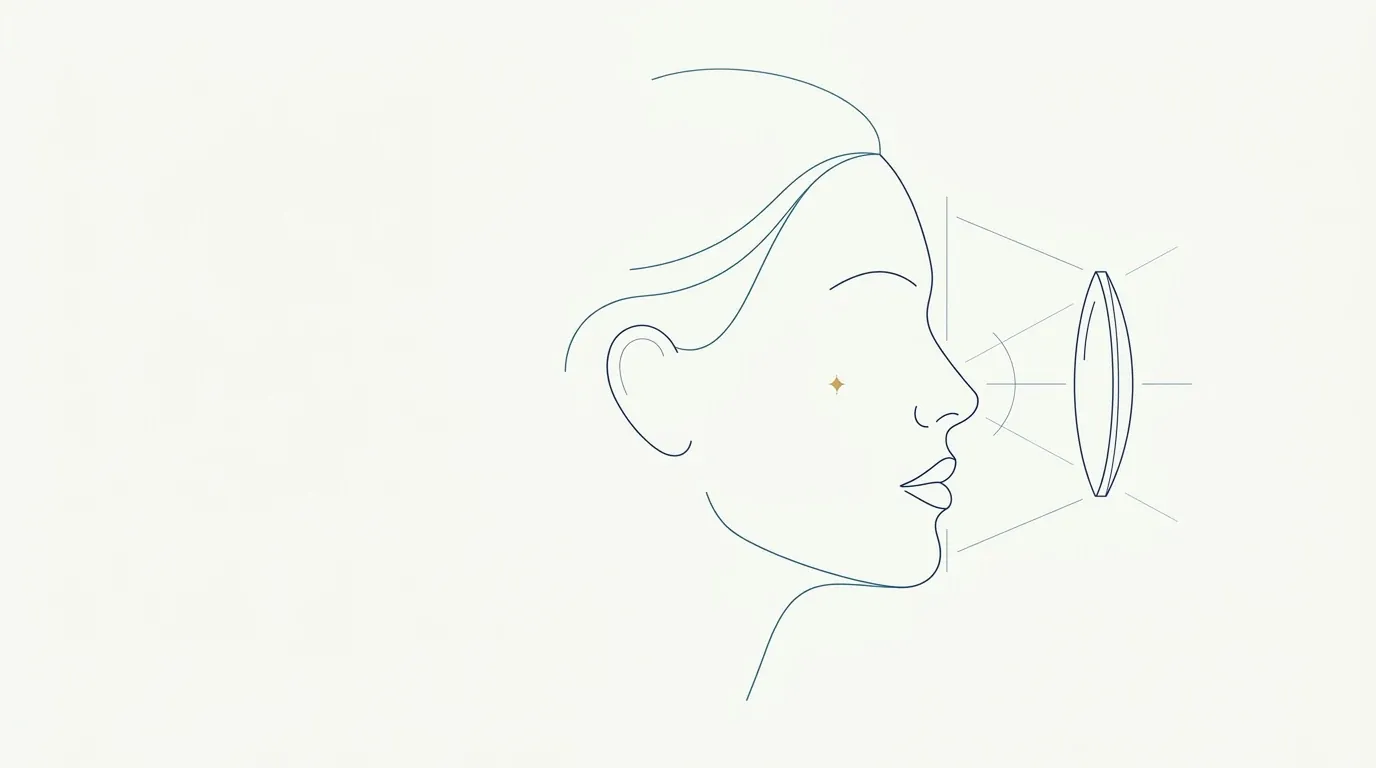
A convex profile is one in which the middle of the face seems to come forward and the chin sits back. Seen from the side, the line between forehead, nose, lips and chin draws an outward curve. It is a very common pattern and, in mild degrees, part of normal variation. In greater degrees, it affects facial harmony and leads the patient to concerns such as "my chin is small", "my nose is big" or "my mouth sticks out".
This page helps assess convexity, decide where soft tissue can contribute and recognize what is skeletal. For the opposite pattern, see concave profile. For the balanced pattern, see straight profile. For the chin-specific concern, see recessed chin and retrognathic profile: assessment.
What makes a profile convex?
There is more than one way to arrive at a convex profile, and the cause decides the approach.
- Mandibular retrusion (a recessed mandible), often associated with Angle Class II. See Angle Class II and micrognathia.
- Small chin with a normal-sized mandible (retrogenia).
- Projected upper lip, from forward-positioned teeth or alveolar bone.
- Large or projected nose, which accentuates the curve of the middle of the face.
- Combinations, the most common.
The facial convexity angle is one of the measures used, and the position of the lip relative to the subnasale-pogonion line and other reference lines helps quantify it. See reference lines of the aesthetic profile and facial profile analysis: checklist.
Where HOF can help
At the discretion of the licensed professional, HOF acts on soft tissue. In a convex profile, the most common point is the chin: projecting the chin brings the profile line closer and reduces the sense of convexity. It is reasoning about balance, not about enlargement. See chin filler, plan to project the chin and small chin.
Other points can come in, always with caution:
- Labiomental fold. The mentolabial angle changes with chin projection and influences how the lower lip reads.
- Lips. In a convex profile, increasing lip volume can accentuate the projection of the middle. It is often better not to touch them, or to touch them very little.
- Nose. The nasal dorsum cannot be safely corrected with filler in every case. See nose and chin: combining in the plan.
| Pattern | Reading | General direction |
|---|---|---|
| Recessed chin, normal lips | Retrogenia | Assess soft-tissue chin projection |
| Recessed mandible, Class II occlusion | Skeletal retrusion | Orthodontics and surgery; HOF as a complement |
| Projected upper lip | Dentoalveolar or labial | Avoid enlarging the lip; assess orthodontics |
| Projected nose, normal chin | Large nose | Assess alternatives; see large nose on the face |
| Mild convexity, harmonious face | Normal variation | Explain; often do not treat |
Caution with the lips
Patients with a convex profile often ask for bigger lips. There is a logic that works against them: with a recessed chin, the lip looks even more projected, and enlarging the lip accentuates convexity. The more balanced approach, in many cases, is to project the chin first, reassess and only then decide about the lips.
This reasoning also works in reverse: a very thin lip on a well-projected chin may be out of balance and benefit from volume. The answer comes from reading the profile, not from a generic standard of a "beautiful lip". See aesthetic profile: lips, nose and chin and lips and chin: combining in the plan.
When the cause is skeletal
Marked mandibular retrusion and skeletal Class II are matters for orthodontics and orthognathic surgery. HOF can compensate the appearance, but it does not change the structure or the bite. In cases with functional complaints (chewing, pain, apnea, mouth breathing), referral is mandatory before any aesthetic plan.
A useful question: has the patient already had, or is the patient currently in, orthodontic treatment? Orthodontics can change the profile, and planning HOF before it is finished can lead to reassessments. See orthodontics and profile change and HOF plan after orthodontics.
Talking to the patient
A patient with a convex profile often sees themselves from the front in the mirror and is surprised by the profile in photos. Showing their profile, calmly, helps explain what you are seeing. Avoid words like "flaw" or "ugly". Prefer describing relationships: "the chin sits slightly behind the line of the lip".
It is also worth asking what they actually want to change. Some want a more defined chin, others want a "slimmer nose", others want lips. The stated concern is not always the visual cause. See explaining the chin to the patient and I want a bigger chin.
What Harmy shows and what it does not
A convex profile is a profile concern, and the Harmy projection starts only from the frontal photo. The simulation can show the chin with a discreet change in the frontal view, but it does not show the curve of the profile. It is important to make this clear to the patient.
In summary
A convex profile calls for a profile reading, a decision about the chin before the lips and honesty about what is skeletal. HOF balances in soft tissue, with caution, and refers when the case calls for orthodontics or surgery. Results vary from person to person and depend on individual factors. The choice belongs to the licensed professional, according to the rules of their professional council.
Frequently asked questions
What is a convex profile?
It is a profile in which the midface and upper lip look projected relative to the chin, which sits back. The profile line forms an outward curve in the middle of the face.
Can chin filler correct a convex profile?
It can improve how the profile reads when a recessed chin is an important part of the picture, by projecting the chin in soft tissue. In marked skeletal retrusion, orthodontic and surgical assessment is necessary.
Is a convex profile the same as retrognathia?
They are related. Retrognathia (a recessed mandible) is a frequent cause of a convex profile, but the picture can also come from a small chin, a projected lip or a large nose.
Can I enlarge the lip in a convex profile?
With caution. Enlarging the lip in an already convex profile can accentuate the projection of the middle of the face. The decision rests on reading the profile and on the lip and chin references.
Harmy images are illustrative simulations generated by AI from the patient's photo to support the conversation between practitioner and patient. They are not a promise of results. Indication, technique, product and volume are solely the decision of the licensed practitioner. This content is for information only and does not replace a clinical assessment.