
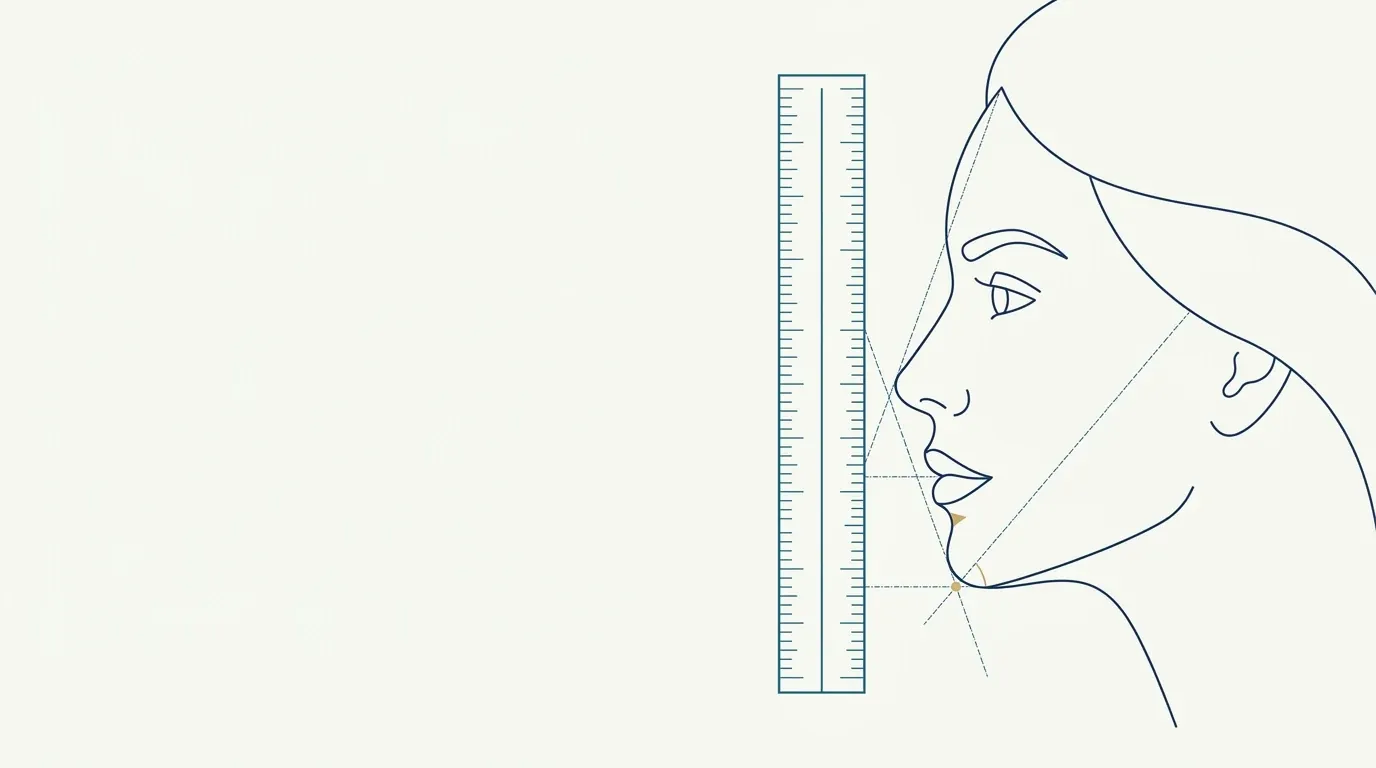
Straight profile: assessment and projection points
- Nerve
- Highlighted area
Quick facts
- Situation
- Profile line without marked concavity or convexity, with balanced proportions
- How it is assessed
- Convexity angle, nasolabial and mentolabial angles, and the Steiner, Ricketts and Holdaway lines
- Clinical stance
- A straight profile rarely needs projection. The work is to preserve and refine
- Pitfall
- Trying to "improve" an already balanced profile and creating disproportion
Between the convex and concave profiles lies the straight profile: the line from forehead to chin is balanced, with no evident curve inward or outward. It is the pattern many professionals use as a reference for balance, and the one many patients ask for without knowing it when they talk about a "proportionate face". But having a straight profile does not mean having no concern, and that is the main point of this page.
When the profile is already balanced, the clinical question shifts from "what to project" to "what to preserve and what to refine". See the contrast in convex profile and concave profile. For the overview, see profile change with age and facial profile analysis: checklist.
How is a straight profile defined?
There is no single value that defines a straight profile, but several references help describe it. The facial convexity angle measures the relationship between the glabella, subnasale and pogonion. The nasolabial and mentolabial angles give information about the upper lip, the base of the nose and the chin. The Steiner, Ricketts and Holdaway lines relate the position of the lips to the nose and chin.
These references come from specific populations and depend on sex, age and ancestry. They are useful as support, and a common mistake is to use them as a target to hit. See facial proportions vary between populations and reference lines of the aesthetic profile.
What can still bother patients with a straight profile
A straight profile does not eliminate concerns. The most common are targeted, and often not about projection.
- Thin or poorly defined lips in a profile that is otherwise balanced.
- A chin with little definition (not recessed, but "soft") relative to the jaw.
- An open cervicomental angle, which gives the impression of a double chin even with a harmonious profile.
- A nose with a dorsum or tip the patient dislikes, even though it stays within the line.
- Signs of aging in the midface or nasolabial fold, which change how the face reads without touching projection.
- Asymmetry on one side of the profile, which the frontal mirror hides.
| Concern in a straight profile | Reading | General direction |
|---|---|---|
| Thin lips | Low lip volume | Assess the lip with caution; see thin lips: what to do |
| "Soft" chin | Lack of definition | Assess the chin and contour; avoid excessive projection |
| Mild double chin | Cervicomental angle | See double chin even when thin |
| Wrinkles and folds | Aging | Volume and skin approaches in specific areas |
| The nose bothers them | Patient perception | Assess whether the concern is the nose or proportion |
Preserving what is already good
In a straight profile, the first skill is not to spoil it. A harmonious face can be thrown off balance by a well-intentioned intervention: a slightly bigger lip shifts the line, a more projected chin alters the mentolabial angle, and the whole loses its lightness. Small changes have a large effect, because the starting point is already balanced.
For this reason, plans for a straight profile tend to be lean. The guiding question is what, when touched, improves the patient's concern without altering the line. In many cases the answer is "almost nothing", and the right decision is to advise, maintain and follow up. See minimum viable plan in HOF, natural-effect plan and how to tell a patient they do not need a procedure.
Where small tweaks can come in
When there is an indication, adjustments in a straight profile are targeted and subtle. At the discretion of the licensed professional, they may involve:
- Lips. Adjusting volume or contour, respecting the reference lines and the nasolabial angle. See lip filler.
- Chin. Definition or slight projection, when the chin is not very pronounced, without breaking the line. See chin filler and chin and jaw: combining in the plan.
- Midface. Subtle support when there is age-related loss, without altering overall projection.
- Jawline. Line definition, when relevant.
The common thread is measure: small ml, low intensity, reassessment in profile. A patient with a straight profile is usually very close to the limit of "too much".
Identity and symmetry
In a straight profile, facial identity weighs heavily. The patient already has a coherent set of features, and HOF can easily alter them. Value what is characteristic about the face. A nose with personality, a chin with its own shape or a discreet asymmetry are part of who the person is, and transforming them can disrupt the image they have of themselves.
Ask the patient what they do not want to change. The answer helps delimit the plan and avoids surprises. See facial identity: how to preserve it, natural facial asymmetry and average beauty and facial attractiveness.
Step-by-step assessment
What Harmy helps show
The projection starts from the frontal photo. A straight profile is a lateral reading, which the app does not show. For a patient with a straight profile, the simulation can help visualize discreet adjustments to the lips and chin in the frontal view, but profile follow-up should be done with clinical photography.
In summary
A straight profile calls for conservatism. The work is to preserve the line, refine specific points with small ml and recognize when the concern is not about projection. Measuring with the references helps, and the patient's identity decides. Results vary from person to person and depend on individual factors. The choice belongs to the licensed professional, according to the rules of their professional council.
Frequently asked questions
What is a straight profile?
It is a profile in which the line between forehead, nose, lips and chin is balanced, with no evident convexity or concavity. It is generally considered the most balanced pattern, but harmony depends on each face.
Does a straight profile need filler?
Generally not. People with a straight profile usually benefit more from targeted refinements, such as the lip or chin in selected cases, than from broad projection. The indication is the professional's after assessment.
How do you measure whether the profile is straight?
Through references such as the facial convexity angle and the Steiner, Ricketts and Holdaway lines, which relate the nose, lips and chin. They serve as support, not as a rigid rule.
Can I project the chin in a straight profile?
With great caution. Projecting the chin in an already balanced profile can create disproportion. The decision should consider the reference lines, the identity of the face and the patient's expectation.
Harmy images are illustrative simulations generated by AI from the patient's photo to support the conversation between practitioner and patient. They are not a promise of results. Indication, technique, product and volume are solely the decision of the licensed practitioner. This content is for information only and does not replace a clinical assessment.