
Nose Anatomy and Nonsurgical Rhinoplasty in Harmonization
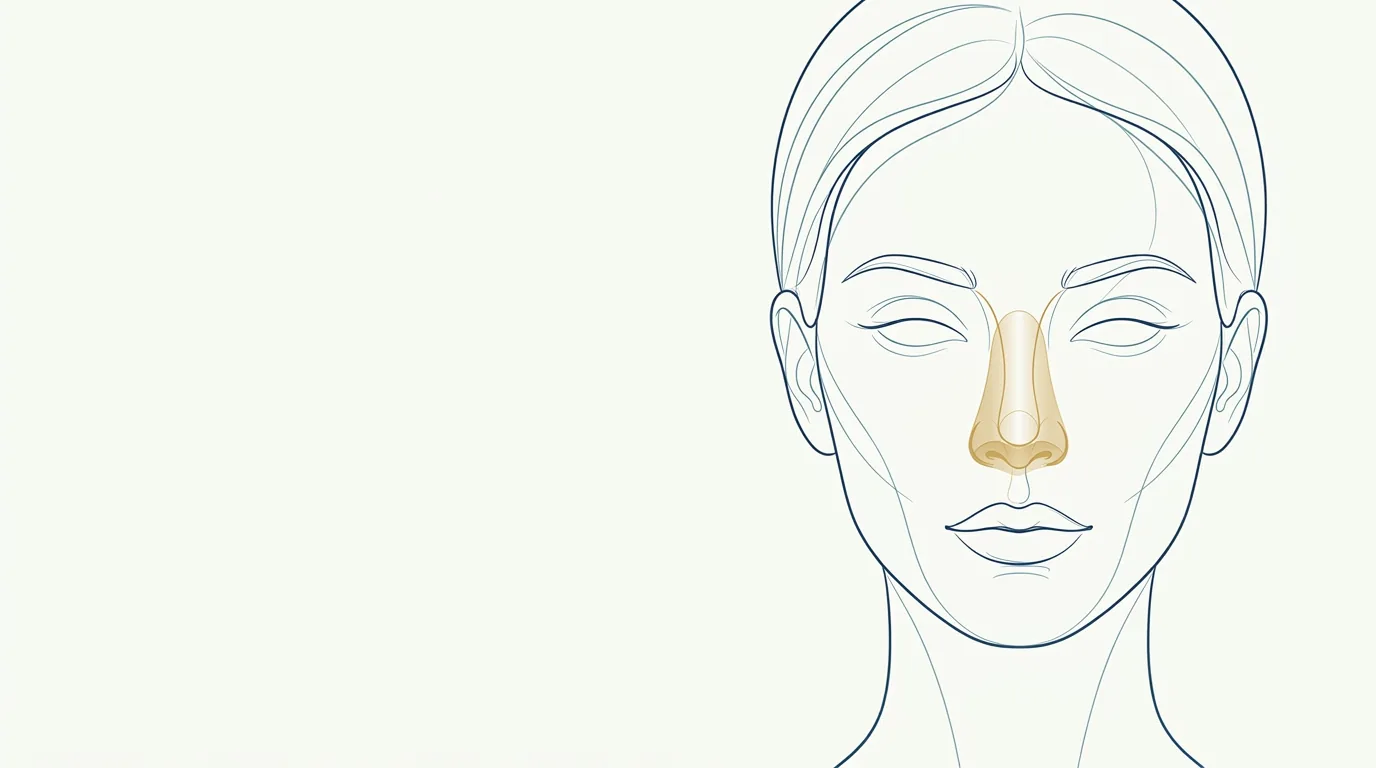
The nose sits at the center of the midface and plays a decisive role in the facial profile. In orofacial harmonization, the best-known approach is nonsurgical rhinoplasty with filler, which can improve the shape of the bridge and tip without surgery in selected cases. At the same time, the nose is among the areas of highest vascular risk on the face, and this fact must be at the center of any conversation about the area.
What are the anatomical boundaries of the nose?
For aesthetic assessment, the nose is usually divided into subunits:
- Root (nasion): transition to the glabella.
- Dorsum: nasal bone above and upper lateral cartilages below.
- Tip: domes of the alar (lower lateral) cartilages.
- Nasal alae and columella, which define the base.
- Nasolabial angle, the transition between the columella and the upper lip.
The skin of the nose changes along the dorsum: it is thinner and more mobile at the rhinion and thicker and more sebaceous at the tip. This difference changes how the product shows and settles.
Vessels and nerves to watch
The nose is a high vascular-risk zone. In the anatomical review, consider:
- Dorsal nasal artery, a branch of the ophthalmic artery, with a direct connection to the orbital circulation.
- Angular artery and lateral nasal artery, branches of the facial artery.
- Columellar artery, a branch of the superior labial artery, at the base.
- Dense anastomotic network between these systems.
This network explains why a vascular occlusion in the nose can lead to skin necrosis of the tip and ala and, in rare cases, to vision loss through retrograde embolization. Noses that have already been operated on have altered anatomy and increased risk.
What do patients usually ask for?
The most frequent concerns:
- "I have a bump on my nose." (dorsal hump)
- "The tip of my nose droops."
- "I'd like my nose more upturned."
- "I want to slim my nose without surgery."
During the assessment, separate what filler can do from what only surgery does. Filler adds volume: it can camouflage a slight hump by filling above and below it, align the bridge in profile, and slightly project the tip. It does not reduce size, narrow the base, or correct functional deviations. Requests to "slim" the nose are usually an indication for surgery.
Which procedures can be done on the nose?
The most common aesthetic procedure is nonsurgical rhinoplasty with hyaluronic acid of a G' suited to support, in small volumes. Technique, plan, and instrument are the decision of the licensed professional, according to the rules of their professional council in Brazil, and are not described here.
The nose also relates to other areas of the profile. A retruded chin, for example, makes the nose look bigger. In some patients, chin filler improves profile balance without touching the nose.
What are the usual volumes for the nose?
Usual ranges in ml of hyaluronic acid, at the discretion of the licensed professional, after assessment:
| Indication | Usual range (total) | Note |
|---|---|---|
| Camouflage of a slight hump | 0.2 to 0.5 ml | Minimal volumes |
| Adjustment of bridge and tip | 0.3 to 1 ml | Rarely above this |
| Nose already operated on | Specialist assessment | Altered anatomy, higher risk |
| Durability | Generally 9 to 18 months | Varies with product and patient |
In the nose, more product means a wider nose and more risk. The rule is the smallest volume able to reach the goal.
Care, contraindications, and complications
Besides the general contraindications (active infection, pregnancy and breastfeeding, allergy, unrealistic expectations), consider:
- Previous nasal surgery, which alters vessels and planes.
- Very thin skin on the bridge.
- A request for reduction, which is not an indication for filler.
- A history of complications with a previous filler.
Reported complications:
- Swelling and bruising.
- Widening of the bridge from excess or migration of product.
- Irregularities and asymmetries.
- Vascular occlusion, with a risk of necrosis of the tip and nasal ala.
- Visual complication, rare and serious.
Hyaluronidase must be available in the clinic, with a protocol for managing occlusion and visual complications defined before the procedure. See the overview of safety and complications.
When not to recommend nonsurgical rhinoplasty?
In the nose, knowing how to say no is part of good care. Some scenarios in which many professionals prefer not to recommend filler, or to refer to another specialty:
- Request for reduction: filler only adds volume. Someone who wants a smaller or slimmer nose has a surgical indication.
- Previous rhinoplasty: the vascular anatomy may be altered and the skin thinner and adherent. The risk increases.
- Functional complaint: difficulty breathing and a deviated septum are not treated with filler.
- Disproportionate expectations: patients who expect a big change tend to be frustrated by what filler can safely offer.
- Little experience with the area: nonsurgical rhinoplasty is among the procedures that demand the most anatomical mastery and complication management skill.
Recording the indication and the alternatives discussed protects both the patient and the professional.
How does the nose appear in Harmy?
Today the nose has no point of its own in Harmy's marking step. The available points are Glabella, Temple, Tear Trough, Cheekbone, Nasolabial Fold, Mouth Corner, Lips, Chin, and Jawline. You can plan the nose in the consultation as usual, but the app's projection does not yet show changes in that area.
Because Harmy's AI changes only what was marked, the nose looks the same as in the original photo in the projection. If the patient's plan includes the nose and other areas, make clear that the image shows only the marked areas. See how it works in marking areas and volumes.
How to talk to the patient about the nose
For the nose, the conversation about risk is as important as the conversation about aesthetics. Explain what nonsurgical rhinoplasty does and does not do, talk about the risks clearly, and record everything in the informed consent.
When the plan includes other areas, an illustrative simulation of the chin or lips can help show how profile balance changes without touching the nose. To handle the most common doubts, see patient objections and answers.
Frequently asked questions
What can nonsurgical rhinoplasty do?
It can camouflage a slight dorsal hump, align the bridge in profile view, and slightly project the tip in selected cases. It does not reduce the size of the nose or replace surgical rhinoplasty.
Is nonsurgical rhinoplasty dangerous?
The nose is one of the highest vascular-risk areas of the face. There are reports of skin necrosis and vision loss after nasal filler, which is why it requires an experienced professional and hyaluronidase on hand.
How much filler is used in the nose?
Small volumes, generally under 1 ml in total, at the discretion of the licensed professional after assessment. Excess product increases the risk and widens the nose.
Does Harmy simulate nonsurgical rhinoplasty?
Not yet. The nose has no point of its own in the app's marking step today. You can plan it in the consultation, but Harmy's projection does not cover the area.
Harmy images are illustrative simulations generated by AI from the patient's photo to support the conversation between practitioner and patient. They are not a promise of results. Indication, technique, product and volume are solely the decision of the licensed practitioner. This content is for information only and does not replace a clinical assessment.