
Under-Eye Circles and Tear Trough: Anatomy and Filler

Dark circles are one of the most frequent concerns in the clinic and one of the hardest to resolve well. In orofacial harmonization, the focus of filler is the tear trough, the groove that runs from the inner corner of the eye toward the cheek, at the boundary between the lower eyelid and the midface. When this groove deepens, it creates shadow and gives the face a tired look.
What are the anatomical boundaries of the tear trough?
The tear trough starts at the medial corner of the eye and runs diagonally downward, following the inferior orbital rim. Laterally, it continues as the palpebromalar groove. The main anatomical elements are:
- Inferior orbital rim, which gives the bony support of the area.
- Tear trough ligament and orbital retaining ligament, which tether the skin to the bone and form the groove.
- Orbicularis oculi muscle, in its palpebral and orbital portions.
- Suborbicularis fat and orbital fat pads, which change the shape of the area with age.
- Very thin skin, which lets color, vessels, and product show through.
Vessels and nerves to watch
The tear trough is a high vascular-risk zone. In the anatomical review, consider:
- Angular artery, at the medial corner, with anastomoses with branches of the ophthalmic artery.
- Infraorbital artery and nerve, which emerge through the infraorbital foramen, below the rim.
- Angular vein and venous plexuses of the area, linked to orbital drainage.
A vascular occlusion in this area can cause necrosis and, in rare cases, vision loss. It is one of the regions where the professional's experience matters most.
What do patients usually ask for?
Patients describe dark circles in many ways:
- "I look tired all the time."
- "Concealer doesn't hide them anymore."
- "I have a hollow under my eye."
- "I inherited my mother's dark circles."
During the assessment, distinguish the types of dark circles, because only one of them is a classic indication for filler:
| Type of dark circle | Characteristic | Response to filler |
|---|---|---|
| Structural (groove) | Shadow from a depression of the tear trough | Usually responds well |
| Pigmentary | Brownish color in the skin | Filler does not treat the color |
| Vascular | Purplish tone from visible vessels | Limited response |
| Due to a fat pad | Volume above the groove | Filling may make it worse; consider surgery |
Many patients have more than one component. Explaining this beforehand avoids the feeling that "it didn't work".
Which procedures can be done on the under-eye area?
The main procedure is under-eye filler with low-crosslinking, low G' hyaluronic acid, chosen to stay soft and minimally hydrophilic. Technique, the use of cannula or needle, and the injection plane are the decision of the licensed professional, according to the rules of their professional council in Brazil.
Two procedures often go together:
- Lower eyelid smoothing, for the eyelid-cheek transition.
- Malar filler, because restoring midface support often improves the dark circle with less product in the tear trough.
What are the usual volumes for the under-eye area?
Usual ranges in ml of hyaluronic acid, at the discretion of the licensed professional, after assessment:
| Situation | Usual range per side | Note |
|---|---|---|
| Subtle groove | 0.3 to 0.5 ml | Often enough |
| Moderate groove | 0.5 to 1 ml | Consider a follow-up for adjustment |
| Deep groove with malar loss | Up to 1 ml in the tear trough, plus malar support | Treat the midface first |
| Durability | Generally 9 to 18 months | May last longer due to low mobility |
In the tear trough, the rule of thumb is that less is often more. Too much product here tends to be visible and puffy.
Care, contraindications, and complications
Besides the general contraindications (active infection, pregnancy and breastfeeding, allergy, unrealistic expectations), assess carefully:
- Obvious fat pads and eyelid laxity.
- Chronic morning eyelid swelling.
- Very thin, translucent skin.
- Recent eyelid surgery.
Reported complications:
- Persistent swelling, the most characteristic one in this area.
- Tyndall effect from superficial product.
- Bruising, lumps, and irregularities.
- Vascular occlusion, with a risk of necrosis and visual complications.
Hyaluronidase must be available in the clinic, along with a protocol for managing visual complications. See the overview of safety and complications.
When are dark circles not an indication for filler?
In the tear trough, patient selection weighs as much as technique. Some scenarios in which many professionals prefer not to fill, or to treat another area first:
- Obvious fat pad: the volume above the groove tends to look bigger after filling.
- Frequent eyelid swelling: the area may retain even more fluid with the product.
- Very thin, translucent skin: increases the risk of the Tyndall effect and visible product.
- Predominantly pigmentary or vascular dark circles: filler does not change the color.
- Significant loss of malar support: treating the midface first usually reduces the volume needed in the tear trough.
Explaining to the patient why their dark circle is not an indication, or why the plan starts with the malar area, is part of safe care. Standardized photos, under the same light, help with this explanation.
How do dark circles appear in Harmy?
In Harmy, the area is the Tear Trough point in the marking step. After the frontal photo, the app detects the face on the device itself and shows the points with labels. Tap Tear Trough to include it in the plan.
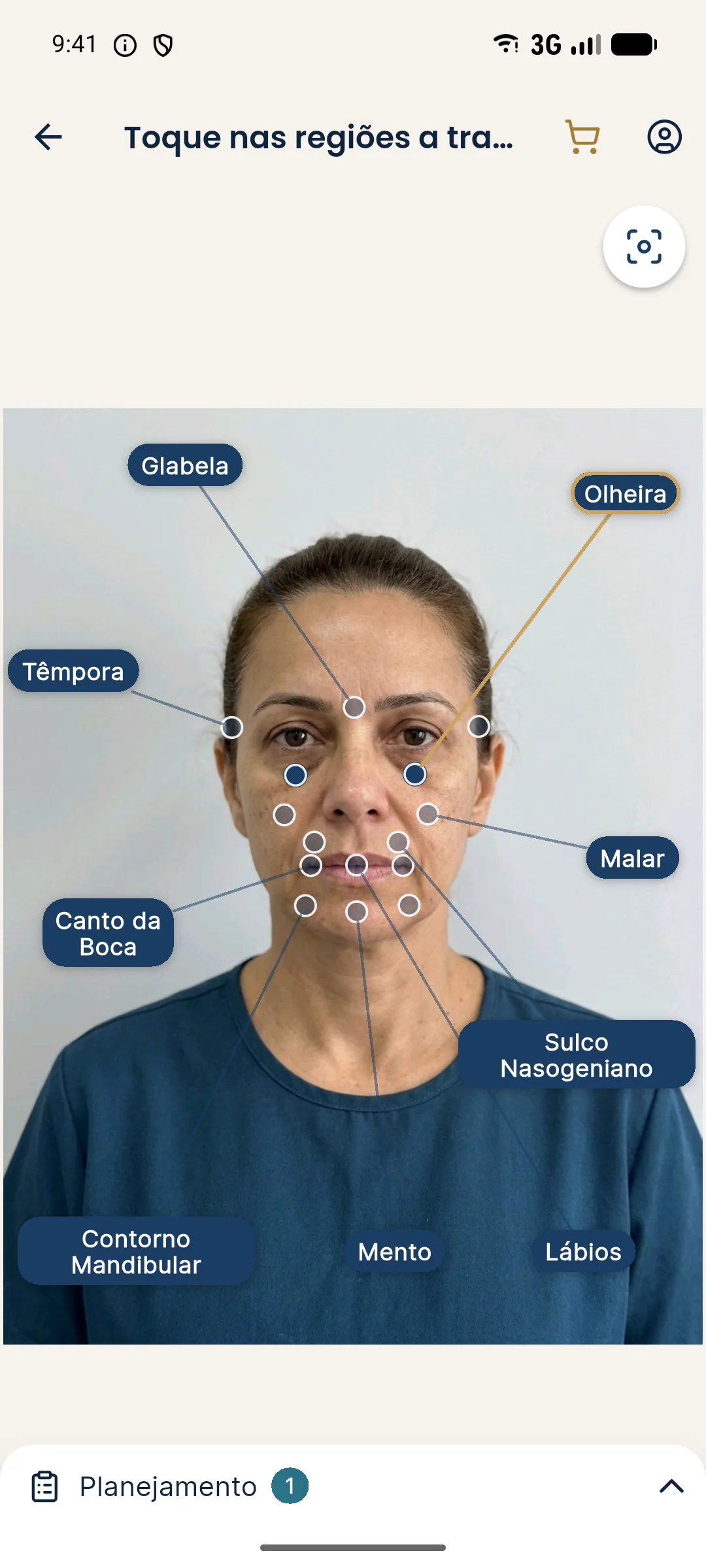
In the Plan, set the volume in ml (0.5 ml steps, from 0.5 to 5 ml). Because it is a bilateral area, the value is the total, split between both sides. The simulation on this site used 1 ml in total. The projection changes only the marked area: it does not lighten the skin, apply makeup, or touch the expression. That is why the effect is subtle, as it should be in the tear trough.
For the step by step, see marking areas and volumes.
How to talk to the patient about dark circles
Dark circles are the concern where expectations drift furthest from what is possible, because patients usually expect the color to disappear too. An illustrative simulation that changes only the groove helps show what filler does, and opens space to talk about what it does not do.
Use the projection as a support tool, make clear it is not a promise, and record the conversation. To guide this step, see how to present the before and after in the consultation.
Frequently asked questions
Does filler fix every kind of dark circle?
No. Filler works on circles caused by a groove or depression. Circles from pigmentation, visible vessels, or fat pads generally call for other approaches, and sometimes a surgical assessment.
How much hyaluronic acid is used under the eyes?
Small volumes, generally 0.3 to 1 ml per side, at the discretion of the licensed professional after assessment. In this area, less product usually gives a more natural result.
How long does under-eye filler last?
Generally 9 to 18 months, and sometimes longer, because the area moves very little. Duration varies with the product and the patient.
Can under-eye filler make the skin look bluish?
It can. This is the Tyndall effect, which happens when hyaluronic acid sits too superficially. It is generally resolved with hyaluronidase.
How do I simulate the under-eye area in Harmy?
Mark the Tear Trough point on the frontal photo and set the volume in the Plan. Because the area is bilateral, the ml entered is the total, split between both sides.
Harmy images are illustrative simulations generated by AI from the patient's photo to support the conversation between practitioner and patient. They are not a promise of results. Indication, technique, product and volume are solely the decision of the licensed practitioner. This content is for information only and does not replace a clinical assessment.