
Tear Trough Filler for Under-Eye Hollows

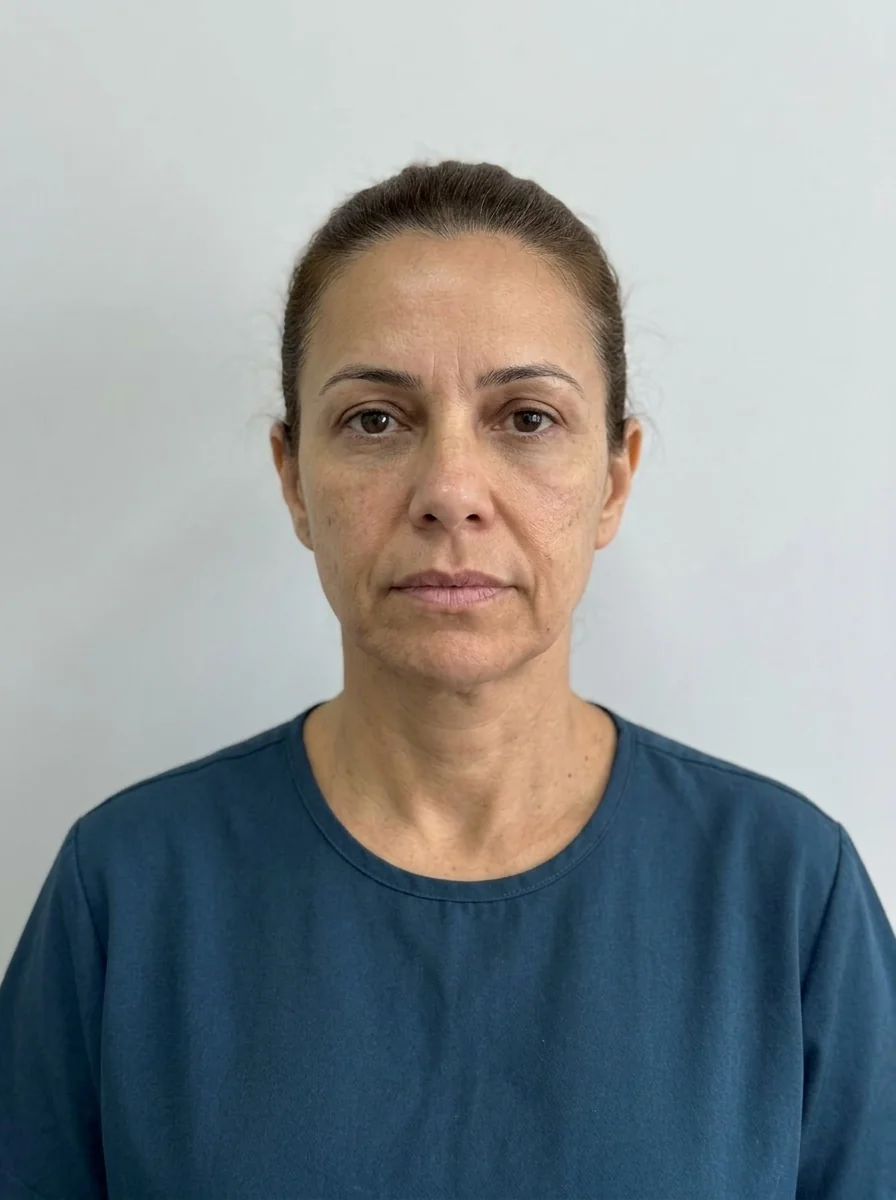 BeforeSimulation
Under-eye filler is placed in the tear trough, the hollow that separates the lower eyelid from the cheek. It is one of the most frequent requests in the orofacial harmonization (HOF) consultation, almost always with the same sentence: "I look tired even when I sleep well." It is also one of the procedures where patient selection weighs most on the result.
On this page you will find the indication, usual volumes, durability, risks and how to set up the simulation in Harmy, which in this case helps show the discreet effect expected in a delicate area.
What is under-eye filler?
It is the placement of hyaluronic acid to soften the hollow of the tear trough and the shadow it casts. When the hollow is the main cause of the dark circle, restoring a small volume at the transition between eyelid and cheek can reduce the shadow and give the eyes a more rested look.
The central point of the indication: filler treats shadow caused by a hollow. It does not treat pigment or visible vessels.
Who is under-eye filler usually indicated for?
Generally, for patients with:
- shadow-type dark circles, which improve when the face is lit from the front;
- a marked tear trough, with skin of reasonable thickness;
- little or no prominent fat bag;
- a realistic expectation of partial improvement.
These patients usually respond poorly or need another approach:
- pigmentary or vascular dark circles, brown or purplish in color;
- prominent bags from fat pseudoherniation, which can get worse with volume;
- very thin or lax skin, or with a tendency to chronic swelling.
General contraindications include active infection, active autoimmune disease, pregnancy, breastfeeding and allergy to the product. The decision always belongs to the qualified professional, in line with the rules of their professional council in Brazil.
Which areas are involved?
The main area is the under-eye area (tear trough), part of the periorbital area. It continues into the lower eyelid and the malar area. In many patients, loss of midface support deepens the trough, and treating the malar before or together can reduce the volume needed under the eye, at the professional's discretion.
Which product is used?
Generally, low-G' hyaluronic acid with moderate cross-linking and low water-absorbing capacity, to reduce the risk of swelling and irregularity in thin skin. The choice between needle and cannula and the injection plan are technical decisions for the professional.
What volumes are usual?
Here, less is usually more. The ranges below are general references; the final volume is set by the qualified professional after assessment.
| Degree of hollowing | Usual range per side | Usual total range |
|---|---|---|
| Mild | 0.2 to 0.3 ml | 0.4 to 0.6 ml |
| Moderate | 0.3 to 0.5 ml | 0.6 to 1 ml |
| Pronounced | Assess in stages | At the professional's discretion |
Starting with a little and topping up at follow-up is common practice, because excess in the tear trough tends to show up as a bag or swelling.
How long does under-eye filler last?
Usual durability is generally between 9 and 12 months, and longer in some patients, because it is an area with little movement. Product, volume, metabolism and skin quality influence this time.
What are the risks and complications?
The tear trough is a high vascular risk area, close to branches of the angular and infraorbital arteries, with connections to the circulation of the orbit. An intravascular injection can cause vascular occlusion and, rarely, a visual complication. Hyaluronidase must be available whenever hyaluronic acid is used, and the professional must master the management protocol.
Other known complications:
- Tyndall effect: a bluish tone when the product sits superficially.
- Persistent swelling, sometimes for weeks or months.
- Irregularities and nodules, palpable or visible.
- Apparent worsening of eye bags when the indication was not appropriate.
- Bruising and asymmetry.
See also safety and complications in facial harmonization.
What care is needed before and after under-eye filler?
Beforehand, a simple test in the consultation is worthwhile: light the face from the front and see whether the dark circle lessens. If it does, shadow carries a lot of weight and filler may help. If the color persists, the pigmentary or vascular component predominates. The medical history should record anticoagulants, eye allergies, morning swelling, previous eyelid surgery and products already placed in the area. The standardized before photo, with frontal light, goes into the patient record.
Afterward, usual instructions include avoiding rubbing the eyes, intense heat, alcohol and heavy exercise in the first 24 to 48 hours, and sleeping with the head slightly raised for the first days to reduce swelling. Disproportionate pain, pallor, purplish patches or any visual change call for immediate contact with the professional. A follow-up at about 15 to 30 days is the time to decide on a top-up, never before the swelling has gone down.
What is not promised to the patient
- That the dark circle will "disappear." The goal is to soften the shadow.
- Color improvement in pigmentary or vascular dark circles.
- No swelling in the first days.
- That a single session solves pronounced hollows.
- That fat bags will be corrected with filler.
Simulation in Harmy
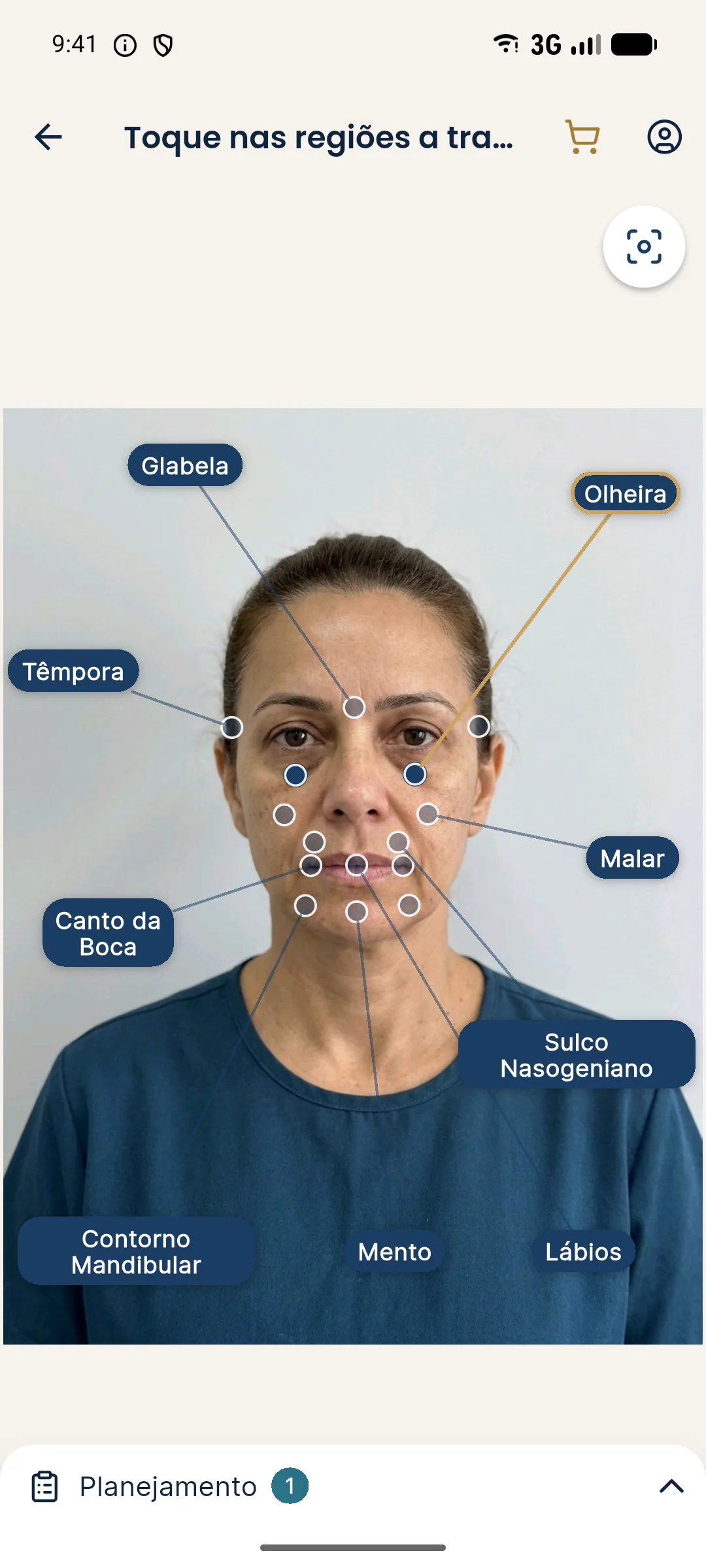
The image at the top of this page was generated by Harmy itself, using the fictional person we use across all our pages, marking only the Under-eye point with 1 ml. Drag the line to compare. The change is subtle on purpose: the AI alters only the marked area, respecting the volume, and does not apply makeup or concealer, retouch the skin or change the lighting. It is an honest projection: if the patient's dark circle is pigmentary, the simulation will not "lighten" the skin, and that helps explain why filler is not the answer in that case. It is an illustrative simulation, not a promise of results.
In the app, under-eye filler and lower eyelid smoothing share the same point, Under-eye. The simulation shows the effect of the point as a whole. The ml is the total for the bilateral area: with 1 ml, about 0.5 ml on each side.
How to simulate in 3 steps
- In New projection, enter the patient's name and use a frontal photo with light from the front, without harsh shadow.
- In the marking screen, tap the Under-eye point and set the total volume in the Plan (from 0.5 ml).
- Tap Create projection and compare on the Before / After slider.
The step-by-step with screenshots is in how to mark areas and volumes. If the plan includes the malar, mark both points and show the patient the combined effect.
Frequently asked questions
How long does under-eye filler last?
Generally 9 to 12 months, and longer in some patients, depending on the product, the volume and the metabolism.
How many ml are used in under-eye filler?
Generally small volumes, 0.2 to 0.5 ml per side, at the discretion of the qualified professional after assessment.
Does filler fix dark circles?
Not necessarily. Dark circles caused by pigment or visible vessels do not respond well to filler. It works on shadow-type dark circles, caused by the hollow of the tear trough.
Can under-eye filler look bluish?
It can. The Tyndall effect is a known complication when the product sits superficially in the thin skin of the area, and it can usually be treated with hyaluronidase.
Can someone with eye bags have under-eye filler?
It depends on the case. Prominent bags can get worse with filler and often have a surgical indication. The professional's assessment decides.
Harmy images are illustrative simulations generated by AI from the patient's photo to support the conversation between practitioner and patient. They are not a promise of results. Indication, technique, product and volume are solely the decision of the licensed practitioner. This content is for information only and does not replace a clinical assessment.