
Periorbital Region: Anatomy and Treatments Around the Eyes
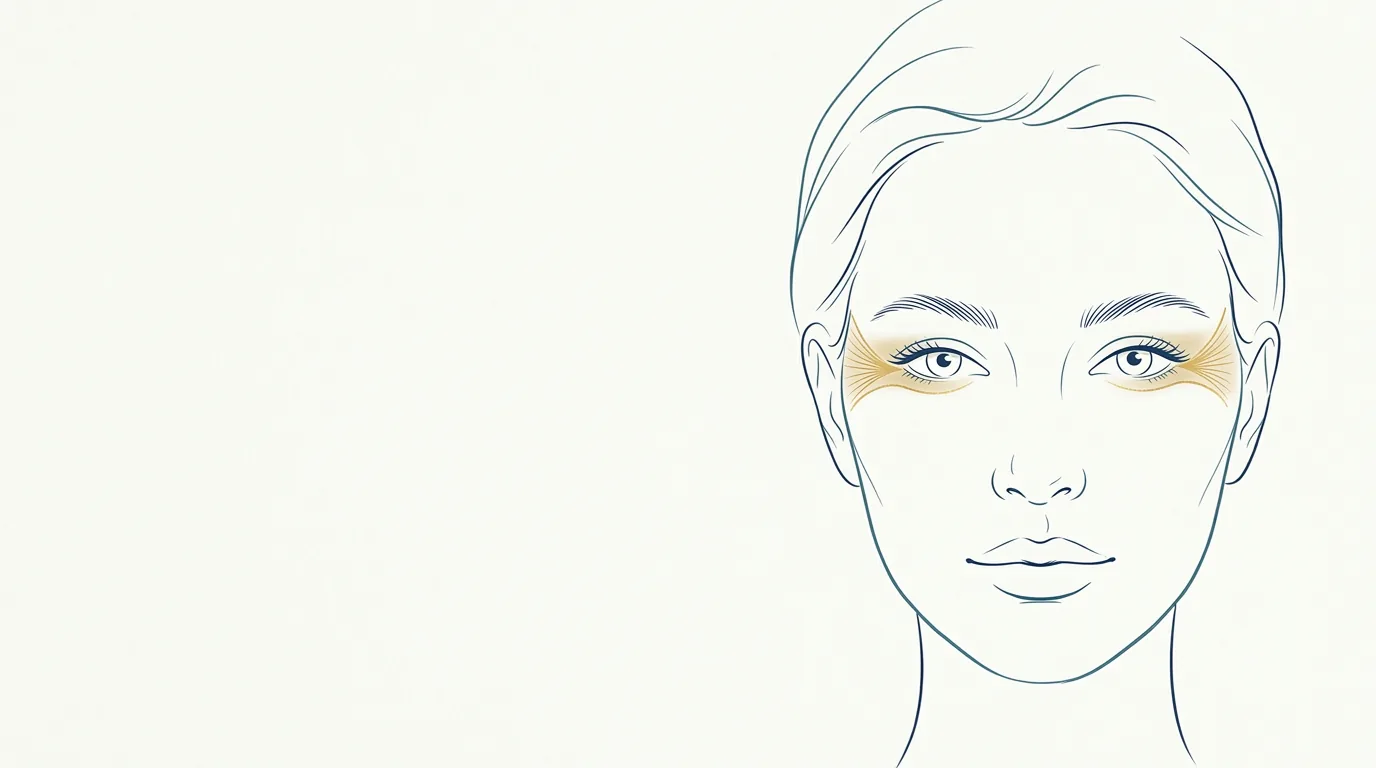
The periorbital region is everything that surrounds the eyes: the eyebrow, the upper and lower eyelids, the lateral corner, and the transition from the eyelid to the cheek. It lies at the passage between the upper third and the midface, and it is the area that communicates tiredness, age, and emotion the most. That is why it concentrates many concerns, and also many risks.
This page gives the overview. For details on each sub-region, see dark circles and the lower eyelid.
What are the anatomical boundaries of the periorbital region?
The practical boundaries are the eyebrow above, the lateral orbital rim to the side, the eyelid-cheek junction below, and the root of the nose at the medial corner. The structures that matter most for orofacial harmonization are:
- Orbicularis oculi muscle, a ring around the orbit, responsible for closing the eyes and for the lateral lines when smiling.
- Orbital septum and fat pads, which can protrude and form eyelid bags.
- Orbital retaining ligament and tear trough ligament, which explain the groove between eyelid and cheek.
- Very thin skin, the thinnest on the face, which lets color, vessels, and product show through.
Vessels and nerves to watch
- Angular artery at the medial corner, connected to the ophthalmic artery.
- Supraorbital, supratrochlear, and palpebral arteries, branches of the orbital circulation.
- Infraorbital artery and nerve, exiting through the infraorbital foramen below the rim.
- Zygomatic and temporal branches of the facial nerve in the lateral portion.
The entire periorbital region should be treated as a high vascular-risk area when filler is used. A vascular occlusion here can lead to visual impairment.
What do patients usually ask for?
The concerns that reach the clinic:
- "I look tired even when I sleep well." (dark circles and tear trough)
- "When I smile, lots of little lines show up beside my eyes." (crow's feet)
- "My lower eyelid has a little bag." (fat pads)
- "My gaze looks droopy." (eyebrow and upper eyelid)
Identifying the cause is the most important step. Dark circles from a deep groove respond one way, circles from pigmentation another, and a true fat pad may not be an indication for filler. Some concerns are surgical and should be referred.
Which procedures can be done around the eyes?
The most common ones in orofacial harmonization are:
- Botulinum toxin in the lateral orbicularis for the dynamic wrinkles of crow's feet, often planned together with glabella toxin.
- Under-eye filler, aimed at the tear trough groove.
- Lower eyelid smoothing, which works on the transition between eyelid and cheek.
Often the best periorbital result comes from treating malar support first, because loss of midface support deepens the dark circle.
What are the usual doses and volumes in the area?
The ranges below are general references, at the discretion of the licensed professional, after assessment.
| Indication | Usual range | Note |
|---|---|---|
| Crow's feet (toxin) | Label range per side, in toxin units | Units are not equivalent between products |
| Tear trough (hyaluronic acid) | 0.3 to 1 ml per side | Low-density product, small volumes |
| Eyelid-cheek transition | 0.3 to 1 ml per side | Assess malar support first |
| Filler durability | Generally 9 to 18 months | In this area the product may last longer |
Small volumes and follow-up sessions are usually preferable to correcting everything at once.
Care, contraindications, and complications
General contraindications include active infection, pregnancy and breastfeeding, allergy to the components, and unrealistic expectations. In the periorbital region, also consider obvious fat pads, significant eyelid laxity, chronic swelling, and recent eyelid surgery: these are situations in which filler can worsen the look.
Reported complications:
- Persistent swelling, more common here than in other areas.
- Tyndall effect, a bluish tint when hyaluronic acid sits superficially.
- Bruising and irregularities.
- With toxin: smile asymmetry, eyelid ptosis, or changes to the lower eyelid.
- Vascular occlusion, with a risk of necrosis and vision loss.
Have hyaluronidase available and a visual-complication protocol ready. See the overview of safety and complications.
How to organize the assessment of the periorbital region?
Because the region brings together many different concerns, a stepwise assessment helps make sure nothing is missed:
- Upper third: position and shape of the eyebrows, upper eyelid, lateral lines at rest and when smiling.
- Lower eyelid: fat pads, laxity, step between eyelid and cheek.
- Tear trough: depth of the groove and type of dark circle (structural, pigmentary, vascular).
- Midface: malar support, which changes the shape of the entire area below the eye.
- History: eyelid surgeries, previous fillers, eye allergies, and frequent swelling.
This outline helps separate what is an indication for orofacial harmonization from what should be referred. Facial assessment by thirds deepens the reasoning.
How does the periorbital region appear in Harmy?
The periorbital region as a whole has no point of its own in Harmy's marking step. What the app covers today is the Tear Trough point, which represents the tear trough and the lower eyelid transition. Crow's feet, the upper eyelid, and the eyebrow do not appear in the marking step.
This means you can plan the entire periorbital region in the consultation, but Harmy's projection will only show what was marked at the Tear Trough point. The AI changes only what you select, so the lines at the sides of the eyes will look as they do in the original photo. See how marking works in marking areas and volumes.
How to talk to the patient about the eyes
Patients with a periorbital concern tend to have high expectations, because a "tired look" is an emotional concern. Showing an illustrative simulation of the tear trough on their own photo helps calibrate how much filler can soften the groove, and how much it will not solve, such as fat pads or pigmentation.
Make clear that the image is an illustration, explain the alternatives, and record everything. To structure this conversation, see patient objections and answers.
Frequently asked questions
What is the periorbital region?
It is the set of structures around the eyes, including the eyelids, the eyebrow, the lateral corner, and the transition to the cheek. It concentrates concerns such as crow's feet, dark circles, and eye bags.
Are crow's feet treated with filler or with toxin?
The lines at the sides of the eyes that appear when smiling are usually treated with botulinum toxin, because they are caused by contraction of the orbicularis oculi. The indication is up to the licensed professional after assessment.
Is the eye area high risk?
Yes. The periorbital vessels communicate with the ophthalmic artery, and a vascular occlusion can have serious consequences, including vision loss. Filler there requires experience and hyaluronidase on hand.
Does Harmy simulate treatments around the eyes?
In part. The Tear Trough point covers the tear trough and the lower eyelid transition. Crow's feet and the rest of the periorbital region have no point of their own in the app today.
Harmy images are illustrative simulations generated by AI from the patient's photo to support the conversation between practitioner and patient. They are not a promise of results. Indication, technique, product and volume are solely the decision of the licensed practitioner. This content is for information only and does not replace a clinical assessment.