
Ideal Jaw Angle by Sex in Treatment Planning

 BeforeSimulation
- Nerve
- Highlighted area
Quick facts
- Goal
- Use the jaw angle as a reading reference, not as a numerical target
- Measurement
- Gonial angle, between the ramus and the body of the mandible, on a standardized profile photo
- Limit
- Ranges vary with ancestry, age, dentition and muscle; the patient's bone sets the rules
- Approach
- Decide the contour from the whole jawline, not from the isolated degree
When patients say they want "a more defined jaw," they are rarely talking about a number of degrees. They are talking about a line they want to see between the face and the neck. The jaw angle is one of the references that help frame that conversation, but it is one reference among several, and treating it as a number to hit tends to produce exaggerated plans and faces that no longer look like the patient.
This page shows how to read the jaw angle in planning, what usually distinguishes the female reading from the male one, where those ranges stop applying, and how to turn the observation into a clear conversation with the patient. The overall assessment is covered in facial analysis in facial harmonization: step by step, and the procedure in jawline filler.
What is the jaw angle and where is it measured?
In lateral view, the mandible has a vertical ramus that rises toward the ear and a horizontal body that runs to the chin. Where the two meet they form the angle, also called the gonial angle. The more open the angle, the more oblique and soft the line looks; the more closed, the squarer and more defined it appears.
To measure it, the photo must be standardized: head in the Frankfort plane, true profile, hair and collar out of the area. Without that, a slight head tilt already changes the perceived angle. The photo routine is in standardized clinical photography.
What ranges are usually cited for women and men?
In the orthodontic and surgical literature, the adult gonial angle is usually described at around 120 to 130 degrees, with wide variation. In aesthetic readings, a more closed angle, within or below that range, goes with a straighter, more defined jaw, which is associated with the male face. A somewhat more open angle goes with a softer, more tapered contour, which is associated with the female face. In published averages, the difference between the sexes is usually a few degrees, with large overlap between men and women.
Treat these numbers as an order of magnitude, not a target. Sources disagree, measurement methods disagree, and the same person gives different values depending on head position.
| Reading | Contour tendency | How it usually looks | Planning caution |
|---|---|---|---|
| More closed and defined | Straight line, evident angle | Face with a pronounced contour | In women, overdoing it can harden the expression |
| Intermediate | Continuous line, discreet angle | Balanced contour | Often calls for little or nothing |
| More open and soft | More rounded transition | Tapered contour | In men, it may be read as lack of definition |
| Angle "blurred" by tissue | Double chin, fat, laxity | Contour without a line | Volume over excess tissue worsens the look |
Why does the angle alone mislead?
What the eye reads as "jaw" is the entire jawline, from the angle to the chin, plus whatever sits on top of it. Three factors change the reading a lot without changing the bone:
- Soft tissue: fat, thin or thick skin and laxity can hide a well-defined angle or fake a contour the bone does not have.
- Masseter: a bulky muscle widens the back of the face and "squares" the base, which changes the relationship between width and definition.
- Chin and cervicomental angle: a recessed chin makes the line look short. A more closed cervicomental angle helps separate face and neck.
That is why, before thinking about the jaw, it pays to look at the whole picture. In many cases, a small chin adjustment changes the perception of the contour more than adding volume at the angle. The relationship between the two areas is covered in chin filler.
How does age enter this reading?
Over time, the jawline loses definition through bone resorption, descent of fat compartments and accumulation of tissue in the jowl and double chin areas. An angle that was sharp at 30 can look blurred at 50 without the bone having changed much.
In that case, the plan usually separates two questions: what is bony contour that can be suggested, and what is tissue that needs to be supported or treated another way. This avoids trying to solve with volume what is really laxity. The reading by age group is in facial analysis at 50.
How do you talk to the patient about sex and contour?
Many patients bring references from celebrities or filtered photos. The conversation is more productive when you ask what bothers them and show what their own line already has.
With transgender and nonbinary patients, the question stops being "what is the standard for the sex" and becomes "what contour does the patient want." The decision is theirs, together with the professional's safety assessment.
What can filler do and what can it not do?
Bone does not change. Filler can increase the perception of the contour by adding volume at the angle and along the body of the mandible, which usually softens the transition or highlights the line, depending on the amount and distribution, at the discretion of the licensed professional. It does not replace surgical assessment when the concern is skeletal.
How do you show this in Harmy?
In Harmy, the jawline is one of the marking points. You tap the point, set the volume in ml and choose the intensity (Subtle, Moderate or Pronounced, with Moderate as the default). For a patient who only wants to highlight the line, Subtle intensity usually conveys the idea better, and the app respects the volume: more ml, more noticeable.
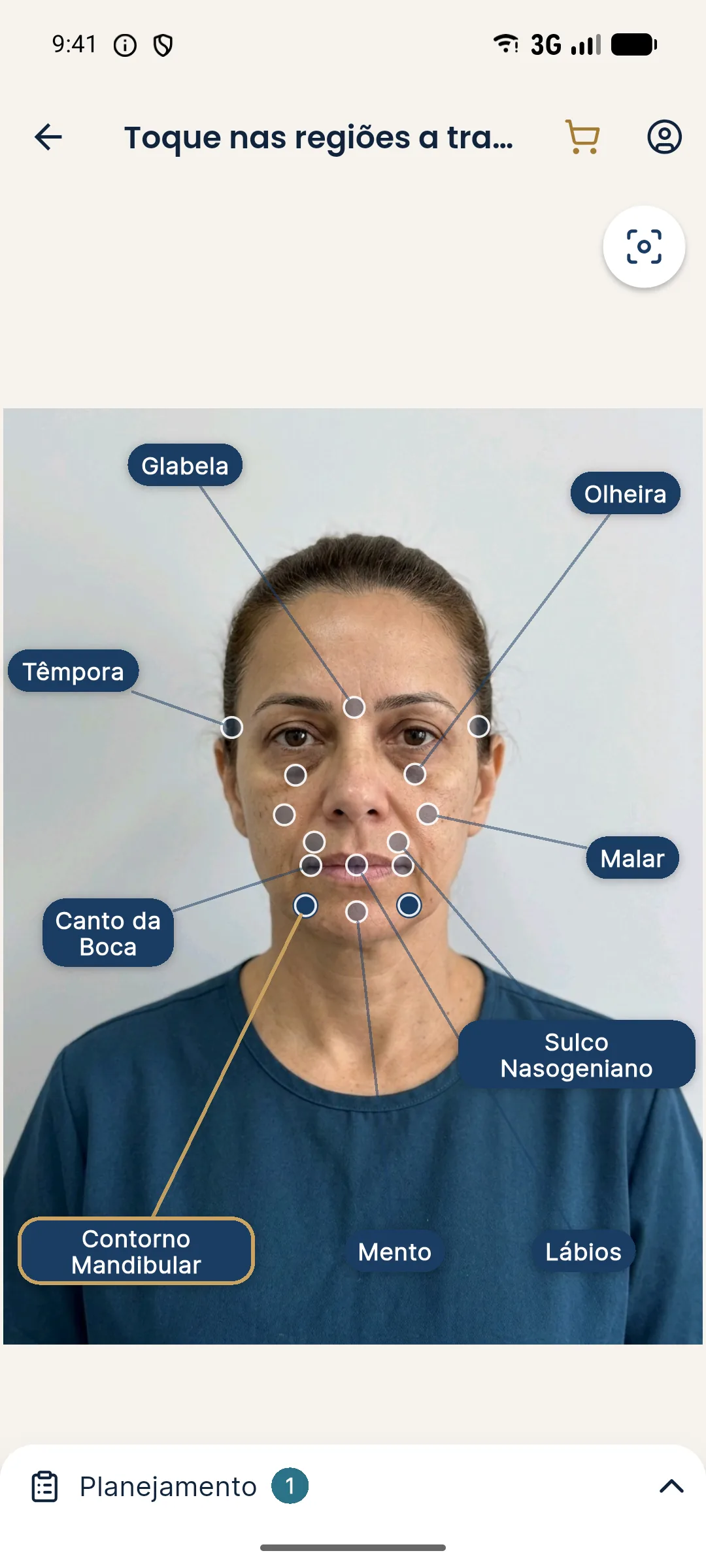
The projection uses only the frontal photo, so it shows width and the line as seen from the front, not the profile angle. For the profile, the reading is still yours. The step-by-step marking guide is in marking the jawline in Harmy.
Summary for decision-making
- Standardize the profile photo before measuring.
- Use the angle as a reference, not as a goal.
- Separate what is bone, what is soft tissue and what is muscle.
- Consider the chin and neck before adding volume at the angle.
- Ask the patient what contour they want, not just which "standard" to follow.
- Record the conversation and the consent. See consent and LGPD in photos.
Frequently asked questions
What is the ideal jaw angle?
There is no single ideal. Reference ranges are usually described, generally sharper and more defined in men and softer in women, but they vary with ancestry, age and bone structure. The plan starts from the patient's face.
Do female and male jaws have different shapes?
In general, the aesthetic reading associates the male jaw with a straighter, more defined contour with a more evident angle, and the female jaw with a more tapered, softer contour. It is a tendency of perception, not a rule, and many patients do not fit it.
Can filler change the bony angle of the jaw?
Bone does not change. Filler can alter the perception of the contour by adding volume to the area, at the discretion of the licensed professional and after assessment. The visual effect depends on the surrounding skin, fat and muscle.
Does Harmy simulate the jawline?
Yes, the marking includes the Jawline point, with volume in ml and Subtle, Moderate or Pronounced intensity. The projection is an illustrative simulation, not a promise of results.
Harmy images are illustrative simulations generated by AI from the patient's photo to support the conversation between practitioner and patient. They are not a promise of results. Indication, technique, product and volume are solely the decision of the licensed practitioner. This content is for information only and does not replace a clinical assessment.