
Ergonomics for the HOF professional: posture and prevention
Quick facts
- Goal
- Reduce the risk of pain and work-related injury in those who spend the day performing procedures, through posture, environment, and routine.
- Starting points
- Treatment table height, professional's position, lighting, organization of materials, and breaks.
- Warning signs
- Persistent pain, tingling, loss of strength, and pain that wakes you at night.
- Reference
- Brazil's ergonomics regulatory standard (NR-17) and guidance from an occupational health and safety professional.
Ergonomics rarely makes it onto the priority list of someone opening a harmonization office. You buy the equipment, set up the decor, think about marketing, and only after months of back, shoulder, and wrist pain does the professional realize that the body is the main work tool. Taking care of it early is cheaper and more efficient than treating the injury.
This page gathers general guidance, at a review level, on organizing the space, posture, and routine. It does not replace an assessment by an occupational health and safety professional, or by a physical therapist. For shoulder and wrist pain in those who inject, see shoulder and wrist pain in injectors.
Why does ergonomics matter in HOF?
The work of the HOF professional combines several classic overload factors:
- Positions held for a long time, with the neck flexed and the shoulders raised.
- Precision movements repeated hundreds of times a day.
- Forceful pinch grip.
- Reaching different areas of the face without being able to change position easily.
- A packed schedule, with little time to recover.
- An environment often designed for the patient, not for the professional.
The result is a high frequency of musculoskeletal complaints, which can reduce work capacity and the quality of care. Prevention requires small changes that add up over the years.
The table and the patient's position
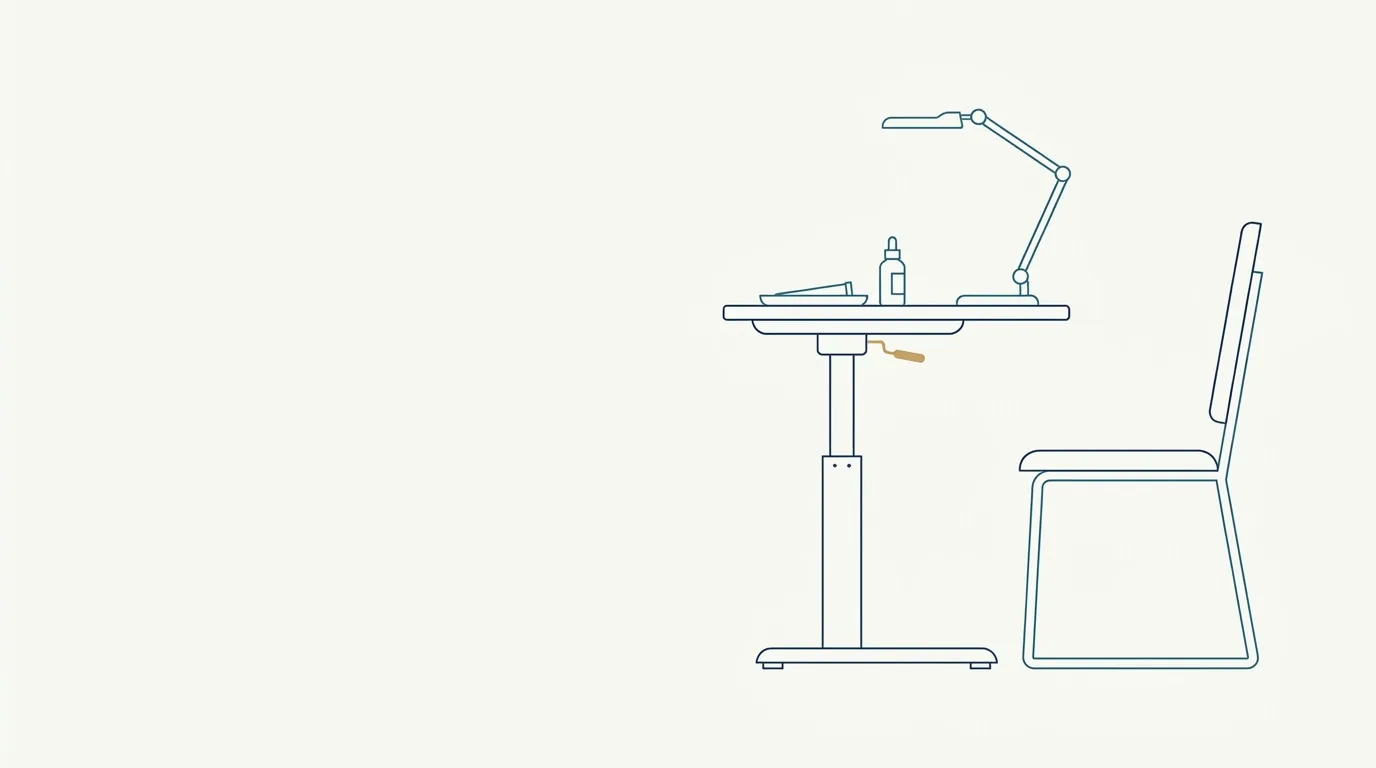
The treatment table is the most important ergonomic item in the office. A table adjustable in height and tilt lets you adjust the patient's position for each procedure and for each professional.
| Adjustment | Goal |
|---|---|
| Table height | Keep the elbow near 90 degrees and the shoulder relaxed |
| Backrest tilt | Bring the patient's face closer to the field without hunching the professional |
| Head support | Stabilize the face and avoid sudden movements |
| Width | Allow moving around without twisting the trunk |
| Mobility | Make it easier to change the patient's position and to clean |
Before starting, position the patient with the face at a height where you can work without flexing the neck more than necessary. If you have to tilt too much, the adjustment is wrong.
The professional's seat
When the procedure allows sitting, the stool should have adjustable height, lumbar support, and casters that allow movement. Feet supported on the floor or on a rest, knees near 90 degrees, and a supported back help reduce the load on the spine.
Avoid sitting on a stool without a backrest for hours. And do not use the patient's chair as an improvised support, because it was not made for that. Alternating between sitting and standing, when possible, reduces fatigue.
Lighting and vision
Good lighting reduces visual strain and keeps the professional from leaning in to see. An adjustable spotlight, with a suitable color temperature, helps see the field without shadows. Gloves, protective eyewear, and loupes should be comfortable. Anyone who uses loupes needs to adjust the focus and angle so as not to strain the neck.
Clinical photography also depends on standardized light, and what works for one helps the other. See standardized clinical photography.
Organizing materials
Searching for material in the middle of a procedure forces you to twist the trunk and interrupts the movement. A well-organized tray, within reach of the dominant arm and not requiring body rotation, reduces those movements.
Safe sharps disposal is a biosafety topic. See biosafety in HOF and needlestick injury.
Breaks and schedule
The break is part of the procedure, not a luxury. Short intervals between patients and a reasonable daily limit let the body recover.
The time for each procedure should account for breaks and preparation. See schedule and time per procedure and the concept of clinical hour.
Movement, strength, and conditioning
A conditioned body tolerates the workload better. Strengthening the shoulders, scapulae, forearms, and trunk, along with stretching and mobility, is a form of protection. The choice of activity depends on each person. Anyone who already has pain should be assessed before starting an exercise program.
General habits also count: sleep, hydration, diet, and stress control. Professional burnout is discussed in burnout in aesthetics professionals.
Equipment and choice of instruments
The choice between needle and cannula follows clinical and safety criteria, but the professional can consider comfort when organizing the day and alternating movements. The syringe and the product should be chosen for the indication, not for the least effort for the thumb. See cannula or needle.
Ergonomic assessment of the office
It is worth inviting an occupational health and safety professional or a physical therapist to observe a morning of appointments. They usually identify problems the professional no longer notices. The regulatory standard NR-17 is the ergonomics reference in Brazil, and how it applies depends on the work relationship and the type of service.
Test your review
Early career and shared offices
Those starting in HOF often set up the office on a limited budget, or work in spaces rented by the shift. In these cases, ergonomics takes a back seat. A few cheap measures already help: an adjustable stool, a good-quality portable light, a footrest, and a tray that follows the dominant arm.
In shared offices, it is worth agreeing with the owner on the table adjustment and equipment availability, and bringing whatever is personal. It is also worth reading how to start in HOF to organize structural priorities without compromising your body's safety.
In summary
Ergonomics in HOF is a set of simple adjustments: the table at the right height, good lighting, organized materials, alternating positions, and breaks. The professional's body is their instrument, and taking care of it is part of patient safety. Start with what is easiest to change and assess the office with a specialist's help.
Frequently asked questions
What is the ideal table height for performing procedures?
The one that lets you work with your elbow near 90 degrees and your shoulder relaxed, without hunching the trunk. It varies with the professional's height, and the table should be adjustable to adapt.
Is it better to work standing or sitting?
Alternating is usually better than staying in one position. Sitting reduces the load on the legs, and standing makes it easier to reach the area. The choice depends on the procedure and the area.
How can I avoid neck pain during injections?
By raising the table or the patient so the face is at the right height, using good lighting so you don't tilt the neck, and taking breaks to loosen the muscles between patients.
Is office ergonomics mandatory?
Brazilian labor law sets ergonomics requirements for those with employees, and the reference standard is NR-17. How it applies to your case depends on the type of work relationship, and it is worth consulting an occupational safety professional.
Harmy images are illustrative simulations generated by AI from the patient's photo to support the conversation between practitioner and patient. They are not a promise of results. Indication, technique, product and volume are solely the decision of the licensed practitioner. This content is for information only and does not replace a clinical assessment.