
Vitiligo and Botox or Filler: Can You Get Them?

Quick facts
- Question
- Can people with vitiligo have botox or filler
- Key point
- Koebner phenomenon, in which trauma can trigger a new lesion
- Usual guidance
- Stable disease, individual assessment, consent, and patient guidance
- Who decides
- The professional, with a dermatologist's opinion when needed
Vitiligo is a condition in which areas of skin lose pigment through destruction of melanocytes, in a process that is generally autoimmune. It affects people of all ages, is visible, and carries emotional weight. When a patient with vitiligo seeks botox or filler, the professional has to think about a specific question: can needle trauma cause a new patch? This page organizes the answer.
What is the Koebner phenomenon?
It is the appearance of new lesions of a skin disease at points of trauma, such as cuts, friction, burns, tattoos, and, in theory, injections. In vitiligo, the phenomenon is described in some patients, especially when the disease is active. The mechanism is not entirely clear and is not predictable: one person may have vitiligo for years without developing lesions at trauma sites, while another may develop them with minor stimuli.
For this reason, the topic comes up in any procedure that injures the skin, and the guidance on vitiligo and skin trauma in HOF discusses it in more detail. There is no consensus on an absolute contraindication: the approach is individualized.
Active or stable disease: why it matters
| Situation | Reasoning |
|---|---|
| Active vitiligo (new patches or recent growth) | Greater chance of response to trauma; caution and, generally, postpone non-urgent procedures |
| Vitiligo stable for a long period | Lower risk, but not zero; individual assessment |
| Under treatment (light therapy, medication) | Talk with the dermatologist about timing |
| History of Koebner | Greater care, with possible refusal |
| Lesion in the area to be treated | Avoid puncturing directly over the lesion, at the professional's discretion |
| Pigmented skin, where a patch is very visible | Attention to the emotional impact of a new lesion |
Stability criteria vary between services; many consider a period without new patches or progression. That period should be defined with the dermatologist, not by the HOF professional alone.
What to ask in the medical history
The medical history should record: how long they have had vitiligo, whether there were new patches in recent months, where, whether they are under treatment, whether they have had lesions after cuts or tattoos, and who follows them. Also check for other associated autoimmune diseases, which are common: the thyroid is one example. For the overview, see autoimmune diseases and fillers.
How the plan is usually adapted
Decisions belong to the qualified professional, according to the rules of their professional board. Some strategies discussed:
- Prioritize need: elective procedures can wait for stabilization.
- Reduce the number of puncture points, when possible, without compromising safety.
- Start with a small area to observe the response, in selected cases.
- Follow up with a return visit and photos to detect any change early.
- Keep the conversation open: the patient should feel they can decline at any time.
Botulinum toxin and hyaluronic acid are not known to cause vitiligo; the concern is the physical trauma of the punctures. Localized loss of pigment, on the other hand, is discussed in hypopigmentation.
Emotional impact
For many patients with vitiligo, skin is a sensitive subject. A new patch on the face can carry great weight. The conversation should be careful and free of euphemisms. A well-informed patient who decides with time tolerates an adverse event better than one who was caught by surprise.
What about Harmy?
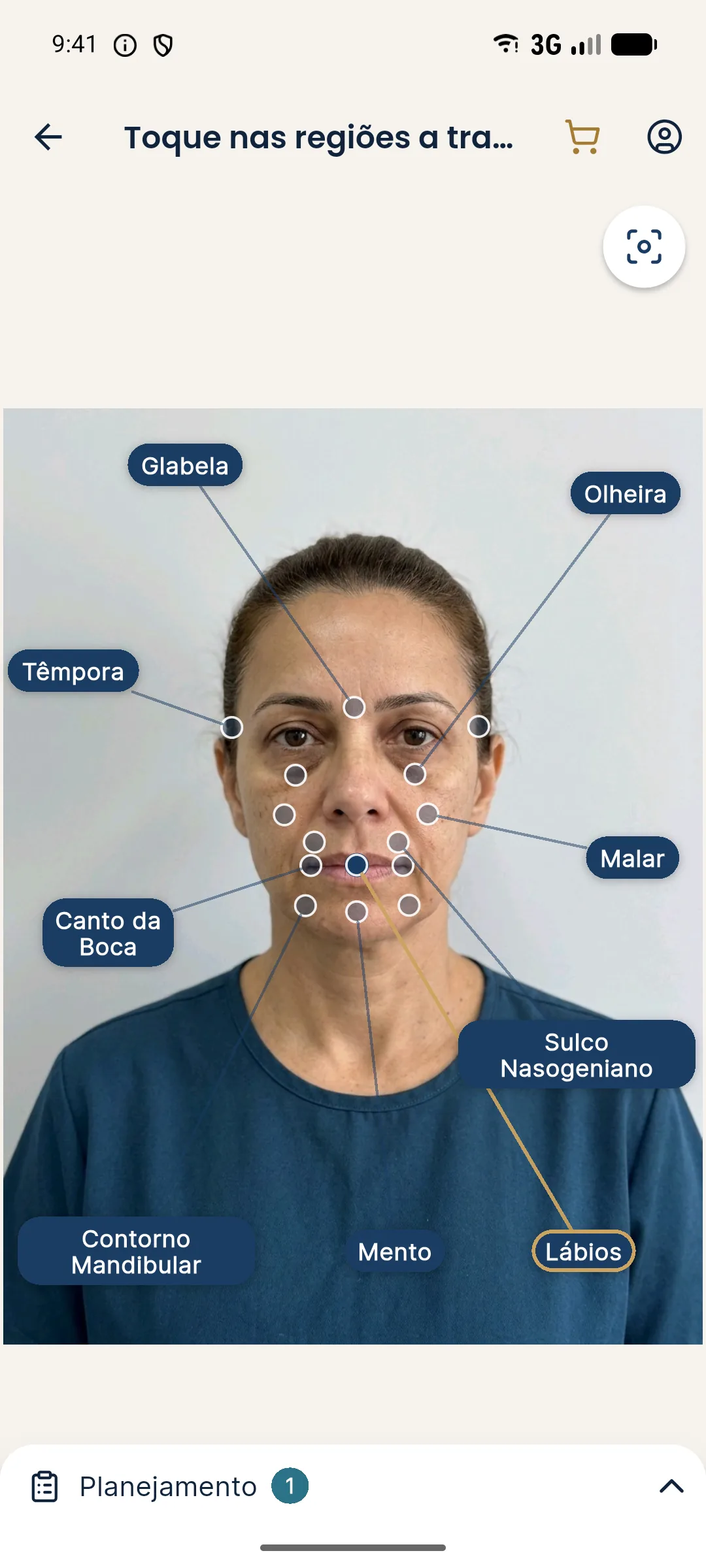
Harmy helps you plan without touching the skin: mark the area, set the volume in ml, and generate the projection. For the patient with vitiligo, this allows them to assess the possible result and decide calmly whether the risk is worth it. Note: the projection uses the frontal photo and does not reproduce vitiligo patches or real pigmentation, and the AI is instructed not to retouch the skin, so any visible lesion tends to be kept. It is an illustrative simulation, not a promise of results.
Frequently asked questions
Can people with vitiligo have botox?
Generally yes, but the decision is individual. Active vitiligo calls for more caution because of the Koebner phenomenon, in which trauma to the skin can trigger new lesions. Stable disease is more favorable.
What is the Koebner phenomenon?
It is the appearance of new lesions of a skin disease at sites of trauma, such as a cut or a sting. It occurs in some patients with vitiligo and is not predictable.
Can filler cause a new vitiligo patch?
It is a theoretical possibility because of needle trauma, and reports exist. The risk is individual, and the patient must be informed beforehand.
Do I need clearance from a dermatologist?
In many cases it is advisable, especially with active disease or while under treatment. The decision to inject remains with the HOF professional.
Harmy images are illustrative simulations generated by AI from the patient's photo to support the conversation between practitioner and patient. They are not a promise of results. Indication, technique, product and volume are solely the decision of the licensed practitioner. This content is for information only and does not replace a clinical assessment.