
Clinical Questions in Comments and DMs: How to Reply

Quick facts
- Topic
- Clinical guidance through public and private messages
- Core limit
- Inform in general terms, do not diagnose or prescribe by message
- Where individual questions go
- Assessment consultation
- Watch out for
- Confidentiality, LGPD and council rules
Anyone who runs the profile of an orofacial harmonization clinic lives with an avalanche of questions: "does it hurt?", "how much does it cost?", "will it look natural?", "can I do it while pregnant?", "is this thing in my photo normal?". Replying fast seems like good service. Replying too much can become informal clinical care, done without an assessment, without a record, without consent and with real risk to the patient and the professional.
This page works on the limit: what can be answered in comments and DMs, what should go to a consultation, what demands immediate attention, how to standardize replies without sounding robotic and how to protect confidentiality. The exact limits of remote guidance depend on your council's rules and on the law (in Brazil, each professional council's rules), and this page does not define them. For reading those rules, see advertising in HOF: how to read the rules, and for WhatsApp use, WhatsApp Business for the HOF clinic.
Three types of question, three types of reply
Not every question calls for the same stance. Classify before replying:
| Type | Example | Stance |
|---|---|---|
| General informational | "What is orofacial harmonization?" | You can answer in an educational, general way |
| Personal without a warning sign | "Do I need filler?" | Do not recommend: invite to an assessment |
| Post-procedure under follow-up | "My lip is swollen, is that normal?" | Reply cautiously, direct to a follow-up and record it |
| Warning sign | "It hurt a lot, turned purple and the skin looks pale" | Direct to immediate care, without waiting |
| Price question | "How much does filler cost?" | Explain that the price depends on an assessment, per the rules |
| Question about another professional | "My doctor did it this way, is that right?" | Do not comment on third parties' conduct by message |
This classification helps the team reply quickly and safely. The same question can call for a different reply depending on the context, which is why the rule is: when in doubt, invite to an assessment.
What not to do by message
Some mistakes repeat in well-intentioned clinics:
- Diagnosing from a photo. A photo and text do not replace an exam, and a wrong diagnosis can delay the right course of action.
- Prescribing or recommending medication by message to someone who is not under follow-up.
- Recommending a procedure or volume without an individual assessment.
- Promising results. "It looks natural, go ahead without fear" is a promise.
- Commenting on another professional's work. It can create an ethical conflict and pass judgment without knowing the case.
- Exposing data. Replying in a public comment with information about someone's care breaches confidentiality.
- Ignoring serious messages because it is outside business hours.
For more on confidentiality, see professional confidentiality and LGPD in clinic marketing. And for care with advertising, misleading advertising in aesthetics.
Sample replies for comments and DMs
Templates reduce improvisation. Adapt them to your voice and your council's rules. These examples are a starting point.
When the patient is already under follow-up
If the person is a patient of the clinic and reports something after the procedure, the situation changes: there is a patient record, there is context, there is a relationship. Even so, some rules help:
- Confirm identity before talking about health.
- Ask for objective information: since when, where, what changed, whether there is pain, fever or vision changes.
- Ask about warning signs before any routine guidance.
- Reply with general guidance and call them in for a follow-up when in doubt.
- Record in the patient record the message, the reply and the date, as part of follow-up. See electronic patient record for HOF.
- Avoid long voice notes and loose screenshots that end up outside the patient record.
The contact script 24 hours after the procedure and the 7-day post-procedure message show how to start the conversation proactively, instead of waiting for the patient to worry. For complications, see recording a complication in HOF.
Photos received by message
Receiving photos from patients is common and useful, but it requires care. A photo of the face is sensitive data, and messaging apps mix personal and professional life. Good practices:
- use a professional channel, preferably a dedicated one;
- save the photo to the patient record and delete it from your personal phone;
- tell the patient how the photo will be used and stored;
- do not forward the photo to third parties without consent;
- do not use the photo in content or ads.
See sending patient photos by WhatsApp and the LGPD and LGPD consent for patient photos.
Educational content as an alternative
Instead of answering the same question a hundred times, turn the most frequent questions into general educational content: a post, a short video, a highlight of frequently asked questions. This reduces the load on DMs, helps whoever asks and keeps the profile in the informational field. Suggestions in content pillars for the HOF clinic, HOF myths to turn into content and short videos.
For replies that need more explanation, the site's questions page already offers examples of clear, cautious language on common patient questions, which can inspire your wording without copying.
What Harmy helps you do in the consultation
Many DM questions come from curiosity about "how it would look". The responsible answer is: that depends on an assessment. Harmy comes in at the consultation, not in the DM. With the patient's frontal photo, the app detects the face on the device, you mark the areas and the ml, and it generates the projection in a slider for the conversation. Presentation mode shows only the slider at full screen.
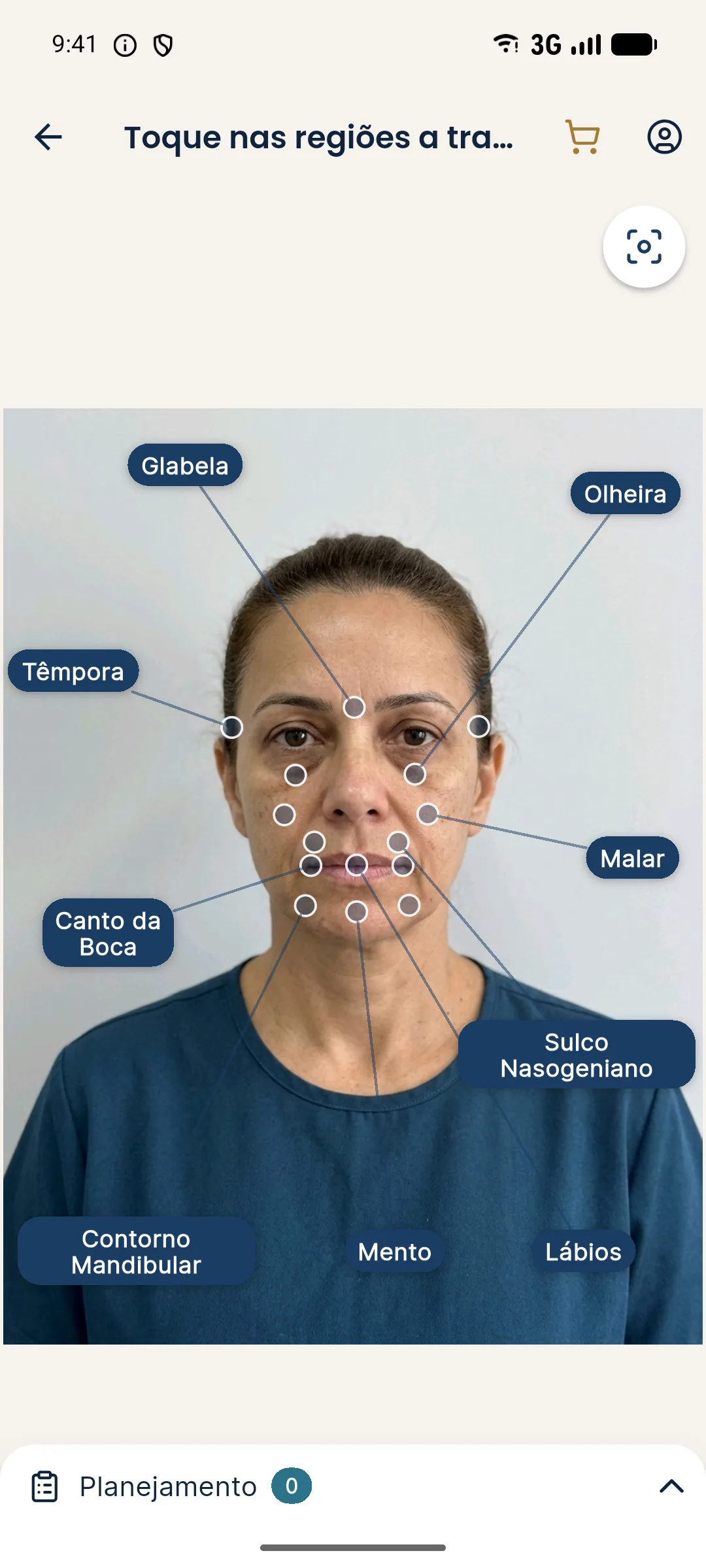
Avoid sending projections by message to people who have not yet had an assessment, because a simulation without context can be read as a promise. Use it in the consultation, with the patient present, or in the patient link after consent.
Messaging care checklist
Replying well to clinical questions by message is less about knowing the answer and more about knowing the limit. A profile that welcomes, informs in general terms and takes the individual case to the consultation builds trust and protects itself.
Frequently asked questions
Can I answer a clinical question in an Instagram comment?
You can answer in a general, educational way, without diagnosing or recommending an individual course of action, and invite the person to an assessment. Your professional council's rules define the limits of remote guidance.
What should I do when a patient sends a photo and asks what is going on?
If there is a warning sign (intense pain, color change, vision changes), tell them to seek care immediately, without delaying the reply by message. For simple questions from a patient under follow-up, reply cautiously and record it in the patient record.
Can I give prices and recommend a procedure by DM?
Recommending a procedure without an individual assessment is not advisable. Saying that the price depends on an assessment and offering to book is the safest path. Price advertising follows your council's rules.
Do standard replies help or hurt?
They help, as long as they are reviewed and adapted when used. Templates reduce mistakes and improvisation, but replies copied without reading the case sound cold and can be inappropriate.