
HOF clinic cash reserve: how much to set aside

Quick facts
- Topic
- The clinic's financial cushion
- Starting rule
- A few months of fixed cost, set by the business's risk
- Where to keep it
- A separate account that is easy to access and low risk
- When to use it
- Slow season, unexpected costs or late payments
Every orofacial harmonization clinic lives with months when the schedule fills up and months when demand drops. Fixed costs, however, arrive the same every month: rent, salaries, taxes, systems, the accountant. Without a reserve, a slow month brings bad decisions: aggressive discounts to attract patients, late payments to suppliers, a reduced withdrawal for the owner, loans with interest. The cash reserve buys what the clinic needs most at those times, which is time to decide calmly.
This page shows how to think about the size of the reserve, how to calculate it in months of fixed cost, how to build it without choking cash flow, where to keep it and when to use it. There is no financial investment advice or promise of returns here. The numbers are hypothetical examples. For the context of ups and downs through the year, see seasonality of the HOF clinic, and for day-to-day management, cash flow of the HOF clinic.
What the reserve is and what it is not
The cash reserve is money set aside on purpose to cover clinic expenses when revenue is not enough. It differs from other concepts:
| Concept | What it is | How it differs from the reserve |
|---|---|---|
| Profit | The result for the period, after costs | Profit can be distributed or set aside. The reserve is the part set aside to protect |
| Working capital | Money to run day-to-day operations | It keeps moving. The reserve sits still for the unexpected |
| Investment | Money put into equipment, renovation, expansion | It seeks growth. The reserve seeks safety |
| Owner's salary (pro-labore) | The owner's pay | It is a monthly cost. The reserve helps keep it stable. See owner's pro-labore at the HOF clinic |
| Money from prepaid packages | Advance payment for future appointments | Part of it still covers appointments to come and must not be treated as free reserve |
Mixing these concepts is the root of many scares. A clinic that looks at its bank balance and thinks it has "cash" may be looking at package money, taxes payable or supplier bills coming due.
How much to set aside: months of fixed cost
The starting point is the monthly fixed cost: everything the clinic pays regardless of the number of appointments, including rent, payroll, payroll charges, fixed taxes, systems, the accountant, insurance, loan installments and the owner's pro-labore. See fixed and variable costs.
Multiply that amount by a number of months that reflects the clinic's risk. A common reference is to start with three months and build up to six. Factors that suggest a larger reserve:
- revenue heavily concentrated in a few patients or in one professional;
- strong seasonality;
- debt with high installments;
- rent or payroll that is heavy relative to revenue;
- no insurance or other sources of income;
- a new clinic, with no track record.
Factors that allow a smaller reserve: stable revenue, recurring follow-ups, low costs and quick access to low-cost credit. Even so, prudence usually recommends having a reserve.
The break-even calculator shows the revenue needed to cover fixed costs, and the monthly net profit calculator helps you see how much is left for the reserve.
How to build the reserve without choking cash flow
People who try to build the reserve all at once usually give up. The more sustainable path is in stages:
Prioritize the automatic rule. Money left in the operating account tends to get spent. Money transferred to another account drops out of sight in day-to-day life.
Where to keep the reserve
The reserve needs to be available and safe. Points to consider:
- A separate account from operations, to avoid confusion and accidental spending.
- Liquidity: quick access, with no penalty for withdrawing when you need to.
- Low risk: the purpose is to protect, not to earn. Avoid investments that could lose value just when you need them most.
- Business ownership: the clinic's reserve should be in the company's name, separate from the owner's personal finances.
For questions about investments and taxation, consult your accountant or a licensed financial advisor. This page makes no recommendation of financial products. See also accountant for a HOF clinic and simple income statement for a HOF clinic.
When to use the reserve
The reserve exists to be used. The opposite mistake to having no reserve is having one and not using it out of guilt, skipping an essential cost while the account is full. Still, set rules for use:
- Expected slow month: cover the gap between revenue and fixed cost.
- Late payment: temporary cover, replenished when the money comes in.
- Unexpected event: breakdown of essential equipment, legal expense, urgent repair.
- Transition: team vacations, renovation, change of address. See renovating the HOF practice.
- Above-normal default. See patient default at the HOF clinic.
When you use it, record the date, the amount and the reason, and create a replenishment plan. The reserve is a cushion, not a second operating account.
Reserve and prepaid packages
A clinic-specific caution: packages paid in one go create a balance in the account, but the service has yet to be delivered. Part of that money covers future appointments and, in case of cancellation, may have to be refunded under the policy and the contract. Do not count that balance as reserve. See procedure packages in HOF and the procedure package pricing calculator. The difference between cash and accrual accounting, in cash and accrual accounting, helps you understand what is earned revenue and what is money received.
How Harmy helps sustain revenue in slow months
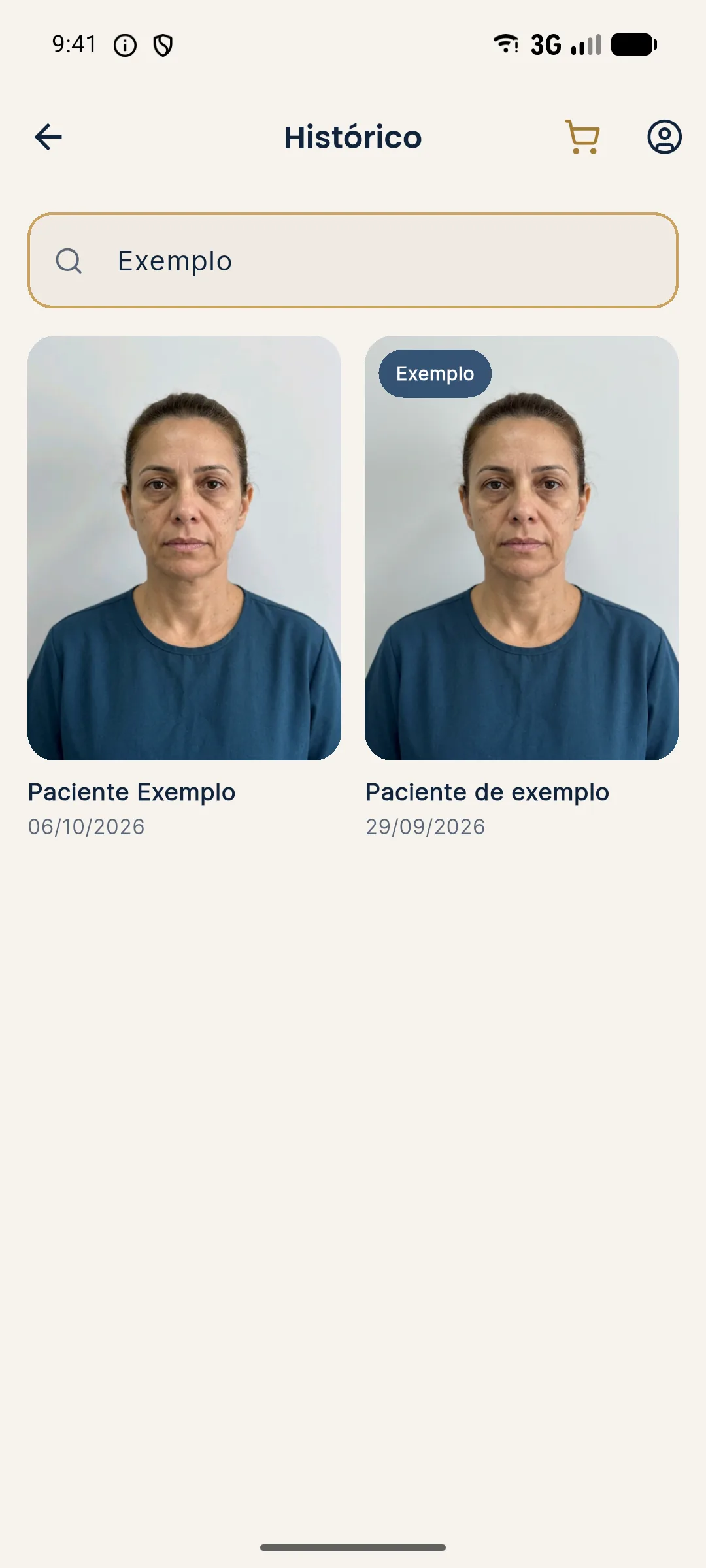
Harmy does not manage reserves or cash. What it does is support the planning conversation with the patient, which sustains revenue. In slow months, the return of existing patients is usually the cheapest way to fill the schedule. History stores sessions by patient, with search by name, and lets you reopen an earlier projection at the follow-up. The "Add actual result" feature stores the post-procedure photo aligned by the eyes, which makes the conversation about maintenance easier.
Common mistakes with the reserve
A cash reserve is not a sign of pessimism. It is what allows the clinic to keep its calm, its prices and its quality in the bad months, which is when decisions most define the course of the business.
Frequently asked questions
How many months of fixed cost should I keep as a reserve?
There is no single number. Many managers start with three to six months of fixed cost and adjust for the clinic's ups and downs, its debt and its dependence on a few patients or a single professional.
Are a cash reserve and profit the same thing?
No. Profit is the result for the period. The reserve is the part of the money the clinic decides to set aside to protect its cash. You can have profit and no reserve if you distribute everything.
Where should the clinic's reserve be kept?
In an account separate from operations, with quick access and low risk. Avoid investments with low liquidity or high risk, because the reserve's job is to be available when cash runs short.
Can I use the reserve to buy equipment?
The reserve exists to protect fixed costs, not to invest. Investments should come from their own planning. If you do use the reserve, define how and when to replenish it.