
Uneven face after toxin: how to assess it

Quick facts
- Concern
- The face became asymmetric after botulinum toxin
- First question
- Is the asymmetry new, or was it already there and now more visible
- Assessment window
- Peak effect usually occurs at about 14 days
- Avoid
- Correcting before the peak, without comparable before and after photos
The patient comes back saying their face "came out crooked" after botulinum toxin. Before any action, the question to ask is simple and changes everything: is the asymmetry new, or was it already there and now more visible? Human faces are asymmetric by nature, and toxin shifts the balance between muscles in a way that makes pre-existing asymmetry more evident. In other cases, it really does produce the deviation, through distribution, diffusion or individual response.
This page organizes the assessment, the wait for peak effect and the conversation with the patient. It complements ptosis after botulinum toxin, complications of botulinum toxin and the broader question botox gone wrong.
How can toxin cause or reveal asymmetry?
Botulinum toxin relaxes the treated muscle. If the left side had slightly stronger muscle action, its response to the same effect may differ from the right, and the difference shows up in the forehead, brows, smile or chin. There are four main scenarios:
| Scenario | What happens | How to recognize it |
|---|---|---|
| Pre-existing asymmetry revealed | Toxin reduced the muscle "disguise" that compensated for the difference | Old photos show the same deviation, with less expression |
| Uneven effect | Different response between the sides | One side more relaxed than the other after the peak |
| Diffusion to neighboring muscles | Reaches non-target fibers | Low brow, heavy eyelid, crooked smile |
| Compensation by the less-treated side | The active muscle "works for two" | Lines or exaggerated lift on one side only |
In all of them, the reasoning begins with comparison to the before photo. Without a photo, any discussion is subjective. The importance of record keeping is covered in standardized clinical photography and in photo consent and LGPD.
When to assess
Toxin takes a few days to work and the peak usually occurs at around two weeks. Assessing asymmetry before then is the most common mistake: what looks like a deviation on day five may even out by day fourteen.
The timeframes are averages that vary with the product, the dose and the patient, and the decision always belongs to the licensed professional. The practical point is to schedule the follow-up for the peak of the effect, not before.
How to assess at the follow-up
The follow-up has to be as standardized as the before photo. Without that, the conversation becomes one impression against another.
Ask the patient to raise and frown the forehead and watch each side. Compare with the before photo: if the deviation was already there, the conversation is about natural asymmetry; if it is new, the conversation is about the effect of the toxin.
What to do after the assessment
The options vary with what was found, always at the discretion of the licensed professional:
- Pre-existing asymmetry revealed: explain using the before photo, adjust expectations and, if an adjustment is made, inject a minimal amount on the side with more action, with reassessment.
- Uneven effect within what is expected: wait for the peak and, if it persists, consider a touch-up on the less-treated side.
- Ptosis or diffusion: follow the progression, document, advise the patient and manage according to the picture, remembering that the effect is temporary.
- Compensation by the active side: treat the more active side with caution and watch for symmetry to return.
The topic of touch-ups, lack of response and the expected timeline is covered in botulinum toxin non-response and botox side effects.
Prevention is recording beforehand
Almost every discussion about asymmetry after toxin ends with "did you have this before?" The practice protects itself and the patient with records: a frontal photo at rest and in motion, notes on differences in brow height and in the smile, and an informed consent form that mentions asymmetry as a possible effect. Before the injection, show the patient the differences that already exist. That reduces complaints and changes the conversation afterward.
In a face with significant pre-existing asymmetry, it is worth discussing in advance that toxin can accentuate the deviation. See asymmetric face, expression lines that differ on one side and asymmetric eyebrow.
How Harmy helps with documentation
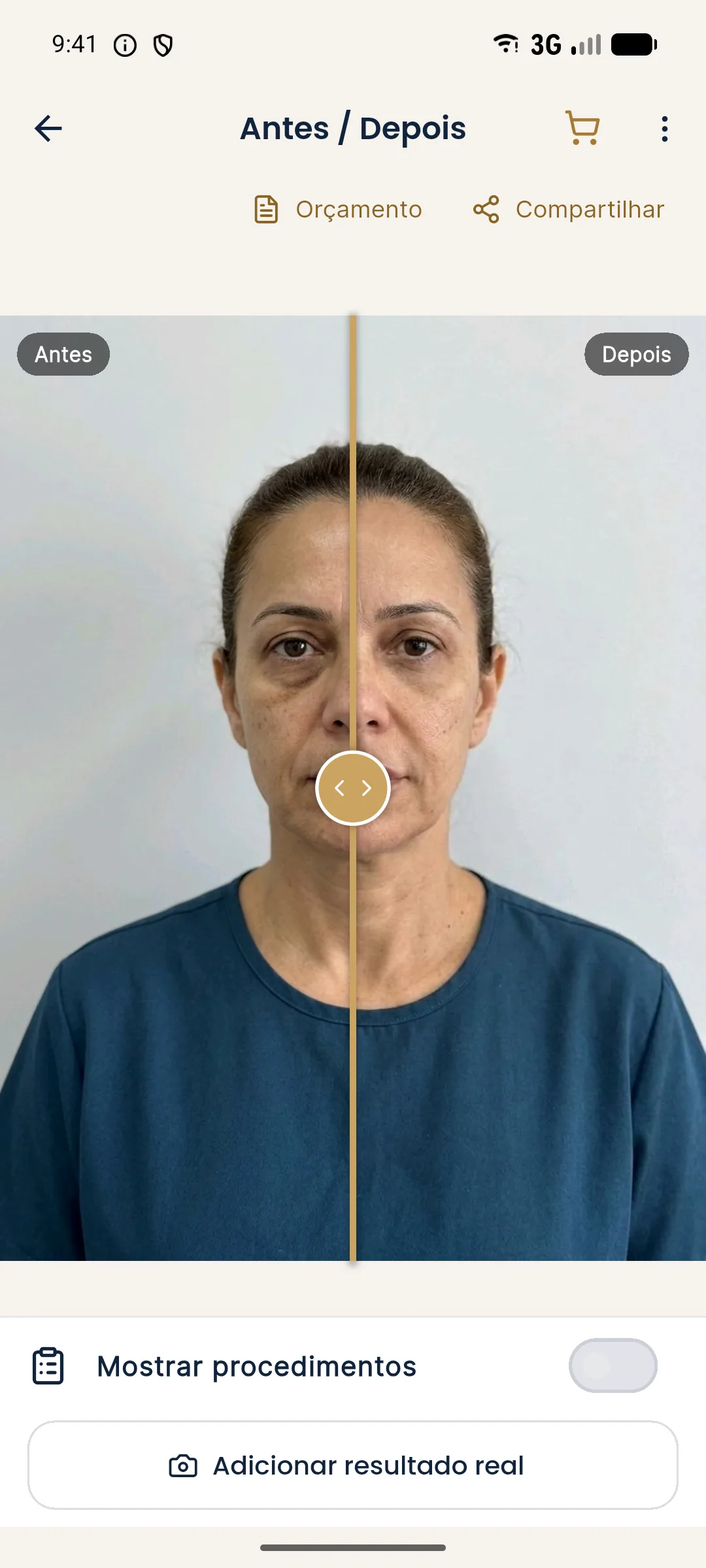
Harmy's projection is a still image and does not reproduce the muscular effect of toxin in motion, but the standardized frontal photo from each session, stored in the History for each patient, serves as a comparison record. If the professional saves the photo before the injection and adds the actual result afterward, they can compare using the guided capture, which shows the "before" photo in transparency over the camera to align the position.
Closing
Agree on the follow-up date with the patient, record photos under the same conditions and write down what was decided. Asymmetry after toxin is usually temporary or manageable, but it is only well resolved when it is well documented. Doses and injection points are left to the discretion of the licensed professional, in line with the rules of their professional council in Brazil, and are not a topic for a public page.
Frequently asked questions
How long should you wait to assess asymmetry after toxin?
Generally the effect sets in within a few days and peaks at about two weeks. Assessing asymmetry before then can lead to unnecessary touch-ups. The decision belongs to the licensed professional.
Does toxin create asymmetry?
It can reveal or accentuate an asymmetry that was already there, because toxin reduces muscle action more on one side than the other, and it can cause unwanted effects such as ptosis. Before photos help tell them apart.
Does asymmetry after toxin go away on its own?
In many cases, muscular asymmetry improves as the effect of the toxin wears off, over weeks to months. This does not replace assessment, especially if there is ptosis or functional change.
What should you do if the asymmetry is obvious after two weeks?
Document with a standardized photo, assess the muscle dynamics and discuss correcting the less-treated side, at the professional's discretion. If there is ptosis, the approach is different and must be monitored.
Harmy images are illustrative simulations generated by AI from the patient's photo to support the conversation between practitioner and patient. They are not a promise of results. Indication, technique, product and volume are solely the decision of the licensed practitioner. This content is for information only and does not replace a clinical assessment.