
Neck bands: assessing the platysma
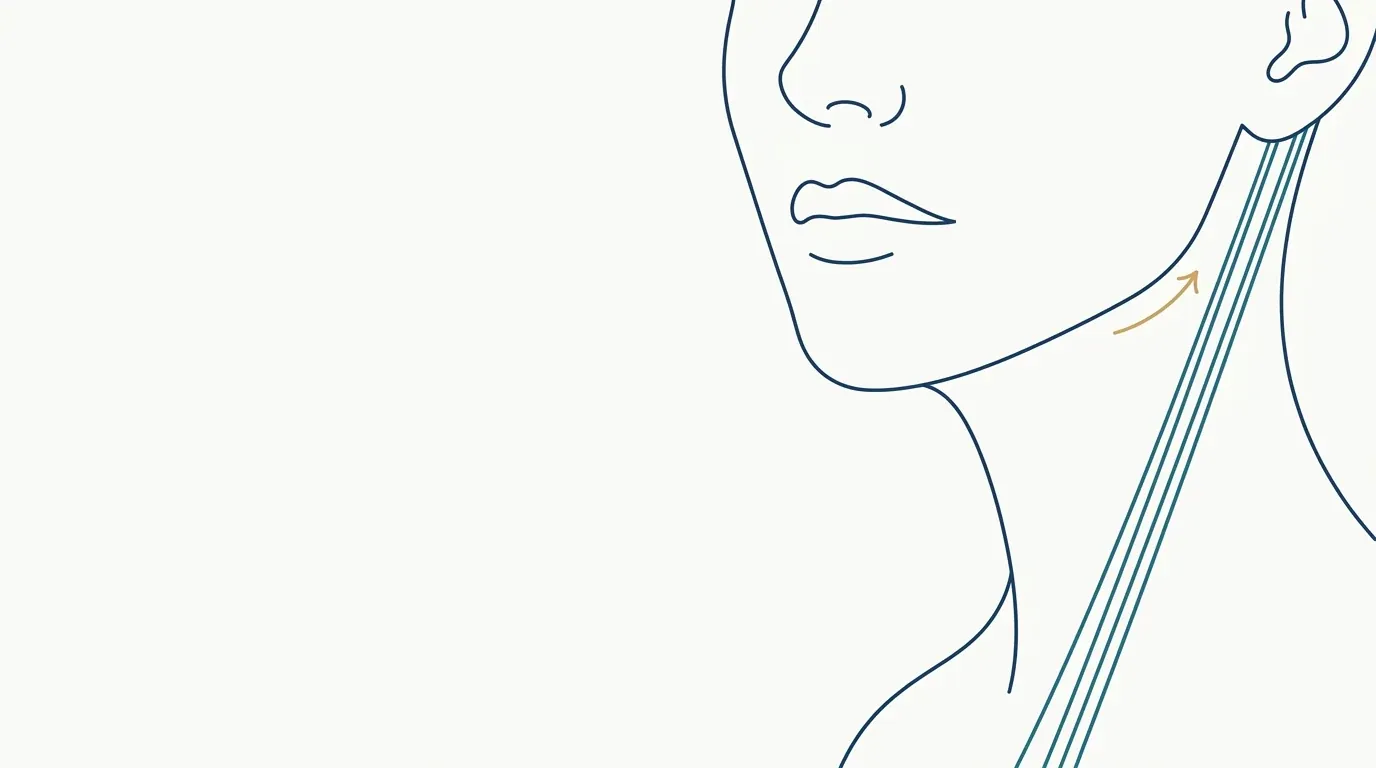
- Muscle
- Highlighted area
Quick facts
- Concern
- Two vertical cords on the neck, more visible when talking, smiling or flexing
- Structure
- Platysma, a thin muscle that runs from the chest up to the jaw, with skin and fat over it
- Simple test
- Ask the patient to tense the neck and show the lower teeth
- Pitfall
- Treating bands as if they were laxity or fat, and the other way around
Neck bands are two vertical cords that appear between the jaw and the collarbone, usually more visible when talking, smiling, tensing the neck or straining. Patients call them "turkey neck", "cords in the neck" or a "marked neck". In many cases the muscle responsible is the platysma, and understanding how it behaves organizes the assessment.
The area has its own page at neck, and the aging overview is at neck aging. For neighboring concerns, see aging neck and short neck. For the conversation, see explaining the neck to the patient.
What is the platysma and why does it form bands?
The platysma is a wide, thin muscle that covers the front of the neck, rises over the jaw and blends with the muscles around the mouth. It is not a bulky muscle, so its front edges are what stand out most when it contracts.
With age, several factors change the look:
- Muscle activity. Repeated contraction marks the edges of the platysma.
- Loss of fat and covering skin. With less fat and thinner skin, the edges become more visible.
- Ligament laxity. The platysmal-cutaneous ligaments loosen, and the muscle slides, forming bands and folds.
- Tissue descent. The whole unit descends and the angle between chin and neck opens.
Each of these factors calls for a different approach. That is why the assessment does not end once you spot the band.
Dynamic, static and mixed bands
The distinction between dynamic and static bands is practical, because it decides whether treating the muscle makes sense.
| Pattern | How it presents | General direction |
|---|---|---|
| Dynamic | Appears on contraction, disappears at rest | Consider an approach to the muscle, at the professional's discretion |
| Static | Present at rest, with loose skin | Skin quality, support; in marked cases, surgery |
| Mixed | More visible on contraction, but persistent | Combined approach, in phases |
| With associated fat | Volume under the chin and bands | Assess the fat; see double chin: assessment |
| With horizontal lines | Folds on the neck, besides the bands | See horizontal neck lines |
For dynamic bands, treating the muscle with botulinum toxin is considered by many professionals, with individual technique and dose. For static bands, toxin alone tends to have little effect, and the conversation turns to skin and support. See botox in the neck, neck: threads or botox and PDO threads in the neck and lower third.
Specific risks of the neck
The neck is an area with important structures: swallowing and speech muscles, vessels, glands and nerves. Procedures here should be done by a professional with anatomical knowledge. With toxin, the risk of spread to neighboring muscles can show up as neck weakness, swallowing changes (dysphagia) and voice changes, usually temporary.
Other risks include swelling, bruising, asymmetry, pain and, with threads, extrusion, infection and irregularity. See dysphagia and voice after neck toxin, complications with botulinum toxin and complications with PDO threads.
Bands and double chin
Bands and double chin often show up together. The muscle marks the neck, and the cervicomental angle loses definition. Treating one without assessing the other leads to a partial result. A useful way to think about it: double chin is a concern about submental volume and contour, while bands are a concern about muscle and skin. See double chin despite being thin, men with a double chin and chin and double chin: combining in the plan.
The cervicomental angle and the subplatysmal fat are part of the reading. In some patients, what looks like a band is partly deep fat that the muscle wraps around. In those cases, treating the muscle does not fix the appearance.
What HOF offers and what it does not
At the discretion of the licensed professional, the range of approaches includes treating dynamic bands, improving neck skin quality, support in selected cases and treating associated components (such as the chin, to balance the area). Each approach has its own risks, duration and indication.
What HOF does not do: it does not replace surgery when there is significant excess skin, it does not eliminate the natural activity of the muscle and it does not restore lost elasticity. Being honest about this protects the relationship with the patient. See aging neck, loose skin without surgery and patient referral in HOF.
Photography and documentation
The neck is hard to photograph well. Light from above erases the bands, head posture changes the look, and contraction varies from photo to photo. Standardize the position (Frankfurt plane), the light (soft side light) and the contraction gesture. See neck and double chin photo and contracted neck in the contour photo.
What Harmy helps show
Harmy projects volume-based changes in areas of the face. The neck, the bands and muscle contraction are not part of the simulation, and the app does not show platysma treatment. What it can show, when part of the plan, are the chin and the jawline, which influence how the transition between face and neck reads.
In short
Neck bands call for an assessment that separates muscle, skin, fat and ligaments, with photos at rest and in contraction. The approach depends on the component, the risks of the area require anatomical training, and the limit of HOF should be stated clearly. Results vary from person to person and depend on individual factors. The choice belongs to the licensed professional, according to the rules of their professional board in Brazil.
Frequently asked questions
What are neck bands?
They are vertical cords formed by the edges of the platysma, a thin neck muscle. They show when the muscle contracts and become more visible with age, because of fat loss and skin laxity.
Does botulinum toxin treat neck bands?
It can be considered for dynamic bands, at the discretion of the licensed professional. It carries its own risks in this area, such as swallowing and voice changes, and requires anatomical knowledge.
Are neck bands just skin laxity?
Not always. They can be muscle activity, skin laxity, fat loss or a combination. Assessing with and without contraction helps tell them apart.
Do threads or filler fix neck bands?
They do not fix the muscular component. They may be part of plans for skin laxity and contour, with their own indications and risks. The professional decides what makes sense.
Harmy images are illustrative simulations generated by AI from the patient's photo to support the conversation between practitioner and patient. They are not a promise of results. Indication, technique, product and volume are solely the decision of the licensed practitioner. This content is for information only and does not replace a clinical assessment.