
Patient wants a screenshot of the simulation: what to do
Quick facts
- Can you hand it over?
- Yes, if it is your decision, with a notice that it is an illustrative simulation
- Format
- An image shared from the app, with the clinic header and the notice
- Risk
- The patient treats the image as a promise or posts it as a result
- Alternative
- Show it during the consultation without handing it over, or share only the patient link
The simulation went well, the patient got excited and asked: "Can I take a screenshot?" The question sounds innocent, but the answer affects expectations, privacy, and even publicity. A loose image, without context, travels much farther than the conversation that came with it.
You can hand it over, you can decline, and you can hand it over safely. This page shows how to decide and how to do it.
Why does the screenshot matter?
In the consultation, the simulation comes with an explanation. Outside of it, it is just an image. The main risks:
- Implicit promise. Months later, the patient compares the real result with the saved image.
- Circulation. The image can be sent to friends or family, or posted, and comments and pressure come back to the consultation.
- Use as a result. Someone may present the simulation as if it were a real photo, which creates an ethical and advertising problem.
- Privacy. It is a photo of a person's face, which is sensitive data. See facial biometric data and LGPD (Brazil's data protection law).
When to hand it over and when not to?
There is no single rule. Some practical criteria:
| Situation | Suggestion |
|---|---|
| Calm patient with realistic expectations | Can share, with a notice on the image |
| Anxious patient who compares too much | Better to show it in the consultation and not hand it over |
| Undecided patient who "will think about it" | Can share it for deciding at home, with a notice |
| Suspected dysmorphia | Do not hand it over; see the specific approach |
| Patient with public exposure | Extra caution, preferably do not hand it over |
For the last two cases, read simulation for a patient with suspected dysmorphia and patient with public exposure. To know when not to show it at all, see when not to show the simulation.
In what format?
The right image is the one that carries the notice inside it. A raw screenshot of the screen, with no header and no text, is the worst option. Prefer an image generated for sharing, with the clinic name and a statement that it is a simulation.
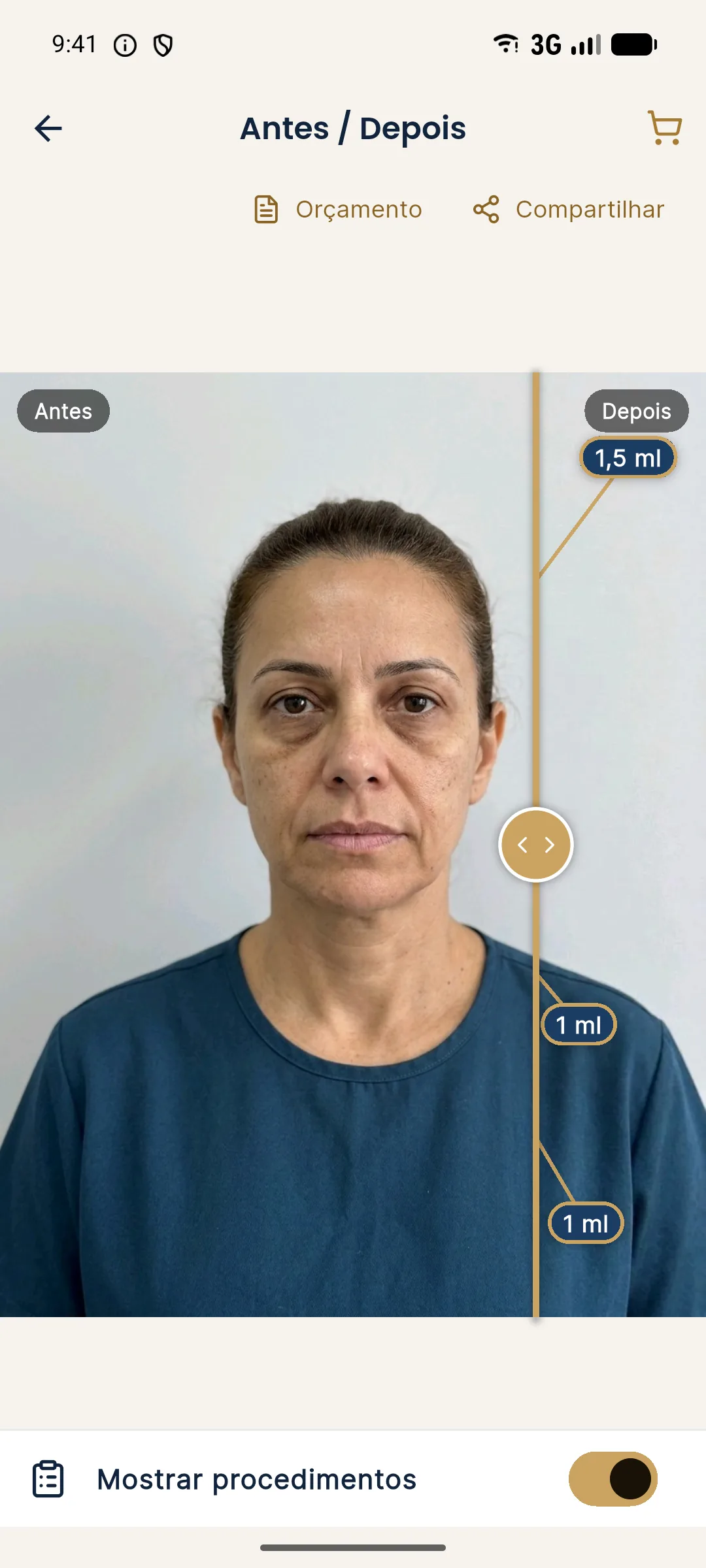
The link has an advantage: the patient sees the slider in the clinic's context, and you control what they receive. For the step by step, see sending the simulation to the patient by WhatsApp.
What to say when handing it over?
Hand it over with context, preferably in writing along with the image. One short sentence solves much of the problem:
After that, confirm the person understood and note in the patient record that the image was handed over and with which notice. If the patient wants, repeat the explanation of the simulation notice, as in illustrative simulation notice for the patient.
What if the patient already took a screenshot alone?
It happens: the patient points the phone at the screen and photographs it. You should not forbid it, and it would not be possible anyway. But you can say what matters right then:
And publicity?
The simulation is not a result and must not be published as one. If the patient asks to post their own simulation, explain the difference and remind them of the advertising rules. The starting point is in what you can advertise (CFO and CONAR). In Brazil, the CFO (Federal Council of Dentistry) and CONAR (the advertising self-regulation body) set those limits. If the clinic intends to use a patient's image in any publicity, it needs specific authorization, covered in asking the patient for image authorization.
When the answer is no
You may decide that the image stays in the consultation. Saying "I prefer to show it here so we can talk calmly" is enough, as long as it does not sound distrustful. If the patient insists, offer the patient link or a new conversation at the follow-up. The gentle refusal approach is in how to say no to the patient in HOF.
What should you record?
Note whether the image was handed over or not, by what means, with which notice, and the patient's acknowledgment. If it was by WhatsApp, the conversation itself can serve as a record, as long as it is stored securely. If it was not handed over, note the reason and the guidance given.
How to make the agreement clear to the team?
The request for a screenshot often reaches the front desk and the clinic's WhatsApp too, and each person answers differently. Set a single rule: who can hand over the image, in what format, and with what notice wording. Write the rule in one line and keep it visible to the team. That way the patient gets the same answer on any channel, and you avoid someone sending a raw screen capture just to please.
It is also worth agreeing on what to do if the patient asks for the image much later. If the decision to hand it over depended on the moment of the consultation, reassess before sending, because the face and the plan may have changed.
Frequently asked questions
Can I give the patient a screenshot of the simulation?
You can, as your own decision. The best practice is to share the image with the illustrative simulation notice and explain that it is neither a promise nor an exact projection of the result.
Can the patient post the simulation on social media?
That is beyond your control, which is why the notice on the image itself matters. Explain that it is an illustration and not a result, and that it should not be shared as if it were.
Do I have to hand over the simulation when the patient asks?
No. Showing it during the consultation and not handing it over is a legitimate choice, as long as you explain the reason calmly.
Can I send the simulation by WhatsApp?
You can, with care for privacy and the notice. Avoid sending it without context, and confirm that the number belongs to the patient.
Harmy images are illustrative simulations generated by AI from the patient's photo to support the conversation between practitioner and patient. They are not a promise of results. Indication, technique, product and volume are solely the decision of the licensed practitioner. This content is for information only and does not replace a clinical assessment.