
Polycaprolactone vs Poly-L-Lactic Acid: What Changes
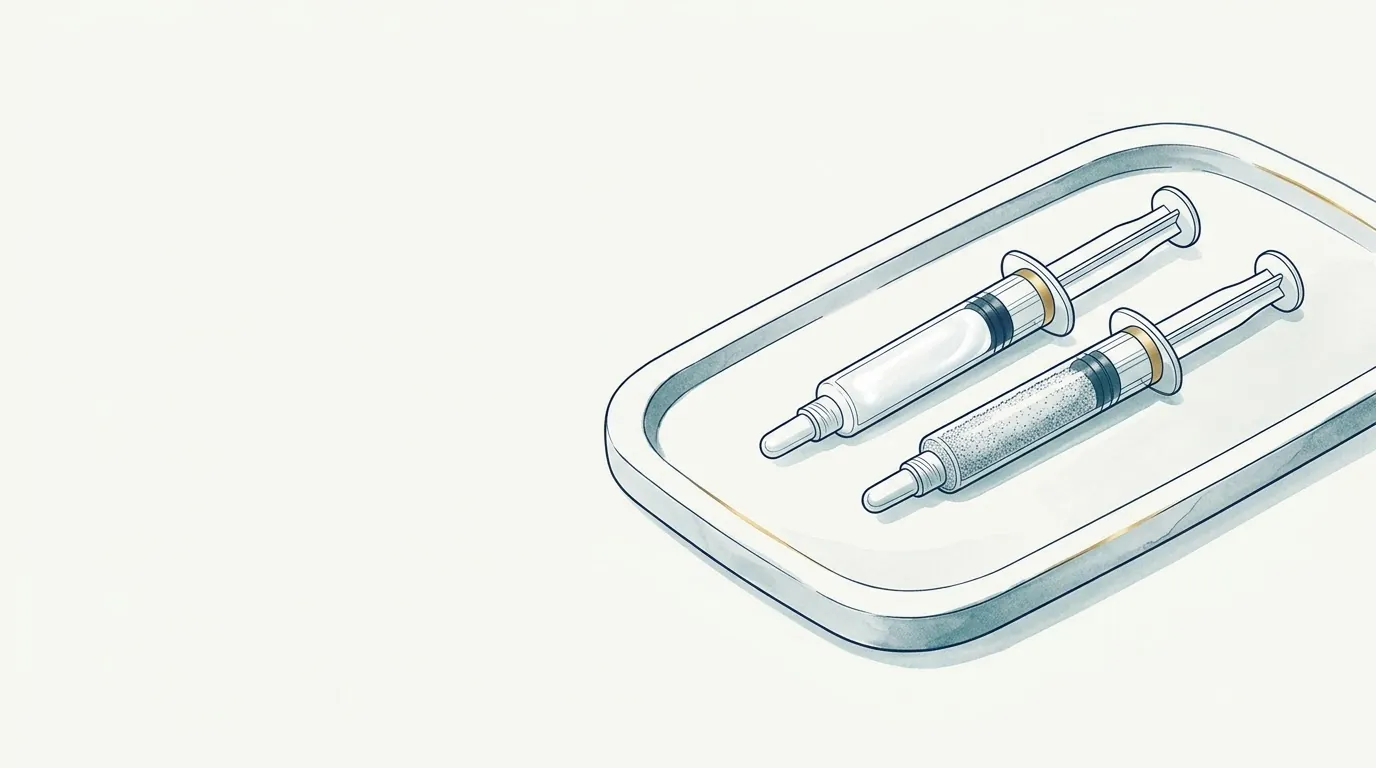
Polycaprolactone (PCL) and poly-L-lactic acid (PLLA) show up together in searches because they play a similar role: stimulating collagen to restore volume and firmness gradually. In practice, the way each one arrives in the clinic, the response in the first weeks and the kind of care they require are quite different, and that changes the indication and the conversation with the patient.
This guide compares the two classes at a review level, without brands, doses, dilutions or technique. For an overview of the category, see biostimulators, overview; for the other common comparison, calcium hydroxylapatite vs poly-L-lactic acid.
What is each product?
Polycaprolactone is a synthetic, absorbable polyester, used for decades in sutures and medical devices. As an aesthetic injectable, it is formulated as smooth microspheres suspended in an aqueous carboxymethylcellulose carrier gel, which comes ready in the syringe. The gel gives volume at first and is absorbed within weeks; the microspheres stay and stimulate collagen around them, until they are slowly broken down by hydrolysis. There are versions with polymers of different molecular weights, which changes the degradation time stated by the manufacturer.
Poly-L-lactic acid is a synthetic, absorbable polymer, also used for a long time in medical materials. The injectable comes as a freeze-dried powder in a vial, with PLLA microparticles and excipients (generally sodium carmellose and mannitol), and is reconstituted with sterile water before use, following the manufacturer's instructions. After injection, the water is absorbed within a few days and the particles induce collagen production while they break down into lactic acid, over months.
Both are medical devices registered with ANVISA (Brazil's health regulator). The risk class, areas and approved indications are in each product's registration and instructions for use, and can vary between products of the same class. See how to look up an injectable's registration with ANVISA.
Polycaprolactone vs poly-L-lactic acid: comparison
| Polycaprolactone | Poly-L-lactic acid | |
|---|---|---|
| Presentation | Ready syringe, microspheres in gel | Freeze-dried powder in a vial, reconstituted before use |
| Preparation | None beyond what the instructions specify | Reconstitution and hydration time per the product's instructions |
| Immediate effect | Some, from the carrier gel | Transient, from the water in the suspension; gone within days |
| Main effect | Collagen around the microspheres, over months | Gradual collagen, over months |
| Sessions | Vary with the goal; the product already delivers part of the volume | Usually more than one, weeks apart |
| Duration | Varies with the product version, per the manufacturer | Varies with the number of sessions and the patient |
| Degradation | Slow hydrolysis of the polymer | Hydrolysis into lactic acid |
| Enzyme reversal | No | No |
| Most cited point of attention | Nodules and excess volume, from combining gel and biostimulation | Papules and nodules linked to preparation, distribution and plane |
Timeframes are described in ranges by manufacturers and the literature, and vary with the formulation, area, volume and patient. When comparing duration, use the instructions for use of the product you have, not promotional figures.
What changes in clinical practice?
Pace of the result
With polycaprolactone, the patient leaves the clinic already seeing some change, which helps acceptance but creates a risk of misreading: the gel is absorbed and part of that initial volume goes down before collagen fills in. With PLLA, the "nothing changed" of the first weeks is expected, and expectations need to be handled beforehand. Patients' questions about this are covered in when the biostimulator result appears.
Planning by sessions
PLLA is usually planned as a cycle, with several sessions and a follow-up to assess the response, which suits patients who accept a process. PCL allows plans with fewer sessions in some cases, because it delivers volume along with the stimulus. In both, the number of sessions follows the instructions for use and the assessment. See how many biostimulator sessions.
Preparation and standardization
Reconstituting PLLA is an extra step, with variables (diluent volume, hydration time, homogenization) that the manufacturer's instructions define and that influence the risk of nodules. PCL removes that preparation, but not the need for careful distribution.
When does each one usually make more sense?
The choice belongs to the qualified professional, based on the product's approved indication, experience with it and the patient. In general terms, the literature and practice describe:
| Case profile | Tends to favor | Comment |
|---|---|---|
| Moderate volume loss, patient wants to see something in the first session | Polycaprolactone | The gel gives immediate volume; make clear part of it goes down |
| Global, diffuse volume loss, patient accepts a process | Poly-L-lactic acid | Gradual result, built over sessions |
| Thin skin, highly mobile areas | Caution with both | Nodules are more visible; many instructions for use exclude these areas |
| Patient who wants to be able to "undo" | Neither | Hyaluronic acid, which hyaluronidase breaks down |
| Need for focal projection | Neither as a first choice | Firmer hyaluronic acid is usually preferred |
In areas such as the temples and the midface, which carry high vascular risk, the decision to use a product with no enzymatic reversal deserves even more careful analysis. See biostimulator in the temples.
Which risks are common to both?
- Nodules and papules, early or late, the complication most associated with biostimulators.
- Granuloma and delayed inflammatory reactions, rare.
- Swelling, bruising and pain in the first few days.
- Asymmetry and surface irregularity.
- Infection, which calls for rigorous asepsis.
- Vascular occlusion, rare but possible with any injectable.
How to approach nodules, including the difference between inflammatory and non-inflammatory, is in nodules after a biostimulator, and the broader picture in complications with biostimulators.
General contraindications include active infection at the site, pregnancy and breastfeeding, active autoimmune disease, a tendency to keloids, allergy to components and unrealistic expectations. See general contraindications in HOF.
Can you switch from one to the other mid-plan?
It can happen, because of a change in indication or response. In that case, record what has already been injected and respect the previous product's response time before assessing the result. Mixing classes in quick succession makes it hard to know what caused an effect, good or bad. When the patient does not know what they received elsewhere, see patient with unknown previous filler.
How do you explain the difference to the patient?
Use an informed consent that mentions nodules and the lack of enzymatic reversal. There is a biostimulator consent form template, and the price per session is covered in pricing a collagen biostimulator.
And in Harmy?
Checklist before choosing between the two
- Indication and area checked against the instructions for use of the registered product.
- Patient informed about the pace of results for each class.
- Lack of enzymatic reversal explained and recorded in the consent.
- Session and follow-up plan defined.
- Product, lot, expiry date, preparation and volume noted in the patient record.
- Complication protocol and vascular danger zones reviewed.
Frequently asked questions
What is the difference between polycaprolactone and poly-L-lactic acid?
Both are absorbable polymers that stimulate collagen. Polycaprolactone comes as microspheres suspended in a ready-to-use gel, which gives some immediate volume; poly-L-lactic acid comes as a freeze-dried powder, reconstituted before injection, with little immediate effect and a more gradual result.
Polycaprolactone or polylactic acid, which lasts longer?
It depends on the formulation. For polycaprolactone, the duration stated by the manufacturer varies with the product version; for poly-L-lactic acid, it varies with the number of sessions and the patient's response. Always compare using the instructions for use of the registered product, not promotional figures.
Does hyaluronidase undo polycaprolactone or poly-L-lactic acid?
No. Hyaluronidase breaks down hyaluronic acid, not these polymers. That is why nodules or excess with either one are harder to manage, and planning tends to be conservative.
Which biostimulator gives faster results?
Polycaprolactone usually shows some effect right after the injection, because of the carrier gel, which is absorbed over the following weeks. Poly-L-lactic acid has a transient immediate effect, from the water in the suspension, and the result appears gradually over months.
Harmy images are illustrative simulations generated by AI from the patient's photo to support the conversation between practitioner and patient. They are not a promise of results. Indication, technique, product and volume are solely the decision of the licensed practitioner. This content is for information only and does not replace a clinical assessment.